
Japan’s Pre-Fukushima Solar Aid for Egypt Proceeds

egypt, solar power, photovoltaicsDespite problems confronted on its own soil, Japan proceeds with its commitment to fund a photovoltaic project in Egypt.

Japan’s International Cooperation Agency (JICA) announced that it will proceed with plans to support a solar energy generating station south of Alexandria. Egypt applied to the aid agency for assistance with the “Project for the Introduction of Clean Energy by Solar Electricity Generation System” long before the Fukushima accident usurped all of Japan’s attention and capital. The plan, approved by JICA in February 2010, includes a 420 kilowatt photovoltaic power plant that is expected to produce 641,000 kw by 2012.

Japan has committed to donating $11 million to the plant that will be installed in Borg al-Arab. The power generated (somewhat disappointingly) will be used to support a sports club, shopping mall, and dormitories.

Other poor Egyptians, who lack access to funding, are developing alternative solar heating solutions.

According to Bikya Masr, Masaki Kudo from JICA supervises the Kurayamat  solar hybrid plant near and notes that the authorities (whoever they may be as the country battles a bevy of post-revolution trouble) is looking to renewable energy to meet what amounts to a 10% annual growth in energy growth.

JICA will provide the equipment, and Egyptians will provide the manpower.

Given the ubiquity of Egypt’s solar resources, and the numerous dangers associated with nuclear power (though Egypt has yet to abandon its nuclear energy ambitions), we applaud this move.

:: Bikya Masr

More on solar energy in Egypt:

Poor Egyptians are Finding Innovative Solutions to Build Solar Water Heating

Iberdrola Fires Up ISCC in Egypt, At Last

MIT Student Kindles Solar Manufacturing in Egypt

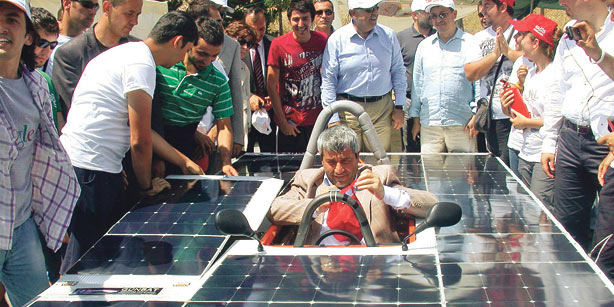
image via uggboy

Tafline Laylin
Tafline Laylinhttp://www.greenprophet.com
As a tour leader who led “eco-friendly” camping trips throughout North America, Tafline soon realized that she was instead leaving behind a trail of gas fumes, plastic bottles and Pringles. In fact, wherever she traveled – whether it was Viet Nam or South Africa or England – it became clear how inefficiently the mandate to re-think our consumer culture is reaching the general public. Born in Iran, raised in South Africa and the United States, she currently splits her time between Africa and the Middle East. Tafline can be reached at tafline (at) greenprophet (dot) com.
3 COMMENTS

LEAVE A REPLY

Please enter your comment!
Please enter your name here

TRENDING

Don’t Regret Your Host: Alternatives to SiteGround That Impress

Discover top alternatives to SiteGround that offer impressive features and performance. Make an informed choice for your hosting needs today!

Asia Powers Ahead in Global Renewable Boom, But Africa Risks Being Left Behind

Asia continues to dominate global renewable energy growth, accounting for 71% of new capacity added in 2024, while Africa and other developing regions remain far behind despite their potential. Solar and wind lead the charge, comprising 97.5% of additions, with solar alone adding 453 GW. Although global renewables capacity hit a record 582 GW, the world is still off track to meet the COP28 goal of tripling capacity by 2030. Without faster growth and more equitable investment, the energy transition risks deepening the global divide.

Yosef Abramowitz: The Israeli Bringing the Sun to the World’s Darkest Places

Abramowitz employs what he calls the Quadruple Bottom Line Impact Platform when bringing solar energy to countries with limited resources and infrastructure. While not the primary driver, each project must provide returns for investors. While these returns may not turn a massive profit, projects must ensure financial viability. Second, every project contributes to climate mitigation.

Iraq’s Ancient Water Wisdom Faces a Modern Reckoning

The land between the Tigris and Euphrates was once a wellspring of invention. Thousands of years before modern irrigation, the Sumerians, Akkadians, Babylonians, and Assyrians carved canals, engineered flood basins, and developed qanat systems—ingenious underground channels that carried water from mountain springs to distant farms.

The unseen tech behind eco villages

If you picture an eco-village, you might imagine a...

6 Payment Processors With the Fastest Onboarding for SMBs

Get your SMB up and running fast with these 6 payment processors. Compare the quickest onboarding options to start accepting customer payments without delay.

Qatar’s climate hypocrisy rides the London Underground

Qatar remains a master of doublethink—burning gas by the megaton while selling “sustainability” to a world desperate for clean air. Wake up from your slumber people.

How Quality of Hire Shapes Modern Recruitment

A 2024 survey by Deloitte found that 76% of talent leaders now consider long-term retention and workforce contribution among their most important hiring success metrics—far surpassing time-to-fill or cost-per-hire. As the expectations for new hires deepen, companies must also confront the inherent challenges in redefining and accurately measuring hiring quality.

8 Team-Building Exercises to Start the Week Off 

Team building to change the world! The best renewable energy companies are ones that function.

Thank you, LinkedIn — and what your Jobs on the Rise report means for sustainable careers

While “green jobs” aren’t always labeled as such, many of the fastest-growing roles are directly enabling the energy transition, climate resilience, and lower-carbon systems: Number one on their list is Artificial Intelligence engineers. But what does that mean? Vibe coding Claude? 

Somali pirates steal oil tankers

The pirates often stage their heists out of Somalia, a lawless country, with a weak central government that is grappling with a violent Islamist insurgency. Using speedboats that swarm the targets, the machine-gun-toting pirates take control of merchant ships and then hold the vessels, crew and cargo for ransom.

Leopoldo Alejandro Betancourt López Turned Ocean Plastic Into Profitable Sunglasses

Few fashion accessories carry the environmental burden of sunglasses. Most frames are constructed from petroleum-based plastics and acrylic polymers that linger in landfills for centuries, shedding microplastics into soil and waterways long after they've been discarded. Leopoldo Alejandro Betancourt López, president of the Spanish eyewear brand Hawkers, saw this problem differently than most industry executives.

Why Dr. Tony Jacob Sees Texas Business Egos as Warning Signs

Everything's bigger in Texas. Except business egos.  Dr. Tony Jacob figured...

Related Articles

Popular Categories