 Jerusalem will get a new railway line, and in the process, geologists find large underground river.
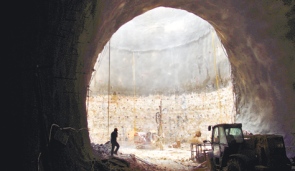
Excavators digging for a new railway station deep under the surface of central Jerusalem have discovered what geologists say is the largest underground river ever found in Israel.
And while its deep canyons and waterfalls may be an impressive find for scientists, it doesn’t contain a significant amount of the precious fluids to affect the water balance in this traditionally parched city.
The river makes sense, because as legend goes the water of the world first emerged from a spring in Jerusalem.
“We found a nice but small underground river,” Professor Amos Frumkin, head of the Cave Research Unit of the Hebrew University’s Department of Geography, told The Media Line.
“In terms of Israel, it’s the longest underground stream that we have ever seen. It is a kind of a canyon that has been cut by the stream of the water over a long period of time, maybe millions of years,” Frumkin said.
Frumkin and his team were called upon by Israel Railways after its engineers chanced upon the cave while excavating an 80-meter (260-foot) shaft close to the city’s main convention centre and central bus station that is being drilled for a huge, underground station that will serve the high-speed Jerusalem-Tel Aviv railway.
“When they reached the depth of 75 meters they cut into this cave accidentally. The water started flowing into this shaft and they had some problems until they found some engineering solution and called us,” Frumkin said.
The first humans to enter ancient Jerusalem cave
“We were the first humans ever to set foot inside this cave. However, it wasn’t very easy. It meant crawling in mud and some rappelling on ropes was required. So you needed some spelunking techniques,” he said. “It was beautiful. One canyon was over 200 meters long and we never reached its end. We found some waterfalls inside, which was nice for our arid country.”
Jerusalem is not known for its water sources and there is only one major spring in the city, the biblical Gihon, which has been gurgling since before King David’s time. With a population of some 700,000, Jerusalem gets its water pumped up from the coastal aquifer.
Frumkin said the cave appears to have developed after water seeped in from the surface and dissolved the underlying limestone. While other major caves have been discovered in Israel, this was the only one with running water.
“This is the longest one with an active stream flowing through it. All the other stalactite caves in Israel are without any stream of water today. They are just dripping water from the ceiling and the stream that formed the cave have long vanished because of geological and hydrological changes in the mountains,” he said.
“This one is still active in terms that the stream which was forming the cave is still active and this is not very common in Israel. It is much more common in other countries that are wetter like Europe and America and tropical countries,” Frumkin said.
Frumkin said the cave was at some points a few dozen meters high and speculated that the water originated from the surface and it was likely rainwater and possibly leakage from pipes and even sewage. Unlike a cave discovered a few years ago in central Israel that contained previously unknown crustaceans, the Jerusalem cavern has been found to host some microbes but no other major forms of life in this cave.
“The study of the cave can help us understand the precise mechanism by which water flows through the aquifer in the Jerusalem area,” he added.
He said that efforts were underway to reseal the cave entrance so that the water channel could be preserved without compromising the railway project.
“The train station will be built, but I believe that we can also preserve the cave by building some doorway to seal the cave but to allow the entry to anyone who needs to get into it for one reason or another. So the cave won’t be lost,” he said.
This story was first printed on the The Media Line, the Middle East News Source.