
“War-Waste” of Rockets, Shells and Morters Facing Local Libyans

munitions libyaLooking for scrap metal, unexploded ordinances a major danger to local Libyans

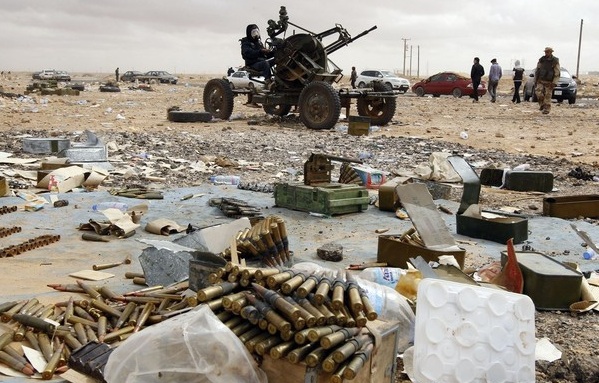
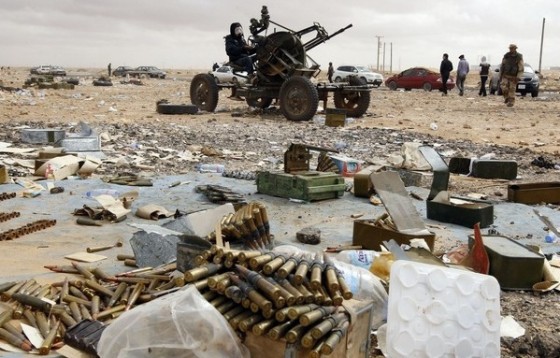
There is so much ammunition and unexploded ordnance scattered across eastern Libya that local people will face a serious threat when they return home, reports the United Nations. But it is difficult to determine the exact quantities because of ongoing fighting just how dangerous these munitions are. “In Tobrouk and Benghazi there are munition bunkers that were destroyed by [government] forces prior to the establishment of the no-fly zone,” Tekimiti Gilbert, spokesman for the UN Mine Action Service (UNMAS), said. “Gaddafi’s forces bombed the bunkers to deprive rebels of weapons. As a result, a lot of ammunition is spread across a wide area on the surface of the ground.

“Because there was access to bunkers, local people are scavenging for scrap metal for re-sale and also explosives which can be used for fishing,” he told IRIN, the United Nations newspaper that reports on environmental issues.

To this end, UNMAS is working with the International Committee of the Red Cross, the Libyan Red Crescent and other partners to try to contain the problem. “One area can be made up of between 10-50 individual bunkers, which could cover an area of approximately 20 football fields,” Gilbert said.

The munitions include rockets, shells and mortars, which are strewn across public places and residential areas in Misrata, Ajdabiya and Benghazi. In Ajdabiya, a threat exists from unexploded devices around and even inside houses.

In mid-April, unexploded ordinances were found in three homes in Ajdabiya, including remnants of a BM-21 rocket embedded in the wall. More was found in other homes. Ten large bombs and 18 smaller missiles were destroyed around Benghazi.The situation, according to UNMAS, is under-reported because most areas of contamination are in battle zones and cannot be reached.

“There is no immediate visual impact because inhabitants of towns inside battle zones have evacuated eastwards to Benghazi,” Gilbert said. “Ajdabiya, etc, are fairly empty. The issue is when displaced people return to their homes where they will be confronted with the risk of unexploded ordnance.

The Mine Action Group is working alongside the Swiss Demining Group, DanChurchAid and the ICRC. “The effort will be extended to conflict-torn Misrata in the near future,” said Herby Elmazi, ICRC operational clearance delegate. In Ajdabiya, the ICRC is working inside the city to clear abandoned ammunition and UXO before most people return, while Handicap International has partnered with the Scout Movement to undertake education through outreach teams.

Since conflict broke out in Libya in mid-February, various reports have emerged of the use of anti-vehicle mines, anti-personnel mines, cluster munitions and other ordnance by both sides to the conflict. The government of Libya is not a signatory to the 1997 Mine Ban Treaty nor the Convention on Cluster munitions.

Read more about the cost of conflict to the environment:
The Cost of Conflict in the Middle East (Strategic Foresight Group)
Gaza Conflict With Israel Has Environmental Aspects Too
Killing For Water In Iraq

::IRIN News

Image via BRQ network

LEAVE A REPLY

Please enter your comment!
Please enter your name here

TRENDING

How does one start prepping?

Faced with an extreme winter storm this year, Americans wonder how to be prepared for catastrophe. Miriam has lived through wars in the Middle East - so she's prepared on giving you a guide to prepping.

Iran’s holiest city about to run dry as terror chosen over water management

Iran’s second-largest city, Mashhad, is facing an acute water emergency after dam reservoirs feeding the city fell below three percent capacity, according to Iranian state and local media. Officials warn that without rainfall or improved inflows from neighboring Afghanistan, the city’s supply could soon collapse.

Arab agricultural land is on the brink

Across the Arab world, croplands face a perfect storm of stressors. Excessive fertilizers and pesticides erode soil ecology. Poor drainage and over-irrigation drive salinization, leaving fields crusted with salt. Rising temperatures, dwindling groundwater, and more frequent sand-and-dust storms—all amplified by climate change—compound the crisis.

Freedom Flotilla sets sail toward Gaza with Greta Thunburg on board to liberate Gaza

Inside the controversial voyage that merges climate activism, human rights, and Middle East politics. Will the Freedom Flotilla make it to Gaza?

The Emirates wants to help Lebanon become a sustainable winner

Can sustainable experts change the future of Lebanon for the better? The UAE is leading the way.

Qatar’s climate hypocrisy rides the London Underground

Qatar remains a master of doublethink—burning gas by the megaton while selling “sustainability” to a world desperate for clean air. Wake up from your slumber people.

How Quality of Hire Shapes Modern Recruitment

A 2024 survey by Deloitte found that 76% of talent leaders now consider long-term retention and workforce contribution among their most important hiring success metrics—far surpassing time-to-fill or cost-per-hire. As the expectations for new hires deepen, companies must also confront the inherent challenges in redefining and accurately measuring hiring quality.

8 Team-Building Exercises to Start the Week Off 

Team building to change the world! The best renewable energy companies are ones that function.

Thank you, LinkedIn — and what your Jobs on the Rise report means for sustainable careers

While “green jobs” aren’t always labeled as such, many of the fastest-growing roles are directly enabling the energy transition, climate resilience, and lower-carbon systems: Number one on their list is Artificial Intelligence engineers. But what does that mean? Vibe coding Claude? 

Somali pirates steal oil tankers

The pirates often stage their heists out of Somalia, a lawless country, with a weak central government that is grappling with a violent Islamist insurgency. Using speedboats that swarm the targets, the machine-gun-toting pirates take control of merchant ships and then hold the vessels, crew and cargo for ransom.

Leopoldo Alejandro Betancourt López Turned Ocean Plastic Into Profitable Sunglasses

Few fashion accessories carry the environmental burden of sunglasses. Most frames are constructed from petroleum-based plastics and acrylic polymers that linger in landfills for centuries, shedding microplastics into soil and waterways long after they've been discarded. Leopoldo Alejandro Betancourt López, president of the Spanish eyewear brand Hawkers, saw this problem differently than most industry executives.

Why Dr. Tony Jacob Sees Texas Business Egos as Warning Signs

Everything's bigger in Texas. Except business egos.  Dr. Tony Jacob figured...

Israel and America Sign Renewable Energy Cooperation Deal

Other announcements made at the conference include the Timna Renewable Energy Park, which will be a center for R&D, and the AORA Solar Thermal Module at Kibbutz Samar, the world's first commercial hybrid solar gas-turbine power plant that is already nearing completion. Solel Solar Systems announced it was beginning construction of a 50 MW solar field in Lebrija, Spain, and Brightsource Energy made a pre-conference announcement that it had inked the world's largest solar deal to date with Southern California Edison (SCE).

Related Articles

Popular Categories