Trees That Don’t Stand a Chance Against Climate Change

The answer to climate woes for pines and and maples may be blowing in the wind.

Sad news so soon after the Jewish New Year for the trees: Many tree species might become extinct due to climate change if no action is taken in time: This is the conclusion of a new research study from the Hebrew University.  According to the research, trees which disperse their seeds by wind, such as pines and maples, will be unable to spread at a pace that can cope with expected climate changes. The research, which focused on the ecological consequences of expected changes in the climate and the environment on tree spread, was conducted by Prof. Ran Nathan and his student, Nir Horvitz.

“Our research indicates that the natural wind-driven spread of many species of trees will increase, but will occur at a significantly lower pace than that which will be required to cope with the changes in surface temperature,” said Prof. Nathan.

“This will raise extinction risk of many tree populations because they will not be able to track the shift in their natural habitats which currently supply them with favorable conditions for establishment and reproduction. As a result, the composition of different tree species in future forests is expected to change and their areas might be reduced, the goods and services that these forests provide for man might be harmed, and wide-ranging steps will have to be taken to ensure seed dispersal in a controlled, directed manner.”

On the basis of earlier work, elevated concentration of carbon dioxide is expected to cause trees to produce many more seeds and to reach maturity earlier than under current conditions, hence speeding up their spread. On the other hand, the weakening of wind speed in certain areas should reduce spread rate of these trees. The balance between these opposing forces remained unknown.

The new research showed that the faster spread predicted for these trees in the future will be much slower than the expected poleward shift of climate (temperature) ranges. Consequently, these tree species might not be able to withstand the climate change.

Published in the journal Ecology Letters, the research provides a mechanistic model developed to predict trends in plant spread. Predictions which were made until now were founded on past trends and did not take into consideration the expected future changes in the key biological and environmental factors that determine plant spread.

In Israel, the research has bearing on various native tree species whose seeds are dispersed by the wind, such as Aleppo pine, Syrian maple and Syrian ash. The model that has been developed will be useful also in predicting the invasive spread of alien tree species, such as the tree of heaven, into Israeli natural habitats. It might be able to be used by planners investigating how to replant after the massive Israel forest fire.

Hand-sown seeds?

Trees with wind-dispersed seeds are mainly common in forests of North America and Eurasia. The current research points to the need to take human action to insure the dispersal of the seeds of these trees within the next half century, in view of the expected climate changes.

“It is important for those responsible for forest management in many parts of the world to understand that nature alone will not do the job,” said Prof. Nathan.

“Human action will be required to ensure in a controlled manner the minimization of unexpected detrimental byproducts, and that those trees which are very important for global ecological processes will not become extinct,” he said.

Read more on trees:

Ancient Palm in Egypt Faces Extinction

Celebrate the Jewish New Year of the Trees

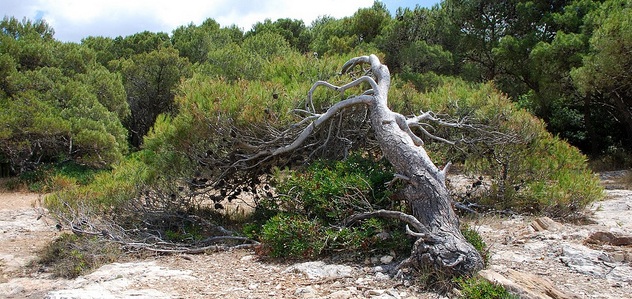
Image via yellow.cat

Karin Kloosterman
Karin Kloostermanhttp://www.greenprophet.com
Karin Kloosterman is an award-winning journalist, innovation strategist, and founder of Green Prophet, one of the Middle East’s pioneering sustainability platforms. She has ranked in the Top 10 of Verizon innovation competitions, participated in NASA-linked challenges, and spoken worldwide on climate, food security, and future resilience. With an IoT technology patent, features in Canada’s National Post, and leadership inside teams building next-generation agricultural and planetary systems — including Mars-farming concepts — Karin operates at the intersection of storytelling, science, and systems change. She doesn’t report on the future – she helps design it. Reach out directly to [email protected]
2 COMMENTS

LEAVE A REPLY

Please enter your comment!
Please enter your name here

TRENDING

Earth building with Dead Sea salt bricks

Researchers develop a brick made largely from recycled Dead Sea salt—offering a potential alternative to carbon-intensive cement.

Farm To Table Israel Connects People To The Land

Farm To Table Israel is transforming the traditional dining experience into a hands-on journey.

Plant trees in cities, for your heart

It seems like a no-brainer, but sometimes you need to give evidence to city councillors: A new multi-institutional study led by UC Davis Health suggests that not all green space is created equal. Living in urban neighborhoods with more visible trees is associated with a 4% lower incidence of cardiovascular disease, while areas dominated by grass or low shrubs may be linked to higher cardiovascular risk.

Funeral for a Tree plays birdsong from tree rings of beloved oak

When a 65-year-old oak tree in Steve Parker’s yard died from fungal disease, he did not cut it into firewood or haul it away. He did not erase it. He cut the tree into disks and then turned them into records that play birdsong –– a touching tribute to the years that the tree was house and home to birds and all manners of creatures. 

Remilk makes cloned milk so cows don’t need to suffer and it’s hormone-free

This week, Israel’s precision-fermentation milk from Remilk is finally appearing on supermarket shelves. Staff members have been posting photos in Hebrew, smiling, tasting, and clearly enjoying the moment — not because it’s science fiction, but because it tastes like the real thing.

Qatar’s climate hypocrisy rides the London Underground

Qatar remains a master of doublethink—burning gas by the megaton while selling “sustainability” to a world desperate for clean air. Wake up from your slumber people.

How Quality of Hire Shapes Modern Recruitment

A 2024 survey by Deloitte found that 76% of talent leaders now consider long-term retention and workforce contribution among their most important hiring success metrics—far surpassing time-to-fill or cost-per-hire. As the expectations for new hires deepen, companies must also confront the inherent challenges in redefining and accurately measuring hiring quality.

8 Team-Building Exercises to Start the Week Off 

Team building to change the world! The best renewable energy companies are ones that function.

Thank you, LinkedIn — and what your Jobs on the Rise report means for sustainable careers

While “green jobs” aren’t always labeled as such, many of the fastest-growing roles are directly enabling the energy transition, climate resilience, and lower-carbon systems: Number one on their list is Artificial Intelligence engineers. But what does that mean? Vibe coding Claude? 

Somali pirates steal oil tankers

The pirates often stage their heists out of Somalia, a lawless country, with a weak central government that is grappling with a violent Islamist insurgency. Using speedboats that swarm the targets, the machine-gun-toting pirates take control of merchant ships and then hold the vessels, crew and cargo for ransom.

Leopoldo Alejandro Betancourt López Turned Ocean Plastic Into Profitable Sunglasses

Few fashion accessories carry the environmental burden of sunglasses. Most frames are constructed from petroleum-based plastics and acrylic polymers that linger in landfills for centuries, shedding microplastics into soil and waterways long after they've been discarded. Leopoldo Alejandro Betancourt López, president of the Spanish eyewear brand Hawkers, saw this problem differently than most industry executives.

Why Dr. Tony Jacob Sees Texas Business Egos as Warning Signs

Everything's bigger in Texas. Except business egos.  Dr. Tony Jacob figured...

Israel and America Sign Renewable Energy Cooperation Deal

Other announcements made at the conference include the Timna Renewable Energy Park, which will be a center for R&D, and the AORA Solar Thermal Module at Kibbutz Samar, the world's first commercial hybrid solar gas-turbine power plant that is already nearing completion. Solel Solar Systems announced it was beginning construction of a 50 MW solar field in Lebrija, Spain, and Brightsource Energy made a pre-conference announcement that it had inked the world's largest solar deal to date with Southern California Edison (SCE).

Related Articles

Popular Categories