
Sahara Forest Project Jordan

solar-sahara-forest-project-jordanJordan will be the location of the Sahara Forest Project which uses solar power to create clean water and electricity for agriculture

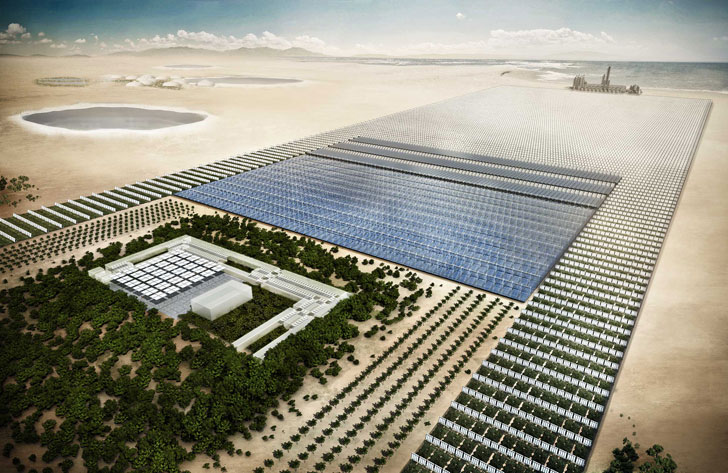
Whilst deserts can be the harshest and most inhabitable places in earth, they are also the perfect locations for new-fangled green technologies such as solar power. For example, Jordan has recently announced its support for the large-scale Sahara Forest Project which brings together solar power and desalination of seawater to provide sustainable energy and agricultural solutions in desert regions. The project aims to create carbon neutral energy, fresh water and food, contribute to forestation and all in the midst of desert lands.

The project’s ability to alleviate food and water shortages is no doubt an important aspect, especially if the recent food riots that hit the region are anything to go by.

Financially backed by the Norwegian authorities, Jordan has signed an agreement which gives the go ahead for the development of the Sahara Forest Project system in the coastal town of Aqaba.

sahara forest project image

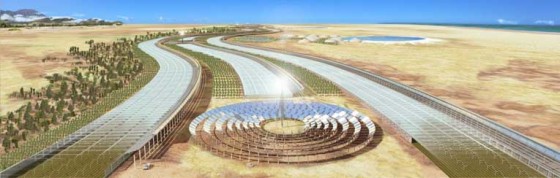
The development site is a 200,000 square metre plot although a further 2 million square metres has been secured for future expansions. The location of Aqaba near the Red Sea is important as the project will be pumping seawater to the power plant to convert into fresh water for use. The project works by simultaneously converting salt water into fresh water which is used to grow fresh vegetables whilst solar power is used to heat water and create steam used to turn a turbine and create energy.

sahara forest project picture

Jordan’s uptake of the project came after the plan caught the eye of Jordan’s King Abdullah II during a meeting with the creators of the project in Oslo in 2010. The Sahara Forest Project has been masterminded by biomimicry architect Michael Pawlyn, Seawater Greenhouse designer Charlie Paton and structural engineer Bill Watts. It has also been supported by the Norwegian environmental group the Bellona Foundation.
The President of the Bellona Foundation, Frederic Hauge said of the new deal:

“We are very happy with the strong support from both Jordanian and Norwegian authorities. It is encouraging to see that we share the vision of a more holistic approach towards solving challenges in the food, water and energy sector.”

According to plans put forward by developers a feasibility study will be carried in 2011, a Test and Demonstration centre built in 2012 with a large-scale roll out of the project planned for 2015. If all goes well, this project will illustrates that the with the help of eco-technologies you really can turn the desert into an oasis.

Image via Sahara Forest Project

For more green stories from Jordan see:
Jordanian Environmentalists to Fight Ajloun Forest Construction
Jordan Joins the Food Protest as Tunisian President Steps Down
Jordan’s Bus Rapid Transit (BRT) Set For 2012 Inauguration

Arwa Aburawa
Arwa Aburawahttp://www.greenprophet.com
Arwa is a Muslim freelance writer who is interested in everything climate change related and how Islam can inspire more people to care for their planet and take active steps to save it while we can. She is endlessly suspicious of all politicians and their ceaseless meetings, especially as they make normal people believe that they are not part of the solution when they are the ONLY solution. Her Indian auntie is her model eco-warrier, and when Arwa is not busy helping out in the neighborhood alleyway garden, swap shopping or attempting fusion vegetarian dishes- with mixed success, she’d like to add- she can be found sipping on foraged nettle tea.
1 COMMENT
  1. A huge project of such may lead to an open end , it is worth taking in consideration the value of segmentation of the project (i.e algae fuel is a major , and its biomass is what can be procesed to mutli transforming productsas Omega 3,6,9 of high value ) at this stage money can be generated in short time which allows a chance to go for other phased desalination of seawater and agricultural solutions in desert regions

Comments are closed.

TRENDING

What are AWG air-water generators, and why they aren’t a golden-bullet solution (yet)

Atmospheric water generators (AWGs) sound like magic: machines that can pull drinking water out of air. The idea is mentioned in the Bible, where the elders would pray for water collected as dew on plants and the catch on turning this into a machine is in the physics. To turn invisible vapor into liquid, you must remove heat, especially the latent heat of condensation.

Jordan’s $6 Billion Aqaba–Amman Desalination Project from the Red Sea Moves Forward

In 2025, the Jordanian government signed agreements with a consortium led by Meridiam and SUEZ, alongside VINCI Construction and Orascom Construction. Under a 30-year concession agreement, the consortium will design, build, finance, operate, and maintain the system before transferring it back to the Jordanian government. The total investment is estimated at approximately $6 billion USD.

The Saudi Startup Turning Desalination’s Toxic Waste Into Its Own Disinfectant

For millennia, the Middle East's water crisis seemed an immutable fact of geography — a region defined as much by what it lacked as by what lay beneath its sands. Today, a convergence of plummeting solar costs, advancing membrane technology, and hard-won engineering expertise is rewriting that story.

Earth building with Dead Sea salt bricks

Researchers develop a brick made largely from recycled Dead Sea salt—offering a potential alternative to carbon-intensive cement.

10 Proven Israeli Technologies to Help Somaliland Build Food, Water, and Energy Security

Israel’s water and agricultural technologies didn’t emerge from ideal conditions. They were developed under pressure: low rainfall, saline water, political isolation, lack of energy resources, and the constant need to feed a growing population with limited land. Over the years, I’ve written about many of these companies not as miracle-makers, but as problem-solvers. That’s what makes them relevant to places like Somaliland. Israel was the first country in the world to recognize Somaliland as an independent state although Ethiopia has been treating the nation as such for decades.

Should You Invest in the Private Market?

startustartup Unlike public stock exchanges, which offer daily trading, strict...

How to build a 100-year-company

Kongō Gumi is a Japanese construction company, purportedly founded in 578 A.D., making it the world's oldest documented company. What can we learn about building sustainable businesses from them?

From Pilot Plant to Global Stage: How Aduro Clean Technologies’ 2026 Expansion Signals a Turning Point for Chemical Recycling Investors Like Yazan Al Homsi

The company's Next Generation Process (NGP) Pilot Plant in London, Ontario, has officially moved into initial operating campaigns, generating the kind of structured, repeatable data that separates laboratory promise from commercial viability.

How AI Helps SaaS Companies Reduce Repetitive Customer Support Work

SaaS products are designed for large numbers of users with different levels of experience, and also in renewable energy.

Pulling Water from the Air

Faced with water shortage in Amman, Laurie digs up...

Turning Your Energy Consultancy into an LLC: 4 Legal Steps for Founders in Texas

If you are starting a renewable energy business in Texas, learn how to start an LLC by the books.

Tracking the Impacts of a Hydroelectric Dam Along the Tigris River

For the next two months, I'll be taking a break from my usual Green Prophet posts to report on a transnational environmental issue: the Ilısu Dam currently under construction in Turkey, and the ways it will transform life along the Tigris River.

6 Payment Processors With the Fastest Onboarding for SMBs

Get your SMB up and running fast with these 6 payment processors. Compare the quickest onboarding options to start accepting customer payments without delay.

Related Articles

Popular Categories