
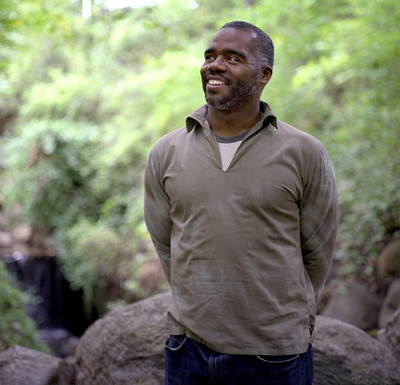
“Green Deen” Ibrahim Abdul-Matin Connects Environmentalism With Islam

feature_ibrahim_abdul-matin_0Ibrahim Abdul-Matin’s acclaimed book educates American believers, “Green Deen: What Islam Teaches About Protecting the Planet.”

For the past ten years, Ibrahim Abdul-Matin has been a passionate voice for transforming our pollution based way of life to one that prioritises our planet and its people. His book Green Deen: What Islam Teaches about Protecting the Planet is a voice for educating us on greening our lives and faith, and here, Ibrahim explains how we can do that.

The book “Green Deen” has a spiritual and ethical form of environmentalism rooted from the Qur’an. Deen is an Arabic word that means a religion, lifestyle or path. So Christianity is a deenand Buddhism is a deen and atheism is a deen. There are many deens. In the English speaking Muslim communities it has become a slang term in our speech. The title ‘Green Deen’ follows this meaning by linking the Muslim lifestyle with environmental responsibilities. “It has a cool ring to it,” says Ibrahim.

Journalist Justin Vogt from One Earth recently interviewed Ibrahim where our eco-Muslim talked about how his Brooklyn upbringing during the ’80s affected his views. He explained, “during my senior year of college, I started to look at the environment and over-consumption and [targeted] corporate abuse as the problem. Both capitalism and socialism define your value as a human being on what you can make or create or destroy or waste or consume.” From a young age Ibrahim connected his faith to his passion for reducing consumption, “the beauty of Islam is that it provides a framework [as] an antidote to that. I would argue that Islam shares this perspective with Christianity, Judaism and other great faiths. If I claim to love God, then I should all love His creations.”
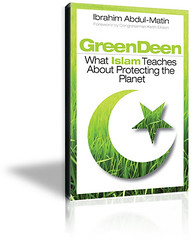
Green Deen book
Ibrahim is green to his roots: "I was told the Earth is a Mosque, you can pray anywhere... from that moment I knew I had to protect the Earth".

After graduating, Ibrahim worked as an Outward Bound instructor, training young people to understand their relationship with the planet and to leave the place better than they found it. He continued a string of eco-related professions including working for a group called the Active Element Foundation in New York City. It was here that Ibrahim was to meet Van Jones (who later became an adviser to President Barack Obama on green jobs).

Ibrahim currently works on Mayor Bloomberg’s sustainability agenda, which is called PlaNYC and is his vision for how people can green New York City. PlaNYC covers land use, housing, transportation, energy; a whole multitude of things. Meetings and idea-sharing is part of the development, “at (one meeting) we met with a group of faith leaders and talked about water,” said Ibrhaim. “All faith traditions use water in some way: for Muslims, it’s for wudhu, the ablutions we make before praying. So maintaining our water system is important for these communities.”

When asked about how Islam works in harmony with environmentalism, Ibrahim focused on a saying of the Prophet Muhammad, peace be upon him, that “the earth is a mosque”. In this perspective, everything on the planet is sacred. Islam also lays out a framework to explain why human beings can have a negative effect on the environment. “There’s a passage in the Qur’an that says: ‘Corruption has appeared on the land and in the sea because of what the hands of humans have wrought. This is in order that [Allah] give them a taste of the consequences of their misdeeds that perhaps they will return to the path of right guidance’.” (Qur’an, 30:41).

So how will his book help in this universal hope? “[Green Deen] was designed to be the first step in this conversation, and my hope is that much more qualified scholars will join in and take this further. To see if we can be a force for good – an example to ourselves first and foremost.”

The question that Ibrahim puts forward to all people and particularly those who have faith is how do we actively live in that framework?

Image :: Lila Garnett on One Earth

Read more book reviews and about Islam and the planet:
Prince Charles on Islam and the Environment
Sufis are Islam’s Eco Guardians
Book Review of Precycle! by Paul Peacock

Zaufishan
Zaufishanhttps://www.greenprophet.com/
95% halal and freedom friendly, Zaufishan is our eco-Muslim reporter from England, UK. Zaufishan reports from her environment blog and is creator of the media savvy group site http://www.muslimness.com.
2 COMMENTS

Comments are closed.

TRENDING

BM Studios is designing systems, not just buildings in the UAE

Balsam Madi is an architect and systems thinker whose work bridges culture, sustainability, and design intelligence across the Middle East and Europe.

From Green Energy to Healthy Societies: Why old systems thinking is becoming relevant again

Across the Middle East and North Africa, large investments are being made in green hydrogen, renewable energy, water infrastructure and sustainability. Most of these efforts are discussed in the context of climate change, decarbonization and economic diversification. That framing is important, but it may not capture their full value.

Plant trees in cities, for your heart

It seems like a no-brainer, but sometimes you need to give evidence to city councillors: A new multi-institutional study led by UC Davis Health suggests that not all green space is created equal. Living in urban neighborhoods with more visible trees is associated with a 4% lower incidence of cardiovascular disease, while areas dominated by grass or low shrubs may be linked to higher cardiovascular risk.

Sustainable Architect Ronak Roshan on the Politics Behind the Houston Ismaili Center

Roshan’s reflection situates the Houston Ismaili Center within a broader discussion about architecture as diplomacy — where aesthetics, faith, and geopolitics intersect. Her words challenge readers to question whether “green” design and grand symbolism can coexist without transparency and accountability.

Blackdot’s painless AI-based tattoos will make inked skin less taboo?

Blackdot’s AI-powered tattoo machine promises precision and less pain, but sparks debate over health risks, artistry, and spirituality. From religious prohibitions to smart tattoos, the future of ink is being rewritten by technology.

Turning Your Energy Consultancy into an LLC: 4 Legal Steps for Founders in Texas

If you are starting a renewable energy business in Texas, learn how to start an LLC by the books.

Tracking the Impacts of a Hydroelectric Dam Along the Tigris River

For the next two months, I'll be taking a break from my usual Green Prophet posts to report on a transnational environmental issue: the Ilısu Dam currently under construction in Turkey, and the ways it will transform life along the Tigris River.

6 Payment Processors With the Fastest Onboarding for SMBs

Get your SMB up and running fast with these 6 payment processors. Compare the quickest onboarding options to start accepting customer payments without delay.

Qatar’s climate hypocrisy rides the London Underground

Qatar remains a master of doublethink—burning gas by the megaton while selling “sustainability” to a world desperate for clean air. Wake up from your slumber people.

How Quality of Hire Shapes Modern Recruitment

A 2024 survey by Deloitte found that 76% of talent leaders now consider long-term retention and workforce contribution among their most important hiring success metrics—far surpassing time-to-fill or cost-per-hire. As the expectations for new hires deepen, companies must also confront the inherent challenges in redefining and accurately measuring hiring quality.

8 Team-Building Exercises to Start the Week Off 

Team building to change the world! The best renewable energy companies are ones that function.

Thank you, LinkedIn — and what your Jobs on the Rise report means for sustainable careers

While “green jobs” aren’t always labeled as such, many of the fastest-growing roles are directly enabling the energy transition, climate resilience, and lower-carbon systems: Number one on their list is Artificial Intelligence engineers. But what does that mean? Vibe coding Claude? 

Somali pirates steal oil tankers

The pirates often stage their heists out of Somalia, a lawless country, with a weak central government that is grappling with a violent Islamist insurgency. Using speedboats that swarm the targets, the machine-gun-toting pirates take control of merchant ships and then hold the vessels, crew and cargo for ransom.

Related Articles

Popular Categories