
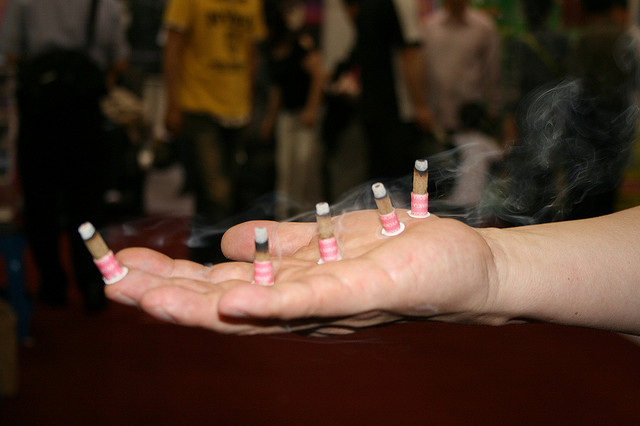

 Pauline discovers in her review of “Uses & Abuses of Plant-Derived Smoke” that there is more to plant-based smoke than meets the eye. Read on for details.
You’ve heard of tobacco and cannabis but what about jimsonweed or torchwood? This book demonstrates that there’s a lot more to smoke created from plant material than just nicotine and narcotics.
We are familiar with plants as a food source or sometimes a construction material, but this volume is a fascinating excursion into a facet of plants that I’ve never seen discussed in this way before. There are over two thousand reported uses of plant-derived smoke. It has been used down the ages as insecticide, medicine, fragrance, food preservative, recreational drug, poison, disinfectant, magical agent and spiritual purgative.
Uses & Abuses
Incense is “any material that is burned or volatized to emit fragrant fumes” and it has been used for over five thousand years by cultures including the Sumerians, Babylonians, Egyptians and Hebrews. The resins from the torchwood family of trees of southern Oman, including frankincense and myrrh, were once part of a trade that was probably more valuable than today’s oil markets.
It has been suggested that plant smoke was used by the Delphic oracles of ancient Greece to produce hallucinogenic vapors. Since then, many plant substances have been smoked by people around the world in the hope of inducing psychedelic visions, including a craze in the 1960s for smoking banana skins. Research by the US Food and Drug Administration concluded that any such affects were due more to psychic suggestibility than the effects of chemical substances within the peel.
There are over a thousand reported medical uses for plant-derived smoke. It has been used for everything from aborting pregnancies, to strengthening newborn babies. Inhalation is a particularly effective way for the body to absorb the substances present in plant smoke. Plant smoke has sometimes been used as a painkiller and cannabis is perhaps the most controversial example of this. It has also been used for respiratory problems, for example Datura stramonium (or jimsonweed) has been widely used by asthma sufferers. It was also used for “dulling the sense of people sacrificed during ceremonial executions” and for its hallucinogenic properties.
Toxic smoke
Unfortunately, jimsonweed also contains lethal toxic ingredients and there is ample evidence of the dangers of inhaling its smoke. A number of the other plants listed in this book can be used to make thoroughly nasty poisons, such as poison hemlock (Conium maculatum) and ricin which is derived from the castor-oil plant, Ricinus communis. So it’s no surprise to learn that the latter plant has also been used as an ingredient in smoke that was intended to cause blindness in one’s enemies.
The authors point out that their information is drawn from many different sources and whilst every effort has been made to ensure its accuracy, survey data is subject to different methods and rigor and even the correct identification of a plant species may be in question for some ethnobotanical field studies. And just because a particular plant material has been used as part of the rituals of a particular culture somewhere in the world, doesn’t mean that it’s necessarily a good idea to try setting light to it in our own homes.
This book provides no endorsements for plant smoke and even where it gives indications of the ingredients in historic recipes, there’s no suggestion that these are suitable for the home-grower and smoker. This is not, therefore, a book for home experimentation with plant smoke.
List of plants
The first part of the book is a fascinating read and I was disappointed when it ended all too soon and gave way to the list of individual plant species. This main part, the directory of individual plants, also contains some real gems, but I was left wishing that some of this information had been gathered together into a more discursive exposition that grouped plant smoke uses together in terms of other characteristics such as belief systems and geographical location.
The plant list also presents some problems for a lay reader. Despite a few line drawings of plants, it’s a rather dry prospect, visually, and organised alphabetically by Latin plant names. So you either have to be prepared to browse this un-appetising-looking directory and dip in at random, or use the index to look up plants by their common names. In some cases this isn’t easy either.
For example, Papaver somniferum can be found in the index under ‘opium’ but not under ‘poppy’. You can only find plums if you happen to know that their botanic name is prunus. However, it does contain some fascinating revelations which repay the effort of finding your way around and it would be a very useful source book for anyone researching individual plant species in detail.
And there’s still much of interest here for the general reader. For example, anyone who has ever followed a recipe that requires you to dry-fry a fresh chili pepper will know that the resulting smoke can provoke a choking cough. So it’s interesting to discover that a tribe in Ecuador used to punish their children by making them stand over fires into which quantities of the plant had been thrown. An equally curious practice is the burning of a mix of garlic and pig excrement which has been used in Hungary to calm frightened children. Definitely not a recipe that many people will be tempted to try at home.
The future of plant smoke
Plant-derived smoke has a long history, but it also has a lot of future potential. The book’s preface offers the tantalising proposal that “few of the plants listed in this book have been studied for novel compounds that arise from the combustion of their parts. A whole new class of compounds quite possibly awaits discovery.” There may be a lot more uses for plant smoke and its derivatives.
Although this book remains morally neutral on the rights and wrongs of smoking various substances, it goes some way towards countering the view that plant smoke is always a bad thing.
This book was reviewed by Pauline Masurel, a Green Prophet guest writer
Uses & Abuses of Plant-Derived Smoke: Its Ethnobotany as Hallucinogen, Perfume, Incense & Medicine (Marcello Pennacchio, Lara Jefferson & Kayri Havens) Oxford University Press
More stories about plant uses:
TransAlgae Seeds A Need For Green Feed
4 Unique Aloe Vera Juice Recipes for Summer and Health
Are You Growing Poison In Your Garden?
image via Stinkie Pinkie




this is good stuff to know and thanks for sharing it
with me, im a tobacco smoker anyways i wouldn’t want to
smoke that stuff if it don’t have nicotine in it its
not for me because im a nicotine head the tobacco seems
to wake me up when im feeling tired and when im out of
cigarettes i feel sleepy and tend to eat more.
and now sens i know what this plants
smoke can do ill put the dead pieces in
the mulch pile and let it rot out in to
dirt
also i noticed that this plants seeds look alot
like green pepper seeds but a bit bigger in size