
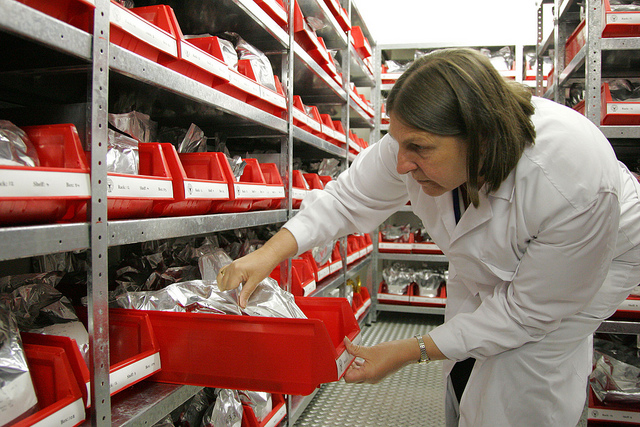

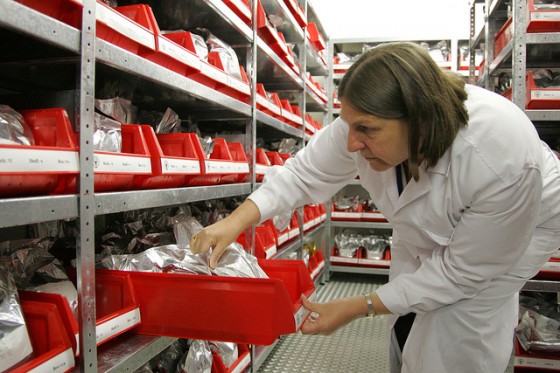
 As populations surge and climate change destroys existing crops, seed and gene banks prepare us for potential food-shortage emergencies.
As we learned when fires raging through Russia destroyed wheat crops, countries all along the food chain, including Egypt, feel the pinch, though climate change is not all that puts at risk Israel’s tomato, cucumber, and melon supply. Lack of biodiversity also threatens agriculture as much it does any ecosystem.
As rising food prices, growing populations and natural disasters increasingly put pressure on food production, governments and scientists are focusing on preserving the world’s agricultural biodiversity through seed and gene banks.
Seedy savings
“Crops are resources that are renewable as long as you can conserve them,” Cary Fowler, executive director of the Global Crop Diversity Trust told IRIN from Rome. “In this sense, seed and gene banks are the libraries of life.”
Gene and seed banks, by storing food varieties, prepare the world for food crises by acting as a “savings account.” Just as one saves money for emergencies, scientists are saving seeds in case certain crops die out or are destroyed.
These stockpiles can be used to feed a growing population, which the UN predicts will balloon from seven billion to nine billion by 2050.
Adaptation
Scientists also hope to use genetic features of these stored seeds to create crops that can adapt to various weather conditions.
“Different varieties have different traits which are suitable for different climates, diseases, soils and markets,” said Rory Hamilton, head of the T.T. Chang Genetic Resources Center at the International Rice Research Institute. “If we lose those traits, then we lose our ability to respond to challenges.”
According to Diverseeds, a food security project of the European Commission, the world’s diet is primarily comprised of only 30 crops. Of those, wheat, corn and rice account for more than half of the world’s food consumption.
IRIN lists some of the most important crop seed and gene banks around the world:
Pavlovsk Experimental Station (Berry Bank) – Russia
What: Established in 1926, the Pavlovsk Experimental Station has one of the oldest collections of fruits and berries in the world and the largest in Europe. It contains more than 5,500 seed varieties of blackcurrants, apples and strawberries. Despite the fact that 90 percent of the station’s collection is unique, it is currently facing demolition plans by the Russian government. Sixty percent of the blackcurrants in Russia – the top producer at $400 million per year – originated from this research centre.
Where: Built outside St. Petersburg, the station earned a special place in Russian history during the World War II siege of the city, when 12 scientists chose to starve to death rather than eat the precious seeds.
International Rice Research Institute (IRRI) – Philippines
What: The oldest and largest international agricultural research institute in Asia, IRRI has more than 109,000 types of traditional, wild and ancestor rice. Rice farms cover 11 percent of the world’s arable area, and almost half the world depends on rice as a major source of food and income. It was established in 1960 by the Ford and Rockefeller foundations, in cooperation with the Philippine government.
Where: Los Baños, about 60km south of the Philippine capital, Manila.
International Maize and Wheat Improvement Centre (CIMMYT) – Mexico
What: Established in 1971, CIMMYT manages the most diverse maize and wheat collections. Each year the centre ships several tons of seed to more than 100 researchers in dozens of countries. The centre has some 140,000 samples of wheat seed from more than 100 countries, and 27,000 samples of maize.
Where: Mexico City.
International Potato Center (CIP) – Peru and Ecuador
What: CIP conducts scientific research on potato, sweet potato and other root and tuber crops, and examines ways to improve natural resource management in the Andes and similar mountain climates. Established in 1971, CIP has 5,000 samples of potato, 6,500 samples of sweet potato and 1,300 samples of nine species of Andean roots and tubers.
Where: CIP has experimental stations in a variety of climates in Peru and Ecuador, including in an irrigated coastal valley in La Molina, outside Lima, Peru’s capital; in the high Andes in Huancayo (Peru); on the eastern, rainforest-covered slopes of San Ramón (Peru); and Quito, Ecuador, in the high Andes.
Svalbard Seed Vault – Norway
What: Managed by the Global Crop Diversity Trust, Nordic Genetic Resource Center (NordGen) and the government of Norway, Svalbard is the largest seed vault in the world. Built in 2008 as a safety net in case other collections are destroyed, the vault cost US$9 million to build and holds 526,000 seed samples (500 seeds per sample).
Where: Dug out of an arctic mountainside nearly 1,000km north of the Norwegian mainland, the vault is located in the Svalbard Archipelago, near the town of Longyearbyen. For nearly four months a year, the Svalbard islands are enveloped in total darkness. Permafrost and thick rock ensure that even without electricity, the samples, which are stored at -18 degrees Celsius, remain frozen.
More food and health news:
6 Ideas For Eating Well With Leftovers
5 Vegetarian Myths To Counter Die-Hard Carnivores
Missing That Special Herb? Abu Dhabi Pesticide Testing Slows Supply
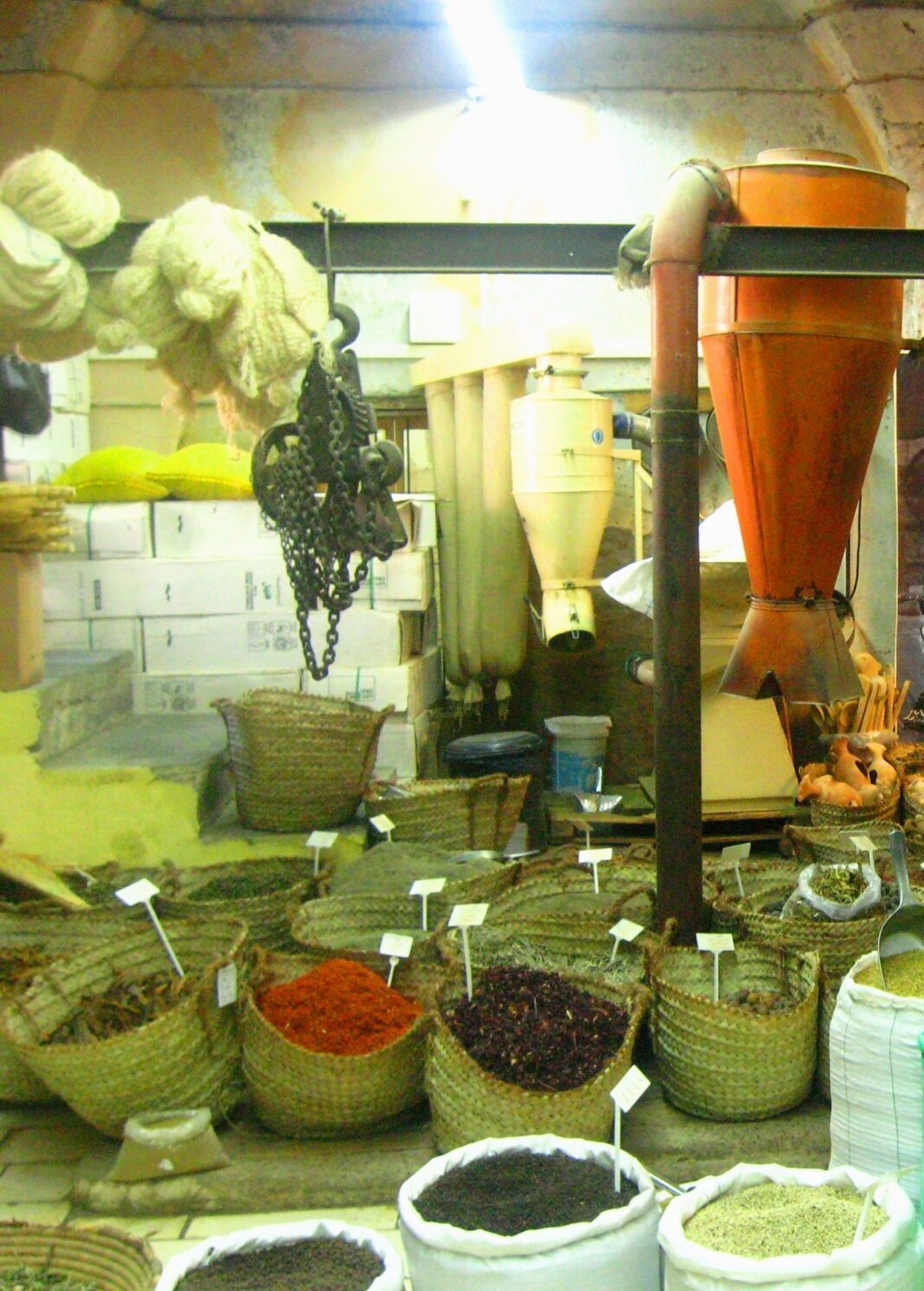


What happens when we can no longer grow crops from the seeds being stored away?