
 The renovated Khan of the White Donkey in Safed, Israel was the last stop on the Silk Road between Acre and Damascus. Now it’s a center for ecological activity, courses, and concerts.
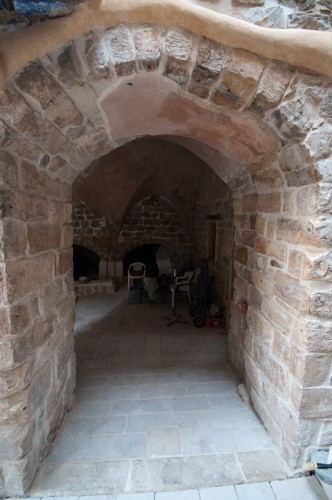
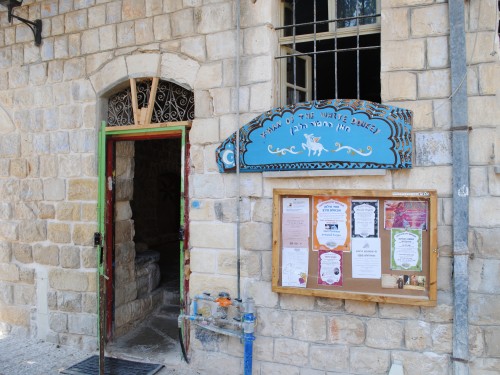
We pushed open the brightly-painted wooden door and walked into a cool stone hall. The roof was a series of arches, in the ancient Arab style. A few steps down, in a big open space surrounded by niches built into the walls, a women’s yoga class was taking place. Located in the mystical city of Safed, Israel, this ancient caravan inn “Khan of the White Donkey” obviously houses very up-to-date activities, most focused on ecology education and health.
What isn’t immediately apparent is that it’s also a modern example of clean technology. Here’s our interview with Andy Alpern, restoration manager at the Khan of the White Donkey since 2009.
GP: Tell us something about this building’s history.
Andy: It’s at least 700 years old and said to be Safed’s oldest building in active use. The main structure goes back to the Mameluke period (a.d.1266), with a “cave” in the back that may be even more ancient. It was a traveler’s hostel and market place. (The arched niches in the right-hand walls, above photo, may have been sleeping places or kiosks.) There’s an ancient mosque and a spring nearby. Safed was an important mercantile center then, and we think the building was on the main street, serving as khan for travelers and the main mosque.
It was known as the “Khan al-Juma”, Juma being Friday in Arabic. The courtyard was where the weekly shuk took place.
After Israel’s independence in 1948, the building was abandoned and fell into disrepair.The government offered it, and other sites, to whoever would take it. Whoever took it constructed the equivalent of a 1960s apartment inside the structure, placing dry-wall over the ancient stones, closing off the niches, and covering the beautiful stone floor with cheap tiles.
GP: Who began the renovations?
Andy: Moshe Tov Krebs, a Safed resident and ecology activist, purchased the building two years ago and began the renovation.
GP: What did Krebs and his crew find inside?
Andy: A lot of garbage. Even the niches were stuffed with garbage. The stone had been damaged by water infiltration from the concrete walls.
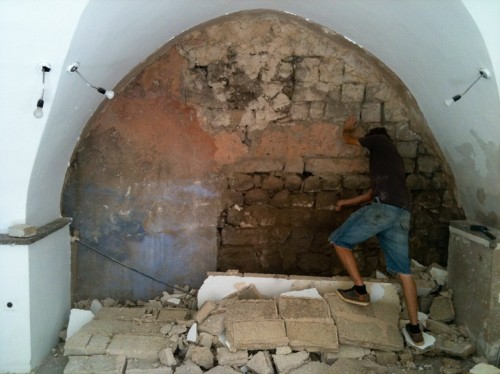
Under the tiles, two ancient water cisterns were discovered. One is ready for rainwater collection.
GP: How do cement and concrete damage stone?
Andy: First of all, production of cement is partly responsible for global pollution and climate change. (GP: according to Wikpedia, cement manufacture is responsible for 5% of global CO2 emissions.) Where building is concerned, it’s a material that doesn’t “breathe.” It seals moisture in behind it.
In the case of the Khan, there is ambient moisture from part of the floor being under ground level, near the spring. The stone behind the impenetrable concrete absorbed the mineral-laden moisture and became corroded. We now work with an expert in stone restoration, Kimi Maman.
GP: Who designed the new look?
Andy: Yarom Friedland, architect. He uses natural materials like lime mortar instead of concrete, as well as mud for outside walls, and wood. Lime mortar allows moisture to evaporate instead of infiltrating stone. We have the biggest polished-lime floor in Israel.
GP: What other ecological improvements are being made in the Khan?
Andy: We provide accommodation for workers, volunteers, and occasional guests. The grey water from showers and the kitchen are being channeled into a system for flushing toilets.
The restoration of the building to beauty and functionality is an ecological activity in itself, but the Khan hosts many others.
- The non-profit Halevav organization dedicated to environmental education offers a permaculture course, organic gardening programs in local schools (with a program for special-needs kids as well), recycling sites, and more.
- People with aches and pains find affordable acupunture in the Khan’s Health and Movement studio.
- Yoga for men and women.
- Storytelling hour for children.
- Reviving the old tradition, there’s a Friday shuk where local crafts, organic food (including shushi!), seedlings, and more are sold.
- A monthly Freecycle event.
The Khan of the White Donkey is located on R. Tet-Vav, the Artists’ Quarter, Safed. Tel: 054-447-3540 and 077-234-7519. (Remove the first 0 and add 972 if you are calling from abroad).
::Khan of the White Donkey website
More on renovations and eco-building in the Middle East from Green Prophet:
The Khaju Bridge in Esfahan, Iran
The Historical Grand Bazaar of Teheran
Planning the Sustainable City: Bogota, Colombia
Photos above courtesy of Eliahu Alperin and by Miriam Kresh www.israelikitchen.com
Hi Moshe Tov,
I just made aliyah to Tsfat – and I’d love to meet you – you look so familiar, do we know each other from Berkeley?
I’d love to find some sort of green/organic/eco work do do, partner in, …. would love to brainstorm with you.
B’shalom,
Ilene Lee (no cell phone yet, but I’m going to the khan for early dinner tonight – I’ll ask for you!
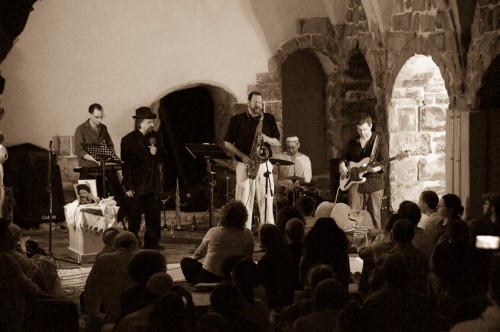
The Khan of the White Donkey also hosts a full schedule of cultural activities, private events and musical performances every week including weekly shows featuring top artists from the Israeli ethnic/world/fusion music scene as well as up and coming local Galilee musicians. We serve local healthy nature-based “slow” food, all with an ecological consciousness. Stop in for a visit next time you are in Tzfat.