

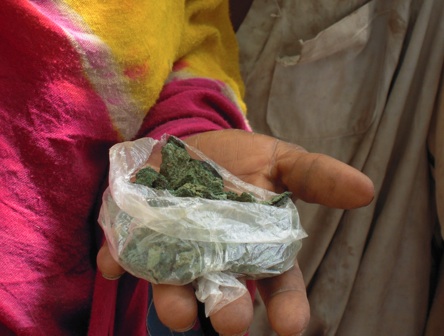
 Add a dash of cumin and you’ll get some “green cake” falafel? This wonder food, from algae is being grown by the UN to solve hunger crisis. It could work in the Middle East.
We know that kids in Gaza and Cairo aren’t getting enough high quality nutrients. And many other oil-less nations, like Syria, suffer agricultural hardships from drought; or from conflict like in Yemen. But “Green Cakes” made from algae (spirulina) could be the wonder food that could provide the missing link to nutrition in developing regions of the world.
“It’s as close as we will get to a miracle food,” said Mahamat Sorto, the United Nations Food and Agriculture Organization (FAO) officer managing the green cakes cultivation project in Chad. He and other aid agencies see the plant as a possible cheap solution to global malnutrition.
Donors to the project indeed hope that spirulina, a blue-green, protein-packed algae, labelled a “wonderful future food source” 45 years ago by the International Association of Microbiology, will deliver on its promise by the time a $1.7 million USD cultivation project in Chad, funded by the European Union, ends in December 2010. We can imagine these “wonder cakes” will appeal to vegans and vegetarians the world over, as well.
The plant’s dry weight contains up to 70 percent of protein matter, based on chemical analyses from the French Oil Institute, university research laboratories in Malaysia and Bangladesh, and the Siam Algae company, a Thai commercial group. And imagine how many cow farts can be saved from cultivating and eating such a product?
Health food stores in rich countries have promoted spirulina as an energy-enhancing supplement, but it has been eaten for centuries in various parts of the world.
Easily digestible, with high protein levels, high levels of B-carotene, vitamin B12, iron and trace minerals, and the rare essential fatty acid y-linolenic acid [also called gamma-linolenic acid (GLA), or omega-6], these green cakes do sound like a wonder.
Good news for the greens: a small environmental footprint with low water needs, production could take place in salty conditions that would kill other crops, and there were no “obvious negative cultural or religious issues associated with its consumption,” finds a recent report.
One drawback. In Chad’s northern Kanem region, spirulina grower Hereta Taher told IRIN that some people found the taste jarring. “It might seem bitter at first, but you get used to it.”
The bitterness could be solved with garlic, a dash of cumin or sage, so why is it not spilling out of market stalls?
Grower Hereta Taher “Lack of political interest,” said Alessandro Manini, secretary general of the Italy-based group, “Convention for the use of food micro-algae, intergovernmental institutional spirulina programme”, which promotes using the algae to combat malnutrition.
A review of seven studies on the impact of spirulina supplements on malnourished children, by researchers at the national hospital in Niamey, capital of Niger, was published in December 2008 in the French medical journal, Revue d’Epidémiologie et de Santé Publique.
The review concluded that although spirulina had a positive impact on the children’s weight, the studies were methodologically poor and had included too few people. The authors called for a larger “double-blind controlled clinical trial” – where neither the patients nor the researchers knew which patients were given spirulina – and longer follow-up period.
“It is a miracle,” said Ousmane Issa Mara, village chief of Barkadressou in the north of Kanem region, pointing to the rain-fed oasis where spirulina typically grows. “It gives you energy. After eating spirulina cakes, our sub-prefect did not have any more health problems. It restores appetite to children who lose it.”
Barkadressou is one of 14 EU-funded sites growing spirulina near Lake Chad and in the Kanem region.
Almost one in five children measured by height, weight and arm circumference in November 2009 by Action Against Hunger, an NGO working in the region, were acutely malnourished. The governor, Djari Ngamai, told IRIN that conditions in northern Kanem, 300km north of Mao, the regional capital, were the most arid in the area.
“It is lamentable how dry and barren the area is. It borders the northern BET [Borkou, Ennedi, Tibesti] regions and shares the same agricultural conditions and difficulties.”
Algae friendly oasis in Kanem region in Chad There were 1,581 women across the country participating in the EU spirulina cultivation project, and hundreds of women in Barkadressou had been packaging spirulina as dried cakes to sell to people who drove up to six hours by car from the capital to buy it. Similar climates and conditions for growing green cakes can also be found in the Middle East and in North Africa.
Need for boosting irrigation
Village chief Mara told IRIN that Barkadressou needed a motorised pump to boost irrigation because a drought in 2009 had halted the local spirulina cottage industry. Each family sold up to 100kg in the annual harvest and the income was critical.
China and India are among the top commercial producers of spirulina, with China’s production doubling from 19,000 tons in 2003 to 41,570 tons in 2004. Yet very little was produced for humanitarian purposes.
::IRIN