
The Limits of Growing Biofuel Crops on a Desert Island

Quick, name the scarcest natural resources in Israel. I’m sure that “land” and “water” would feature prominently in most people’s answers.

Israel is, to all intents and purposes, a “desert island’, with finite – very finite – natural resources. Not your romantic desert island, and not an island geographically, but rather politically. Not a desert entirely, but dominated by arid lands, and with much of the rest what might be considered recovering or rehabilitated. Some of that is again under threat from various forces, mainly driven by economic and political factors, population growth and lifestyle.

So, while there have been few serious proposals for converting Israeli agricultural production to bio-fuel crop production, would it in theory make sense to ever do so?

Not if one applies the understandings shared by noted German economist Hans Werner Sinn in this Jerusalem Post article. The president of the Ifo Institute for Economic Research was visiting Israel last week to give the D.B. Doran Lecture on Population, Resources and Development at the Hebrew University of Jerusalem lecturing about the problems of land use for biofuel.

According to Sinn:

In much of the world, bio-fuels are produced from food crops using vast amounts of land, Sinn explained, which means that energy and food are now competing for the same space and resources. That hasn’t happened since the Middle Ages, when energy meant horses to ride or pull things, and they needed hay to eat.

The Industrial Revolution introduced coal as an energy source and freed up land to be planted for food. The major population boom that occurred in the years since can be traced to that shift. At the dawn of the industrial age, there were approximately 600 million people in the world, he said.

“And now there are seven billion, which means that linking the cost of energy and the cost of food is much more problematic. Food riots in 2007 and 2008 can be attributed to the rapid increase in bio-fuel production, particularly in America,” he told the Post.

[…]

“If one would replace just the energy needed for transportation, which is one fifth of the energy man uses, we would need the total acreage of the world planted as bio-fuel crops,” he pointed out.

Referring specifically to Israel, the article concluded:

Israeli scientists are working on energy crops that are not food crops and that can thrive on marginal land. While Israel still lacks the great swaths of land needed to grow energy crops, the technology will be marketed worldwide.

Given the momentum behind the conversion to bio-fuels, perhaps it’s time for Israel to draw up a set of “acceptable use” guidelines for production, e.g.:

  • Prime agricultural land not to be used for bio-fuel production, which should instead be limited to marginal lands
  • Crops should not be water intensive, i.e. require irrigation (no field crops)
  • Make use of agricultural waste, where this cannot be returned to the land
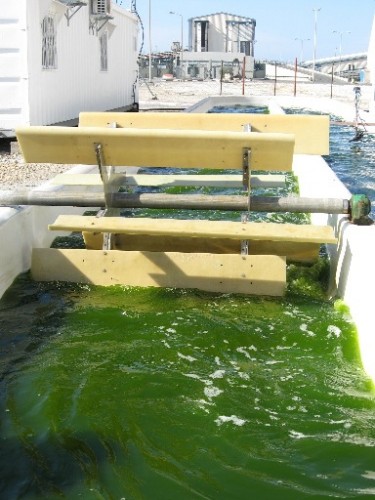
  • Focus on innovative technologies. Think algae rather than fibre or bulk.

At a more philosophical level, we need to get away from the mindset (driven by the oil or energy industry) that energy consumption will continue at existing or higher levels, and that this insatiable demand needs to be met somehow. Instead, we should focus on energy conservation (both active and passive, e.g. green building technologies), truly renewable energy sources and a massive shift away from private to public transport. In a nutshell, shifting to simply living in a more sustainable way; supporting the changes that millions of individuals, companies and (especially) the lower tiers of government worldwide have begun making in their lives and day-to-day operations.

The “desert island” need not and should not become a factory farm for producing bio-fuel.

Photo:www.seambiotic.com

:: Top economist: Bio-fuels may lead to land shortages

Read more on biofuel:

Kaiima Doubles Chromosomes To Make More Plant Power
Biofuels Spark Regional Cooperation Between Israel, Palestinians and Germany
Algae Into Biofuel a Greener Story In $10 Million Joint Israeli and Chinese Project
German Firm to Invest in Green Israeli Jet Fuel From Algae


Russel Cohen
Russel Cohenhttp://blog.maskil.info
Russell became interested in the intersection between Judaism, Zionism and the environment as a teenager in the 70s, reinforced by a year as a kibbutz volunteer in the early 80s. That interest took a back seat to the need to earn a living, and he spent the next several decades in corporate IT with one of the Big 4 banks in South Africa. He has returned to his first love by writing on Jewish affairs, the environment and technology as a blogger and freelance writer, while also providing support to small office/home office (SOHO) computer users. He writes under the screen name Maskil and tries to collect his thoughts here (http://blog.maskil.info). Russell lives in the urban village of Norwood in Johannesburg with his wife and daughter. Russell can be reached at russell (at) greenprophet (dot) com.

LEAVE A REPLY

Please enter your comment!
Please enter your name here

TRENDING

Astro uses AI to help procure land for renewable energy

For oil-rich, environmentally vigilant Gulf states, Astro isn’t just another startup story. It is a blueprint for accelerating an energy transition that is now existential, not optional.

Earth building with Dead Sea salt bricks

Researchers develop a brick made largely from recycled Dead Sea salt—offering a potential alternative to carbon-intensive cement.

Farm To Table Israel Connects People To The Land

Farm To Table Israel is transforming the traditional dining experience into a hands-on journey.

Remilk makes cloned milk so cows don’t need to suffer and it’s hormone-free

This week, Israel’s precision-fermentation milk from Remilk is finally appearing on supermarket shelves. Staff members have been posting photos in Hebrew, smiling, tasting, and clearly enjoying the moment — not because it’s science fiction, but because it tastes like the real thing.

An Army of Healers Wins the 2025 IIE Goldberg Prize for Peace in the Middle East

In a region more accustomed to headlines of loss than of listening, the Institute of International Education (IIE) has chosen to honor something quietly radical: healing. The 2025 Victor J. Goldberg Prize for Peace in the Middle East has been awarded to Nitsan Joy Gordon and Jawdat Lajon Kasab, the co-founders of the Army of Healers, for building spaces where Israelis and Palestinians — Jews, Muslims, Christians, Druze, and Bedouins — can grieve, speak, and rebuild trust together.

Qatar’s climate hypocrisy rides the London Underground

Qatar remains a master of doublethink—burning gas by the megaton while selling “sustainability” to a world desperate for clean air. Wake up from your slumber people.

How Quality of Hire Shapes Modern Recruitment

A 2024 survey by Deloitte found that 76% of talent leaders now consider long-term retention and workforce contribution among their most important hiring success metrics—far surpassing time-to-fill or cost-per-hire. As the expectations for new hires deepen, companies must also confront the inherent challenges in redefining and accurately measuring hiring quality.

8 Team-Building Exercises to Start the Week Off 

Team building to change the world! The best renewable energy companies are ones that function.

Thank you, LinkedIn — and what your Jobs on the Rise report means for sustainable careers

While “green jobs” aren’t always labeled as such, many of the fastest-growing roles are directly enabling the energy transition, climate resilience, and lower-carbon systems: Number one on their list is Artificial Intelligence engineers. But what does that mean? Vibe coding Claude? 

Somali pirates steal oil tankers

The pirates often stage their heists out of Somalia, a lawless country, with a weak central government that is grappling with a violent Islamist insurgency. Using speedboats that swarm the targets, the machine-gun-toting pirates take control of merchant ships and then hold the vessels, crew and cargo for ransom.

Leopoldo Alejandro Betancourt López Turned Ocean Plastic Into Profitable Sunglasses

Few fashion accessories carry the environmental burden of sunglasses. Most frames are constructed from petroleum-based plastics and acrylic polymers that linger in landfills for centuries, shedding microplastics into soil and waterways long after they've been discarded. Leopoldo Alejandro Betancourt López, president of the Spanish eyewear brand Hawkers, saw this problem differently than most industry executives.

Why Dr. Tony Jacob Sees Texas Business Egos as Warning Signs

Everything's bigger in Texas. Except business egos.  Dr. Tony Jacob figured...

Israel and America Sign Renewable Energy Cooperation Deal

Other announcements made at the conference include the Timna Renewable Energy Park, which will be a center for R&D, and the AORA Solar Thermal Module at Kibbutz Samar, the world's first commercial hybrid solar gas-turbine power plant that is already nearing completion. Solel Solar Systems announced it was beginning construction of a 50 MW solar field in Lebrija, Spain, and Brightsource Energy made a pre-conference announcement that it had inked the world's largest solar deal to date with Southern California Edison (SCE).

Related Articles

Popular Categories