

A New Solar Energy Source from the Common Pea

pea pod solar energyAn Israeli scientist has found a way to pull solar energy from pea plants.

If harnessing the unlimited solar power of the sun were easy, we wouldn’t still have the greenhouse gas problem that results from the use of fossil fuel. And while solar energy systems work moderately well in hot desert climates, they are still inefficient and contribute only a small percentage of the general energy demand. A new solution may be coming from an unexpected source — a source that may be on your dinner plate tonight. Peas!

“Looking at the most complicated membrane structure found in a plant, we deciphered a complex membrane protein structure which is the core of our new proposed model for developing ‘green’ energy,” says structural biologist Prof. Nathan Nelson of Tel Aviv University’s Department of Biochemistry. Isolating the minute crystals of the PSI super complex from the pea plant, Prof. Nelson suggests these crystals can be illuminated and used as small battery chargers or form the core of more efficient man-made solar cells.

Nanoscience is the science of small particles of materials and is one of the most important research frontiers in modern technology. In nature, positioning of molecules with sub-nanometer precision is routine, and crucial to the operation of biological complexes such as photosynthetic complexes. Prof. Nelson’s research concentrates on this aspect.

The mighty PSI

To generate useful energy, plants have evolved very sophisticated “nano-machinery” which operates with light as its energy source and gives a perfect quantum yield of 100%. Called the Photosystem I (PSI) complex, this complex was isolated from pea leaves, crystalized and its crystal structure determined by Prof. Nelson to high resolution, which enabled him to describe in detail its intricate structure.

“My research aims to come close to achieving the energy production that plants can obtain when converting sun to sugars in their green leaves,” explains Prof. Nelson (below).
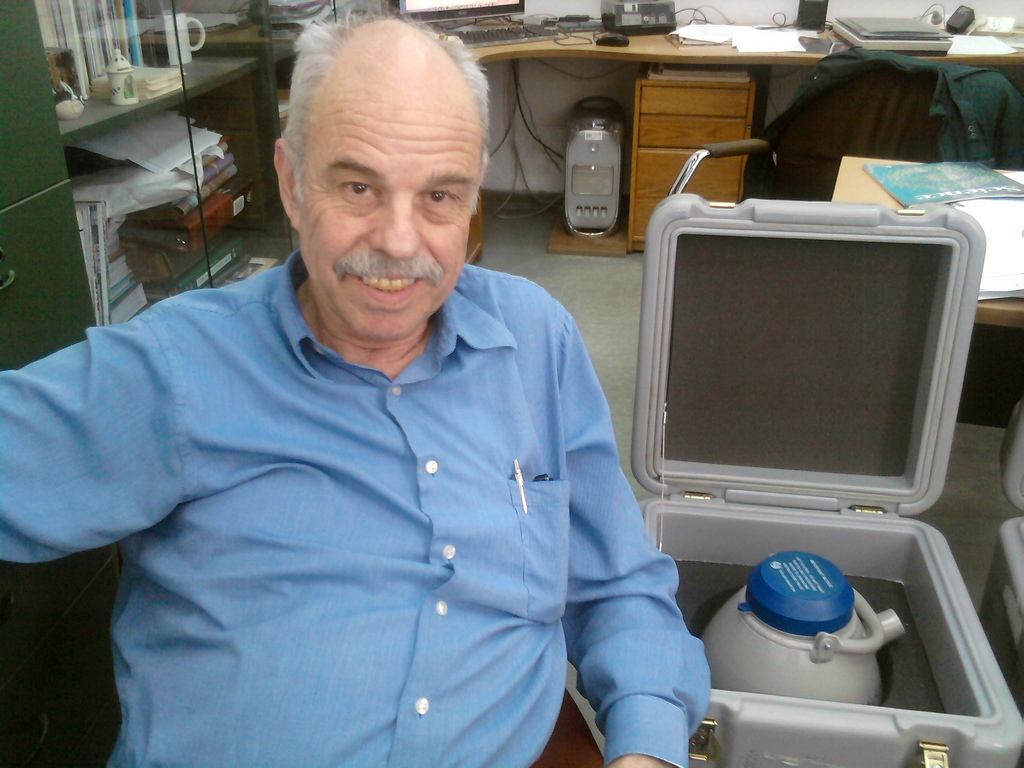
pea pod solar energy

Described in 1905 by Albert Einstein, quantum physics and photons explained the basic principles of how light energy works. Once light is absorbed in plant leaves, it energizes an electron which is subsequently used to support a biochemical reaction, like sugar production.

“If we could come even close to how plants are manufacturing their sugar energy, we’d have a breakthrough. It’s therefore important to solve the structure of this nano-machine to understand its function,” says Prof. Nelson, whose lab is laying the foundations for this possibility.

Since the PSI reaction center is a pigment-protein complex responsible for the photosynthetic conversion of light energy to another form of energy like chemical energy, these reaction centers, thousands of which are precisely packed in the crystals, may be used to convert light energy to electricity and serve as electronic components in a variety of different devices.

“One can imagine our amazement and joy when, upon illumination of those crystals placed on gold covered plates, we were able to generate a voltage of 10 volts. This won’t solve our world’s energy problem, but this could be assembled in power switches for low-power solar needs, for example,” he concludes.

1 COMMENT
  1. Kind of reminds me of the movie, Avatar, where plants created their own light and glowed at night. “Light without heat”.

Comments are closed.

TRENDING

Batteries from salt? New grid projects suggest the idea is becoming real

Peak Energy makes storage batteries from salt making us one step closer to cleaner, endless energy from the wind and the sun

Eco organization offices destroyed by Iran missile

Tel Aviv's eco organization, the Heschel Center, was impacted by an Iranian missile.

What are AWG air-water generators, and why they aren’t a golden-bullet solution (yet)

Atmospheric water generators (AWGs) sound like magic: machines that can pull drinking water out of air. The idea is mentioned in the Bible, where the elders would pray for water collected as dew on plants and the catch on turning this into a machine is in the physics. To turn invisible vapor into liquid, you must remove heat, especially the latent heat of condensation.

Jordan’s $6 Billion Aqaba–Amman Desalination Project from the Red Sea Moves Forward

In 2025, the Jordanian government signed agreements with a consortium led by Meridiam and SUEZ, alongside VINCI Construction and Orascom Construction. Under a 30-year concession agreement, the consortium will design, build, finance, operate, and maintain the system before transferring it back to the Jordanian government. The total investment is estimated at approximately $6 billion USD.

The Saudi Startup Turning Desalination’s Toxic Waste Into Its Own Disinfectant

For millennia, the Middle East's water crisis seemed an immutable fact of geography — a region defined as much by what it lacked as by what lay beneath its sands. Today, a convergence of plummeting solar costs, advancing membrane technology, and hard-won engineering expertise is rewriting that story.

Should You Invest in the Private Market?

startustartup Unlike public stock exchanges, which offer daily trading, strict...

How to build a 100-year-company

Kongō Gumi is a Japanese construction company, purportedly founded in 578 A.D., making it the world's oldest documented company. What can we learn about building sustainable businesses from them?

From Pilot Plant to Global Stage: How Aduro Clean Technologies’ 2026 Expansion Signals a Turning Point for Chemical Recycling Investors Like Yazan Al Homsi

The company's Next Generation Process (NGP) Pilot Plant in London, Ontario, has officially moved into initial operating campaigns, generating the kind of structured, repeatable data that separates laboratory promise from commercial viability.

How AI Helps SaaS Companies Reduce Repetitive Customer Support Work

SaaS products are designed for large numbers of users with different levels of experience, and also in renewable energy.

Pulling Water from the Air

Faced with water shortage in Amman, Laurie digs up...

Turning Your Energy Consultancy into an LLC: 4 Legal Steps for Founders in Texas

If you are starting a renewable energy business in Texas, learn how to start an LLC by the books.

Tracking the Impacts of a Hydroelectric Dam Along the Tigris River

For the next two months, I'll be taking a break from my usual Green Prophet posts to report on a transnational environmental issue: the Ilısu Dam currently under construction in Turkey, and the ways it will transform life along the Tigris River.

6 Payment Processors With the Fastest Onboarding for SMBs

Get your SMB up and running fast with these 6 payment processors. Compare the quickest onboarding options to start accepting customer payments without delay.

Related Articles

Popular Categories