Japan and Saudi Arabia Plan Giant Desalination Equipment Plant to "Freshen Up" Regional Water Supplies

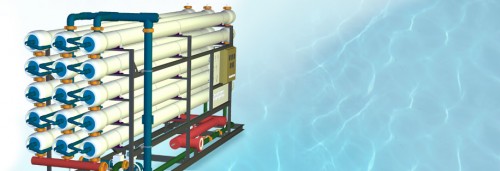
saudi arabia desalination plant with japan image Revese osmosis membrane equipment will help quench thirst of oil rich, but water-poor Saudi Arabia.

Saudi Arabia has been in the news a lot in regards to building desalination facilities, on which the Kingdom depends for most of its fresh water supplies. This includes what has been hailed as the worlds’ largest desalination facility in the Jubail Industrial Zone, on the shores of the Persian Gulf. But now, something different is in the works, as the Kingdom has reached an agreement  with two Japanese companies, Toyobo, and Itochu corporation, to build a plant in Saudi Arabia to construct the equipment used in the desalination plants, making it much easier to construct new water producing facilities as needed.

The new plant will be called the Arabian Japanese Membrane Company, and will combine the expertise of Toyobo, an expert in the manufacture of desalination membrane material with that of Itochu, which builds large manufacturing facilities. The two Japanese companies will work together with the Saudi infrastructure developer ACWA Holding to construct the plant, which will be located 150 km north of the port city of Jeddah in the Rabigh Technical Park on the Red Sea Coast.

Construction is scheduled to begin in 2011, and when completed, the company will manufacture reverses osmosis membrane elements for seawater desalination for the Kingdom’s increasing desalination needs. The technology in the plant will include  using “hollow fiber” membranes which are not only used extensively in desalination, but in other uses as well, including the medical field (blood fractionation), water purification, gas separation,  and azeotropic mixture separation using pervaporation.

Toyobo’s famous membranes technology is already utilized in most of the largest desalination plants in the Middle East; and boasts 80% of the seawater desalination membrane market in Saudi Arabia and over half the share in the Middle East/Gulf region. The third partner ITOCHU has considerable experience building seawater desalination plants in Saudi Arabia since 1970’s.

Estimated total investment in the giant facility will be around $352 million and will be the first plant of its kind to manufacture reverse osmoses desalination elements in the MENA region.

While this idea will be a big boost to the region’s ability to produce fresh water from desalination, little mention was made as to what power source will be used to manufacture these membranes, as well as to power future desalination themselves. We did mention the idea of using solar power for desalination plants in a previous article, however, in which the Kingdom is planning to integrate solar energy to power future desalination facilities, and is in line with the Kingdom’s desire to become a member of the international renewable energy group IRENA.

But the new venture between Saudi Arabia and Japan, does point the importance of international cooperation in projects which will help increase the supply of fresh water supplies to a region where this resource is sorely lacking.

:: desalt.net/

More articles on Saudi Clean Tech and Desalination Projects:

Saudi Arabia Opens World’s Largest Desalination Plant

Saudi Arabia to Use Solar Energy to Power Desalination Plants

DOW Chemical and Saudi Arabia’s KAUST University Vow to Clean Up Environment

Maurice Picow
Maurice Picowhttps://www.greenprophet.com/
Maurice Picow grew up in Oklahoma City, U.S.A., where he received a B.S. Degree in Business Administration. Following graduation, Maurice embarked on a career as a real estate broker before making the decision to move to Israel. After arriving in Israel, he came involved in the insurance agency business and later in the moving and international relocation fields. Maurice became interested in writing news and commentary articles in the late 1990’s, and now writes feature articles for the The Jerusalem Post as well as being a regular contributor to Green Prophet. He has also written a non-fiction study on Islam, a two volume adventure novel, and is completing a romance novel about a forbidden love affair. Writing topics of particular interest for Green Prophet are those dealing with global warming and climate change, as well as clean technology - particularly electric cars.

TRENDING

Forever chemicals banned from Europe’s drinking water

The EU is taking a bold step in making sure all European Union member states worked to monitor and reduce PFAS levels in drinking water.

Australian camels fly on a plane to Saudi Arabia

Australia has the largest population of feral camels in the world. Some get repatriated to Saudi Arabia.

Play spogomi the garbage picking sport and win a World Cup

If the future of environmental action looks less like a lecture and more like a pickup game, that might not be a bad thing at all.

Seaweed fashion brands can source from Saudi Arabian sea

From Red Sea seaweed to runway-ready fabric, Saudi Arabia is quietly reshaping fashion’s material future. KAUST scientists, designers, and textile innovators are proving that sustainability can begin in local ecosystems. As seaweed becomes wearable, fashion is learning to grow not from fields — but from tides.

The Line’s 15 minute city failure and the limits of green futurism

The failure of The Line is not a failure of imagination. It is a failure of restraint by western architects and planners who go along with the charade. Who is holding these firms accountable? This is actually a reasonable kind of project for the UN to take on and challenge. 

Turning Your Energy Consultancy into an LLC: 4 Legal Steps for Founders in Texas

If you are starting a renewable energy business in Texas, learn how to start an LLC by the books.

Tracking the Impacts of a Hydroelectric Dam Along the Tigris River

For the next two months, I'll be taking a break from my usual Green Prophet posts to report on a transnational environmental issue: the Ilısu Dam currently under construction in Turkey, and the ways it will transform life along the Tigris River.

6 Payment Processors With the Fastest Onboarding for SMBs

Get your SMB up and running fast with these 6 payment processors. Compare the quickest onboarding options to start accepting customer payments without delay.

Qatar’s climate hypocrisy rides the London Underground

Qatar remains a master of doublethink—burning gas by the megaton while selling “sustainability” to a world desperate for clean air. Wake up from your slumber people.

How Quality of Hire Shapes Modern Recruitment

A 2024 survey by Deloitte found that 76% of talent leaders now consider long-term retention and workforce contribution among their most important hiring success metrics—far surpassing time-to-fill or cost-per-hire. As the expectations for new hires deepen, companies must also confront the inherent challenges in redefining and accurately measuring hiring quality.

8 Team-Building Exercises to Start the Week Off 

Team building to change the world! The best renewable energy companies are ones that function.

Thank you, LinkedIn — and what your Jobs on the Rise report means for sustainable careers

While “green jobs” aren’t always labeled as such, many of the fastest-growing roles are directly enabling the energy transition, climate resilience, and lower-carbon systems: Number one on their list is Artificial Intelligence engineers. But what does that mean? Vibe coding Claude? 

Somali pirates steal oil tankers

The pirates often stage their heists out of Somalia, a lawless country, with a weak central government that is grappling with a violent Islamist insurgency. Using speedboats that swarm the targets, the machine-gun-toting pirates take control of merchant ships and then hold the vessels, crew and cargo for ransom.

Related Articles

Popular Categories