
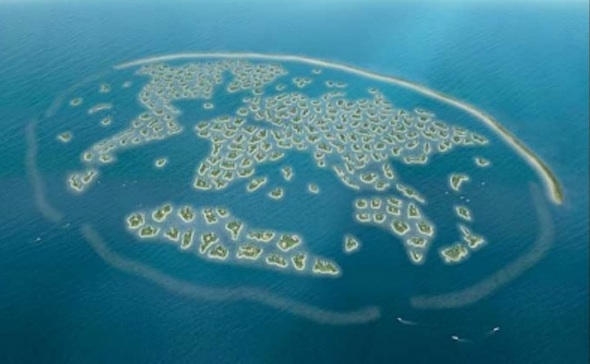

 Projects like Dubai’s “The World” will cause untold damage of shoreline erosion and habitat loss. So do modern ports, threatening endangered species. But there are solutions, says US expert.
Coastal waters are evolutionary hotspots, says Jerry Berne, a shoreline expert from the NGO Sustainable Shorelines in the US. Based in Charlotte, NC, USA, Berne is concerned about the toll construction and shoreline projects are having on the world’s marine ecosystems. Looking at the intensive construction projects ongoing in the Gulf region, such as Dubai’s The World, and over-pumping of aquifers by the Palestinian and Israeli authorities, Berne sees our current management of shorelines as a disaster. In an interview with Green Prophet, Berne points out the problems in the Middle East and gives alternative solutions, such as offshore ports powered by solar energy, to stop soil erosion and habitat loss.
1. Please tell us a little more about you and your interest in soil erosion.
I was an architect who, upon experiencing the rapid erosion of a favorite beach in the mid-1990’s, began to investigate its causes and possible mitigation options. The more I discovered the more concerned I became for the damage being done to our coastal resources by man’s activities.
 I volunteered to work with North Carolina’s famed environmentalist and nature photographer Hugh Morton in his efforts to save the Cape Hatteras Lighthouse in its powerful place by the sea.
Mr. Morton also owned Grandfather Mountain, a major natural tourist attraction and a UN Biosphere Reserve site. Mr. Morton advocated using an environmentally sound and sustainable method of coastal erosion mitigation, Holmberg Technologies, to protect the Lighthouse and to demonstrate this method’s suitability to preserve other coastal habitats.
This effort failed in a large part due to the influence of the US Army Corps of Engineers (major dredging advocates) as well as some who strongly supported abandoning our coastal resources to the sea. Given the evidence of man’s impact on these, this was/is an irrational and un-environmentally sound position.
From my architectural education, I could readily see the problem of overdevelopment in habitat loss and pollution. What was not so obvious was what was mostly hidden from us underwater: the navigational channels, offshore aggregate mining, erosion “control” and navigational structures. These with changes to our river systems –channelization, dams, etc.– also impacted our coastlines ability to “heal” itself from the natural erosion caused by storms and incremental sea level rise.
As my perspective is mainly from “on the beach”, my answers on soil erosion are going to embrace the often ignored erosion crisis on our shorelines. To encourage more attention to this crisis, I work with other organizations with similar goals as the UK’s FOE/MARINET group (http://marinet.org.uk/) and have participated in research programs including the EU’s Soil Protection Issue Group’s contribution to its Environmental Technologies Action Plan.
2. What are some of the root causes of soil erosion and why is this a concern in the Gulf Region?
The Gulf region shares this problem with any other area with coastlines. It also has been very active in dredging for both navigation and land reclamation (see Answer 5). As such, its shorelines are experiencing much habitat loss both on and offshore. This activity can also impact fresh water resources (see Answer 3), a critically scarce Gulf resource.
While many do not necessarily consider coastal erosion when thinking of the phrase “soil erosion”, it is imperative that we began to do this. Not only are we losing expensive real estate and tourism economics, we are losing habitat.
Our coastal habitats –deltas, estuaries, wetlands, reefs — are also our sealife nurseries from which most of our commercial fishing resources are derived. We must consider the commercial aspects of our shorelines as this seems to be the major concern of those with the power to actually implement policies and practices to mitigate manmade coastal erosion.
Perhaps the greatest contributor to this erosion is dredging. In our efforts to facilitate commercial –even recreational– navigation, we have changed nature and not adapted our vessels to it. Altering coastal waterways, inlets and bays also alters current and wave patterns. These are often accelerated and redirected creating what amounts to hydraulic mining along our coastal landforms scouring these away. Much of the sediment from these is flumed far offshore and out of the littoral systems.
To “mitigate” this loss, the same engineering firms and marine construction companies who dredged these initially are often hired to replace the lost shoreline with sand from these excavations or mined from the offshore. Either way, this process actually accelerates erosion such that beach “nourishment” is, in truth, a starvation diet. Sand fill derived from navigational dredging of a channel or inlet can be tainted with pollutants, it changes currents and flumes much of the naturally replenishing sediments far offshore and out of the littoral systems. If the fill is mined (stripped-mined) from offshore, naturally storm energy damping shoals are removed allowing more energy to strike the shoreline creating more ecological and economic damage. Both processes can deepen the nearshore
3. What kinds of effects can we expect to see in the marine and land environment if too much erosion takes place?
The most obvious the loss of the dry beach and dunes often with the accompaniment of manmade structures. What we do not see is the undersea side of this with changes to shoal and reef fish habitats. Eroding shorelines typically mean more sedimentation in the form of silts and fines. These can smother seabed and reef habitats.
The changes in salinity as land barriers erode effect wetlands and estuaries by altering critical sealife chemical balances. This also allows the loss of coastal fresh water aquifers to salt water infiltration effecting plants and, of course, human potable water sources. Salinization becomes even more problematic as climate change lessened rainfall reduces river flows and groundwater recharge. We must consider that the shallow deltas and inlets which once constrained the outward flow of fresh water and held the salt sea at bay are now hydraulic super highways thanks to dredging.
One of the most symbolic environmental concerns to many are sea turtle losses and the Gulf is home to the endangered green turtle. These are being lost to fishing operations, native food traditions and the ingestion of solid and chemical pollutants. Equally critical is the loss of habitat to development, erosion and the indiscriminate use of beach “nourishment” projects to “restore” beaches which are nesting grounds.
The fill sand may provide a temporary dry beach for nesting, but the fill is often incompatible to the original beach’s naturally acquired sand and alters the survival of the baby turtles through changes in sand temperature, compaction and irregular scarping.
4. How could overbuilding and climate change exacerbate soil erosion?
Overbuilding or over-development can impact erosion by destroying parts of our natural shorelines’ abilities to protect itself. The loss of sand dunes, the filling of wetlands and traditionally engineered shore “protection” structures to “protect” this development all contribute to the further loss of shoreline.
One of the most insidious methods to protect this development is the heavy promotion of beach “nourishment” as a rational method. Both navigational dredging and offshore aggregate mining weaken our natural shoreline defenses (beaches, shoals, reefs, etc.) by removing naturally replenishing sediments to deep water and by actually deepening the nearshore allowing more wave energy to strike the shoreline. We must remember that we only see the loss of dry beach, not the massive amount of near and off shore that is removed before this occurs.
Climate change is anticipated to cause rapid (in geologic terms) sea level rise and increased storm intensities. The manmade changes to our coastlines have severely weakened our natural coastal defenses’ ability to mitigate and slow the impacts of climate changes –itself the major manmade change encompassing the entire earth.
5. What Middle East countries are at risk?
The loss of coastal barrier lands to erosion and the dredging of deep channels far inland allows salt water to infiltrate any fresh ground water and aquifers contiguous to these. This is exacerbated by over-pumping these sources for potable water and agricultural as is happening in Israel and the Palestinian territories.
Salt water is also effecting agricultural lands in the critical Nile River delta. This is due to both the loss of fresh, unpolluted water and its rapid erosion. This erosion is due in part to the loss of sediment now trapped behind the Aswan Dam. Channel dredging and sea level rise accelerate this loss.
Again, dredging is a major component of our coastal erosion crisis whether is for navigation or seabed strip-mining for construction fill or aggregates. Even so, MENAFN has several articles on recent efforts to expand dredging and coastal construction in the Mideast.
These include $629 million to construct four artificial islands off Abu Dhabi; Saudi Arabia welcoming its new dredging ship, the largest of its kind in the world, for coastal construction; plans for a new Suez Canal entrance channel; Haifa harbor mining for construction aggregates; $200 million for port dredging/construction at Sohar, Oman; etc.
There has even been a scheme proposed to expand Israel/Palestinian lands by filling in the eastern Mediterranean with dredged fill from it!
All of this puts sealife habitats at risk such as the Gulf’s reefs. A new study on the effects of climate change and coral reefs is just being released by the UK’s University of Exeter. While it states that reefs in marine reserves can recover from global warming, it also states that these also protect the reefs from “potentially-damaging human activity, like dredging and fishing.”
Even more interestingly, this study was funded by the Khaled bin Sultan Living Oceans Foundation (whose website video show’s its founder exploring a reef). Astonishingly, we are already aware of the severe stress on Gulf reefs due to sedimentation from erosion or fines and silts from the dredging there. We should also be aware that that reefs were just declared “evolutionary hot spots” in a new research report from Germany’s Humboldt University.
6. What measures can be done to stop this from happening.
We must become more aware of our impact on coastal environments. Just as we once thought the sea too vast for us to harm with our discards and pollutants, we now know our actions can effect the entire planet. We would not accept environmentally disastrous strip-mining or canyon digging on our lands; we must not accept it in our waters. Unfortunately, we still accept paving over our coastal resources.
To reduce the need for navigational dredging and structures, we need a new vision for our commercial shipping industry which is, in many ways, “back to the future”. While deeply dug navigational channels may extend inland several kilometers, these can extend seaward tens of kilometers to reach deep water.
By engineering new, technologically advanced offshore ports, we could remove the major man-made erosion cause from our coastlines. Current/wave, wind and solar energy might power these.
The super-deep draft vessels of today and even larger ones of tomorrow could ply the oceans between these drill-platform style island ports where each’s cargo could be handled robotically and even have it security checked.
This cargo could be transferred to coastal vessels (as once was done) which are designed for our coastal waterways rather than re-engineering our waterways for massive ships. This could help our coastlines to heal naturally as well as create more ports of entry spreading coastal economies –and jobs– all along our coastlines. This would also reduce port pollution and potentially reduce land transportation costs and pollution.
To help with this coastal healing, we must adopt proven erosion mitigation technology. One of its most successful implementations of these is in the Middle East. In 1999/2000, Holmberg Technologies installed one of its Undercurrent Stabilizers Systems at Ras Tanura, Saudi Arabia for Aramco.
The site was one where dredging and all other engineered methods, including a massive boulder/concrete seawall, had failed to stop the erosion threatening a housing complex. This erosion was caused by the oil loading terminal east of the site which created a sand starved area in the shadow of its long structures.
After seeing its housing complex again threatened, the Aramco housing authority overruled its engineers and employed Holmberg’s passive, permanent method to halt the erosion. Within weeks of its completion, the beach had expanded by 20 meters and elevated by 2 covering sections of the remaining seawall. The shoreline continues to expand.
This demonstration is important in that it shows that we can mitigate much of our current self-inflicted shore wounds with an existing technology –shown to be environmentally sound and sustainable– even in areas thought to be sand starved. As importantly, it is considerably less expensive to the environment and government economies than the beach nourishment and traditionally engineered projects sold by engineering firms and international dredging companies. Holmberg’s work is shown to shallow the nearshore while expanding the dry beach and backshore dunes. It also is shown to elevate the shoreline –an important attribute as sea levels rise.
There are a myriad of other methods which are proposed or which have been attempted, though not necessarily successfully. These include beach dewatering (which might be problematic to coastal aquifers), artificial offshore reefs/breakwaters, semi-permeable netting to catch sand, etc. There is even one method which is a biochemical designed to neutralize pollutants which may cause sand to flow more freely thus allow beaches to erode faster. To date, however, Holmberg remains the only method with any long-term, credible evidence of success including university research, professional monitoring reports and over 30 years of empirical evidence.
In the 1960’s, a dam project on the Amazon River threaten to drown a huge population of indigenous animals as the water rose behind the dam. Biologists called for help to save those trapped with the alarming message, “Time is short and the water rises.” Now the water rises for all of us.
Sustainable Shorelines is a nonprofit corporation dedicated to documenting current environmental events on our shorelines, identifying and seeking to change those coastal policies and practices which are harmful and advocating protecting our coastal habitats and the ecosystems these support with methods proven to be environmentally sound and sustainable.



[…] Coastal Erosion Threatens Evolutionary Hotspots In Gulf Region – What are some of the root causes of soil … do not necessarily consider coastal erosion when thinking of the phrase “soil erosion”, it is imperative that we began to do this. Not only are we losing expensive real estate and tourism economics, we … […]
[…] Coastal Erosion Threatens Evolutionary Hotspots In Gulf Region – What are some of the root causes of soil erosion … not necessarily consider coastal erosion when thinking of the phrase “soil erosion”, it is imperative that we began to do this. Not only are we losing expensive real estate and tourism economics … […]
[…] to media reports it looks like the crazy plan is going ahead despite environmental risks to the fragile Mediterranean Sea, and security risks of […]
[…] to media reports it looks like the crazy plan is going ahead despite environmental risks to the fragile Mediterranean Sea, and security risks of […]
[…] especially in the face of unknowns such as rising sea levels brought on by climate change. Eroding coastlines, pollution and the big black holes of unknown marine ecosystems lying in the depths of the […]
[…] especially in the face of unknowns such as rising sea levels brought on by climate change. Eroding coastlines, pollution and the big black holes of unknown marine ecosystems lying in the depths of the […]
[…] of various up-scale residential developments (Qatar’s resorts and Dubai’s Islands), it is at growing risk from environmental degradation. According to a report by scientists at the United Nations University Institute for Water, […]
[…] from Dubai in the United Arab Emirates tended to be dominated by new construction projects being announced or more recently debts levels, but it seems that the government is making a serious push to promote […]
[…] large real estate projects in both Abu Dhabi (Al Rheem Island); and in neighboring Dubai, where coastal erosion is taking its toll on the region’s […]
[…] from commercial fish farming and silt from coastal destruction takes its toll on marine life – we've already learned about the effects of coastal erosion in this evolutionary hotspot, so why the big question of where the corals are. Human activity have killed […]
[…] commercial fish farming and silt from coastal destruction takes its toll on marine life – we’ve already learned about the effects of coastal erosion in this evolutionary hotspot, so why the big question of where the corals are. Human activity have killed […]
[…] environmental issues: Jordan and Israeli Scientists Cooperate to Study and Protect Gulf of Aqaba Coastal Erosion Threatens Evolutionary Hot Spots in Gulf Region Garbage Trucks Dump Straight into the Sea in Lebanon AKPC_IDS += "19110,";Browse topics: […]
[…] other less concerned individuals in the UAE who construct grandiose development projects such as Dubai’s “The World” which is threatening marine and coastal eco-structures; as well as Abu Dhabi’s Al Reem Island […]
[…] Coastal Erosion Threatens Evolutionary Hotspots In Gulf Region The loss of coastal barrier lands to erosion and the dredging of deep channels far inland allows salt water to infiltrate any fresh ground water and aquifers contiguous to these. This is exacerbated by over-pumping these sources for potable water and agricultural as is happening in Israel and the Palestinian territories. […]