

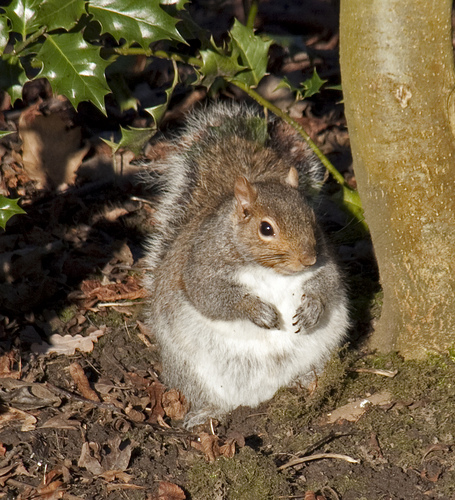
Some animals, it seems, are going on a diet, while others have expanding waistlines.
It’s likely these are reactions to rapidly rising temperatures due to global climate change, speculates Prof. Yoram Yom-Tov of Tel Aviv University, who has been measuring the evolving body sizes of birds and animals in areas where climate change is most extreme.
Changes are happening primarily in higher latitudes, where Prof. Yom-Tov has identified a pattern of birds getting smaller and mammals getting bigger, according to most of the species he’s examined. The change, he hypothesizes, is likely a strategy for survival. Prof. Yom-Tov, who has spent decades measuring and monitoring the body sizes of mammals and small birds, says that these changes have been happening more rapidly.
His most recent paper on the topic, focused on the declining body sizes of arctic foxes in Iceland, appeared in Global Change Biology.
Radical changes in body size
Animal populations in a wide variety of geographical areas — birds in the UK, small mammals in the arctic, and most recently foxes, lynx and otters in cold Scandinavian regions — are adapting to a shift in rising temperatures. Where temperature changes are most radical, such as those at higher latitudes, Prof. Yom-Tov has measured the most radical changes of these animals’ body size over time.
“This change can be seen as an early indicator of climate change,” says Prof. Yom-Tov. “There is a steady increase of temperatures at higher latitudes, and this effect — whether it’s man-made or natural — is having an impact on the animals living in these zones.”
In his most recent paper, Prof. Yom-Tov and his Tel Aviv University colleague Prof. Eli Geffen report that arctic foxes are being influenced by changing water currents in the oceans. These changes, likely a result of climate change, affects the foxes’ food supplies. Hydrologists are confounded as to why the shifts in currents are happening, but the effect in foxes is evident: their bodies are changing along with the changing currents.
Scientists are finding changes in animals’ bodies across the whole animal kingdom. “Climate change is affecting migration patterns and the behavior and growth of birds, mammals, insects, flowers — you name it,” says Prof. Yom-Tov. “The global warming phenomenon is a fact.” What we do with this information may change our world.
Adapting to survive
Whether or not human beings are primarily responsible for climate change, Prof. Yom-Tov says, science shows that plants and animals are rapidly evolving in response to these changes. Smaller bodies allow mammals, for example, to cope with warmer temperatures, since a smaller body size gives the body a proportionally increased surface area for the dissipation of heat, he says.
“These animals need to adapt themselves to changing temperatures. In some regions the changes are as large as 3 or 4 degrees centigrade,” says Prof. Yom-Tov. “If they don’t adapt, their numbers may decline. If they do, their numbers remain stable or even increase.”
Prof. Yom-Tov’s method accesses many years’ worth of data, comparing bones and skulls that natural history museums and individuals have collected over decades. He measures body sizes by studying various features (cranial size, for example) and then statistically analyzes how they have evolved.



Some animals, it seems, are going on a diet, while others have expanding waistlines. It's likely these are… http://reduce.li/zoren7 #cope
Animals Cope With Climate Change At the Dinner Table | Green Prophet http://bit.ly/b1fV2H
Animals Cope With Climate Change At the Dinner Table | Green Prophet http://bit.ly/aJ1LLW
TAU researcher observes how animals are quickly responding to climate change: http://bit.ly/adDqhZ
RT @GreenProphet Animals Cope With Climate Change At the Dinner Table http://bit.ly/ayrpBA
Animals Cope With Climate Change At the Dinner Table | Green Prophet http://bit.ly/aK2z3f
Animals Cope With Climate Change At the Dinner Table | Green Prophet http://bit.ly/d9GC79
Animals Cope With Climate Change At the Dinner Table | Green Prophet: Some animals, it seems, are going on a diet,… http://bit.ly/9mkMNq
Animals Cope With Climate Change At the Dinner Table http://tinyurl.com/y9m2d28
RT @greenprophet Animals Cope With Climate Change At the Dinner Table http://bit.ly/dpev7q