
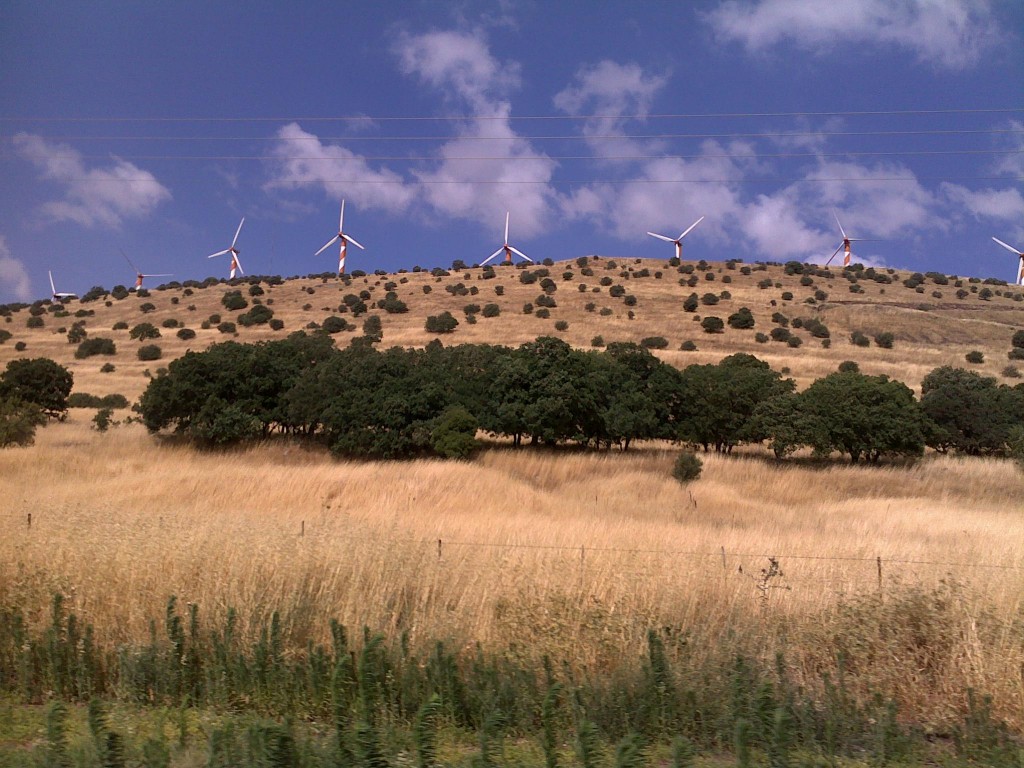

 Israeli-built wind farm on the Israeli-occupied Golan Heights. Israeli Syrian expert skeptical that nature Peace Park on Golan Heights would bring peace.
We’d reported last month on the Peace Parks conference hosted by Tel Aviv University. The idea is to create a nature reserve out of the occupied Golan Heights now under Israel sovereignty, and to return the land to Syria, of which one third would be a peace park and nature reserve open to both Syrians and Israelis.
Could a Peace Park use nature and our natural environment to broker peace between Syria and Israel? Tel Aviv University’s Syrian expert Prof. Eyal Zisser doesn’t think so. Here’s a Q&A from Prof. Eyal Zisser, head Moshe Dayan Center for Middle Eastern and African Studies, thinks about the concept:
Rounds of indirect talks between Syria and Israel ended without resolution in 2008. To re-open a channel, Tel Aviv University hosted a conference last month to explore the possibility of a Syrian-Israeli Peace Park.
The proposed park would turn one-third of the disputed Golan Heights into a nature reserve to be managed by Syria and enjoyed by both Syrians and Israelis. The remaining two-thirds, now under Israeli sovereignty, would be returned to Syria. Sponsored by the U.S. Embassy in Israel, the conference sessions attracted a full house of academics, politicians, NGO leaders and diplomats from countries across a diverse spectrum of opinion and expertise.
Prof. Eyal Zisser, head of Tel Aviv University’s influential think tank The Moshe Dayan Center for Middle Eastern and African Studies, appeared at the conference. He approves the positive thinking of proponents of the Peace Park, but finds it hard to see the project becoming a reality. An internationally renowned analyst of Syrian-Israel relations, Prof. Zisser explained why in a recent conversation:
Q: What makes you so skeptical about the prospects for a Peace Park?A: While it’s a positive and creative idea, remember that the two countries have had no diplomatic relations since Israel was established in 1948. The Syrians and Israelis have vastly different mentalities. For the Syrians, national pride is important and complete sovereignty over land is crucial.
In Israel, there are politicians, academics and NGOs are seeking a way to convince the public to return the Golan Heights to Syria, but that kind of one-sided negotiation is destined to fail in the current political climate.
Q: What would it take to make the concept a reality?
A: The whole idea behind a Peace Park would work after you’ve established peace, to help normalize relations. It would help develop warm bonds between the two peoples. But that’s not the sequence that’s being explored — and escalating security concerns between Israel and Syria mean that it could take years before the conditions are ripe for a peaceful resolution.
In Israel, the public well remembers a decade of brutal attacks with Syrians firing at civilians without provocation, a prelude to the Syrian assault in 1967. For us, giving back the land of the Golan Heights comes with a huge security risk that most Israelis would hesitate to take.
 Q: So after 10 years of discussion, why is there is a renewed interest in a Peace Park now?
A: Researchers, non-governmental organizations, and those involved in the peace talks — including some Americans — think that a peace park would be a confidence-building measure among the Israeli public, a simple way make peace with Syria by giving back some acreage.
I think that’s naive. If there were the possibility of real public diplomacy between Israel and Syria, we wouldn’t need this park to cement our relationship.
Syria’s position is simple — they want the Golan Heights back. Period. They are not showing any signs they are willing to make real, warm peace for this kind of exchange, or even to pursue real public diplomacy, and for their part, Israelis are not interested in compromising with Syria for an empty photo op.
Another aspect of the proposed park is that two countries have exhibited very different levels of environmental protection and awareness. Syria is a third world country with a growing population that has very low environmental awareness.
Q: So why the U.S. interest in establishing a peace park?
A: The American government funded the recent conference as a friendly gesture — but there is no real U.S. interest. Some years ago, well before there was any diplomatic activity, a geographer who is currently a member of the Mitchell team suggested a peace park as an option.
The conference attendance and recent support from the U.S. government was really just a gesture. And the whole idea has progressed with no involvement at all from the Syrian side.
Q: If not a park, what might move the parties forward?
A: In order for there to be peace with Syria, the Israelis would need to see a radical about-face from the leader of Syria. They’d need a leader like Sadat to make a dramatic, historical move. That’s not who Bashar is, and it’s not going to happen. The only other conceivable game-changer would be Israel electing a prime minister who is willing to give up the Golan Heights — but without a change in Syria’s behavior, that’s unlikely.
Q: So is it fair to call the Golan Heights “occupied land”?
A: For all intents and purposes in the eyes of the international community, that’s true — but the occupation by Israel is very similar to the way the U.S. occupied Japan. That wasn’t a greedy colonial take-over to occupy more territory, nor is that the case for Israel in the Golan.
The “occupation” is situational and pragmatic: there was Syrian aggression towards Israel, and the 1967 War was the result. Israel defended itself, captured the Golan Heights, and remains there today because there is no peace with Syria.
It would be nice if a Peace Park were the mechanism to change that — but I’m quite certain it isn’t.
The international conference “Peace parks on Israel’s borders: The Syrian case study from theory to reality”, which took place on January 7th , 2010, was organized cooperatively by the Porter School of Environmental Studies, the Moshe Dayan Center for Middle Eastern and African Studies, the Tami Steinmetz Center for Peace Research, the S. Daniel Abraham Center for International and Regional Studies, and the University Institute for Diplomacy and Regional Cooperation of Tel Aviv University.


[…] environmental issues in Syria: Syria’s President Appoints Woman As New Environment Minister A Nature Peace Park Won’t Work Without Syrian-Israel Peace First‘ AKPC_IDS += "19500,";Browse topics: conference, Middle East, renewable energy, […]
It is an idea proposed ten years ago before Obama was polishing his shoes for presidency… and the US government is not pushing the idea, merely supporting constructive efforts that could lead to peace.
Why does Israel need a nature peace park?Right now Israel controls the entire Golan Heights and lots of Israelis go there for a day out but at the same time Israel has all the rest of the land to provide homes for thousands of Israelis and businesses.This idea of a nature peace park is an Obama gimik … I never heard Bush or Clinton talking about nature peace parks and I hardly see it as something thats going to swing politicians one way or another.In Israel peace park or not the left will be willing to give up the Golan whilst the right even with the peace park will refuse to give it up.In Syria Assad will refuse to give up demands.Neither Israel or Syria need a nature peace park its another Obama facade.