

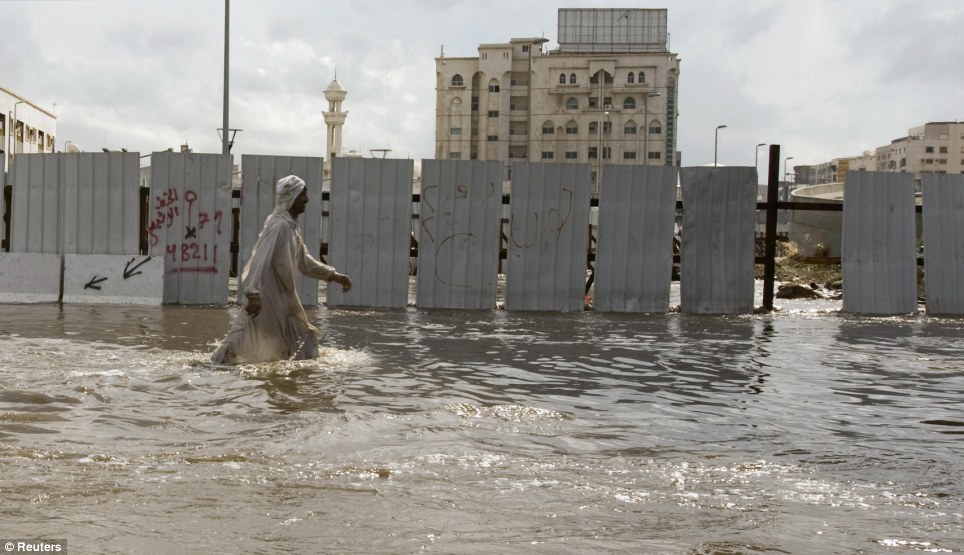
 Sewage on the streets of Jeddah, Saudi Arabia, left more than 120 dead and questions about the country’s green credibility very much open to debate. Photo: Reuters.
We’ve covered the recent Hajj 2009 to Mecca in Saudi Arabia and the Saudi Abrabian government’s desire to make future Hajj pilgrimages more environmentally friendly.
All these efforts may be for naught if the Kingdom’s infrastructure authorities do not make a greater effort to deal with environmental disasters such as the recent flooding and sewage leak incidents in Jeddah, a city of about 2.6 million people, with almost no municipal sewerage system.
The severe flooding in Jeddah the Kingdom’s second largest city and main seaport, occurred ironically during the Hajj pilgrimage in late November, and killed at least 123 people, most of whom were foreign guest workers living in illegally built “shanty town” areas outside the city. It barely made the news.
But an article published in the The National, reported that the flooding in Jeddah, which also caused a serious sewage spill problem due to overflowing sewage lagoons, was only a symptom of an environmental problem that has been building up years.
Ongoing efforts have been made to introduce a number on environmental projects into the Kingdom, including being involved in a world-wide Muslim “Seven Year Plan” for greening the environment that is to include building a “Green Mosque” to emphasize the role Islam can play in improving the environment.
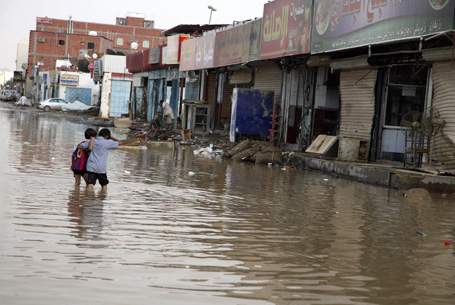
But like the old saying that making changes begins at home, can certainly pertain to cities like Jeddah, and even in the capital Riyadh where sprawling “colonies” of guest workers live in often deplorable conditions. Such is the case of Jeddah, and the recent flooding there, which is the result of years of neglect by governmental authorities, and where at least a million people live in inadequate housing conditions.
The article went on to say that the city’s sewage system which is supposed to drain off rain water that sometimes pours down in torrents in rare heavy rain storms, simply could not deal with overflowing sewage – which is now said to be one of the main causes of the deaths last November.
“It seems that the government is calming the public by diverting the attention to municipality figures and contractors as they are people at the end of the corruption scale to avoid exposing people at the top to the public,” said Waleed Abu al Khair, a Jeddah-based lawyer and activist.
“If government anti-corruption agencies were doing their job properly in the past years, then we wouldn’t have ended up with this mess in our infrastructure.”
One must take into account that large numbers of foreign workers are employed in Saudi Arabia, as they are in neighboring countries in the Persian Gulf area to work in the energy industry, construction projects (like Burj Dubai or Khalifa), and in municipal labor requirements, which include being of service to the many members of the Saudi Royal Family, who have homes and palaces scattered all over the Kingdom.
Although large sums of money have been set aside for projects dealing with infrastructure and welfare, very often little of this money reaches people like the ones who lost virtually everything from the flooding in Jeddah. The king of Saudi Arabia, King Abdullah bin Abdul Aziz Al Saud, was quoted afterwards when he said in regards to infrastructure projects that have never been completed:
“Some projects have gone unfinished or have been lost. I hope that you inform me of any failings on anyone’s part, including the minister of finance. If there is a failure, it is the minister alone who will shoulder the blame.”
With ongoing rumors of massive corruption within Saudi Arabia, it is no wonder that the large numbers of foreign workers living there, not to mention the millions of pilgrims who come from all over the world on the annual Hajj pilgrimage, are not benefiting from a “greener” Saudi Arabia.
Lower photo and story via The National
Other articles on “greening” Saudi Arabia:
Muslims adopt a Seven Year Plan as Part of Islam’s Green Agenda
Registration Open for first Gulf Environment Forum in Saudi Arabia
Dow Chemical and Saudi Kaust University Vow to Clean up Environment



[…] not least on its deployment of resources. Riyadh gains this billion-dollar redevelopment while the sewers in Jeddah overflow, people continue to live in poverty and human rights are severely restricted. As I mention in […]
[…] not least on its deployment of resources. Riyadh gains this billion-dollar redevelopment while the sewers in Jeddah overflow, people continue to live in poverty and human rights are severely restricted. As I mention in […]
I'm Saudi and proud to be one, but it's a shame we don't have that education and knowledge about converting Saudi Arabia to be Green and environment friendly. We need to stop blaming the govenment and leaders in Saudi Arabia and we need to start the change from ourselves. We are the people of Saudi Arabia must start the change by educating ourselves more and more about green and by doing so, we need to be leading and educating our family, friends, people among us and around us of the important of being green. platic bags in a supermarket are not the only issue. I'm doing my Master Degree in Industrial Management and I will do everything in my power to pass the knowledge I'm getting into real action in my Saudi Arabia. There is much to say, but I want to pass my words into actions very soon.. God Bless
[…] More on Middle Eastern sanitation issues: Saudi Arabia’s Desire to “Go Green” Spoiled by Sewage Scandal” […]
no public awareness of going green or the importance of itno company takes any lead in this in any industry or service sector, nor is anyone bothered at grocery shopping time where 1 plastic bag is given for every 2 or 3 grocery items
The word green is non existant . No green credentials whatsoever, they dish out plastic shopping baggs 1 for almost every three items in every store, the word green doesnt exist in any shape or form, I dread to think about water quality, draining and human health hazards. All this managed by no take charge bureacrats
[…] of environmental problems in Jeddah and other major population areas in the country. We know that sewage leaks and garbage dumps threaten the Red Sea, but what other problems to Saudis […]
[…] disposal. An example of this occurred last November when a number of people in Jeddah were killed by sewage flooding during some heavy rain […]
I think being green is the last thing on the mind of the Saudi goverment. They pump raw sewage into the Red Sea. During the Hajj the desert south of Mecca is a river of open sewage running into the desert. I read a real good book about saudi called “Paramedic to the Prince” written by an American who worked on the medical staff of king abdullah. A real insight into Saudi Arabia
I think being green is the last thing on the mind of the Saudi goverment. They pump raw sewage into the Red Sea. During the Hajj the desert south of Mecca is a river of open sewage running into the desert. I read a real good book about saudi called “Paramedic to the Prince” written by an American who worked on the medical staff of king abdullah. A real insight into Saudi Arabia
Death by Sewage: Saudi Arabia’s Desire to “Go Green” Spoiled by Sewage Scandal http://ff.im/-dSLu2
Death by Sewage: Saudi Arabia's Desire to “Go Green” Spoiled by … http://bit.ly/5RZCgg
Death by Sewage: Saudi Arabia – http://www.greenprophet.com/2010/01/06/15691/saudi-arabia-sewage/
Death by Sewage: Saudi Arabia's Desire to “Go Green” Spoiled by …: With ongoing rumors of massive corrupt… http://bit.ly/5KNEO6
Death by Sewage: Saudi Arabia's Desire to “Go Green” Spoiled by … http://bit.ly/5Z6hYI
Death by Sewage: Saudi Arabia's Desire to “Go Green” Spoiled by … http://bit.ly/7x7app
Death by Sewage in Saudi Arabia: http://www.greenprophet.com/2010/01/06/15691/saudi-arabia-sewage/
RT @greenprophet News:: Death by Sewage: Saudi Arabia's Desire to "Go Green" Spoiled by Sewage Scandal http://bit.ly/6KnFtR
News:: Death by Sewage: Saudi Arabia's Desire to "Go Green" Spoiled by Sewage Scandal http://bit.ly/6KnFtR