

 If you read any story this week make it this one: What could be the most important event of the next decade, world leaders and activists are meeting as we speak in Copenhagen, Denmark to lay the foundations of a plan to stop climate change.
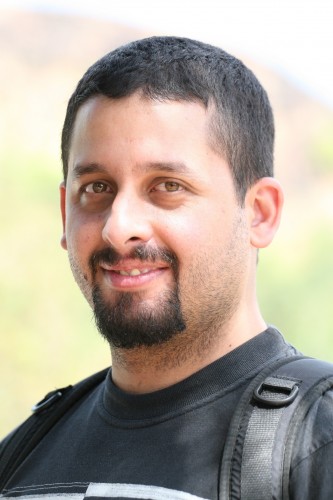
On the forefront of representing the Arab world, and criticizing the oil-producing ones, is Wael Hmaidan, the executive director of IndyACT. We covered Hmaidan and recent protests at the pre-Copenhagen event in Barcelona, where IndyACT helped draw attention to the fact that Arabs are more than oil.
Green Prophet sits down with Hmaiden for a few minutes, when he’s not sleeping or busy campaigning for climate change action at Copenhagen.
What’s your organization’s goals at Copenhagen?
IndyACT as part of the global civil society is campaigning for a strong and ambitious treaty that would save us from catastrophic climate change impacts that could mean the end of human civilization. IndyACT, as the only organization from the Arab region, also works on insuring that the region strongly and positively engage the negotiations process.
Copenhagen is considered one of our last chances to achieve the a global agreement that would save human civilization. According to the UN, we have less than 10 years to radically change our lives to avoid catastrophic impacts of climate change. So our goal for Copenhagen is ‘to save the planet’.
What’s the feeling on the ground? Excitement, things happening? Boring policy talk?
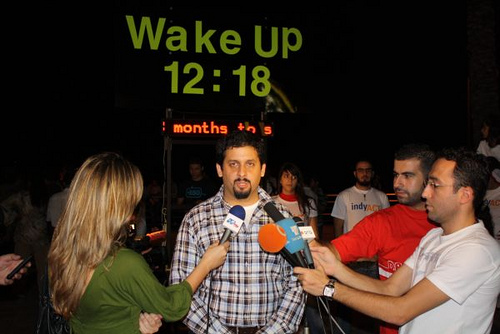
IndyACT has a delegation of more than 40 individuals in Copenhagen. We have 10 climate policy experts that follow on policy discussions, review text, conduct policy analysis, produce policy suggestions, and lobby delegates. We also have 15 youth activists from across the Arab region that organize daily activities to inspire and push country delegates toward strong action. IndyACT also has a communication team of five that communicate the work the policy team and activists to media, supporters, delegations and other related stakeholders. IndyACT also brought media representatives, NGOs, VIPs from the Arab region in order to increase the region’s involvement in climate change issues.
Therefore, our days are never boring, and every day there is something new coming out of the process or out of the NGOs. Nevertheless, many other feelings are felt on the ground. There is a lot of frustration, a lot of anger, a lot of indifference, a lot of sadness. Delegates from small island states cry, while some other delegates have no concern whatsoever.
Which Middle East countries have the most to lose from these talks. Which have the most to gain?
Knowing that climate change the existence of human civilization, no one can say that they will lose from the talks (unless they fail of course). Everyone on this planet will benefit from a strong and ambitious climate treaty. Nevertheless, some oil exporting Arab countries, like Saudi Arabia, consider the fight against climate change as a threat to their oil trade, and thus try hard to weaken the outcome. IndyACT does not consider that Saudi Arabia is working for the interest of their country, nor the planet. Eventually, oil is a limited resource, and it will end one day.
Some say that Canada (tar sands) are more dangerous than Saudi oil pollution for global warming. What are your thoughts on that? Anyone talking about it?
Definitely Canada should in no-way start mining the tar sands. We are entering a new era, a new way of life, and a new mode of energy production. We need to slowly stop our addiction to all fossil fuels, including coal, oil and tar sands. The more we invest in these conventional energy sources, the less we move away from a healthy and safe future.
How is Middle East representation? Bumping into anyone from the region?
IndyACT policy experts constantly (many times during the day) meet with Arab delegates, and discuss developments, ideas, suggestions, etc. We do not only lobby Arab countries. We also constantly meet with delegations from Europe, Americas, Africa and Asia. We also constantly coordinate with small island states, to insure that their survival is secured. IndyACT team has on several occasions achieved significant change in country positions. We also have helped introduce new ideas that were adopted by several countries. It is very exciting to read new text and find your suggestions in it.
Also IndyACT activists constantly talk to delegates during their activities. They do influential stunts that hopefully would inspire country delegations. (Photos of stunts available)
Has IndyACT played any special role, led any debates, or started any protests at the talks? Do tell.
IndyACT is recognized as a leading organization in the climate negotiations. We play central part on almost all levels. We lead within several global networks, and with four other NGOs (Greenpeace, WWF, David Suzuki Foundation, and Germanwatch) have produced 8 months ago a full legal agreement for countries to use as a template.
Let me outline a full-day for IndyACT in the negotiations:
We usually wake up around 5:30am, and head directly to the meeting center (most of the time without breakfast).
7am is our daily coordination meeting for the whole IndyACT team, where we give briefing on what happened the day before and what each team did. Then we discuss what we will do today, and any relevant information that the team needs to know.
8am we split and go to coordination meeting with other coalitions and partners, such as the youth coalition, gender coalition, etc.
9am youth start their activities (and continue like this for the rest of the day), while policy team starts talking to arriving delegations, before the sessions start at 10. Someone from IndyACT attends the 9am political coordination group of the NGO network, CAN (climate action network).
10am sessions start, so some of the policy team attends these sessions to gather intelligence, while other policy team members continue lobbying delegates, analyzing new material, organize bilateral meetings with key delegations.
The above continuous till 7pm.
Then the different teams start doing their meetings, where the activists plan activities for the second day, the policy team coordinate our strategy, etc. We also meet with different partners and country delegations till late night. We usually have dinners with delegations.
At 12 midnight the coordinating team (head of delegation, youth coordinator, policy coordinator, communication team coordinator, logistics officer and administration officer) meets to make sure that everything is going smoothly and effectively.
Yes… We are lucky if we get five hours of sleep. All of this just for the joy of making a difference.
To read more about Hmaiden and IndyACT, visit their site. Thanks Wael!




[…] organisations funded by un-green corporations face in the Middle East. I sat down for a chat with Wael Hmaidan, a green campaigner from Lebanon who heads an independent organisation for activists, to discuss […]
[…] organisations funded by un-green corporations face in the Middle East. I sat down for a chat with Wael Hmaidan, a green campaigner from Lebanon who heads an independent organisation for activists, to discuss […]
[…] the impressive action of IndyACT, Lebanon’s delegation brought little environmental agendas with them for December’s COP […]
[…] of the conference allows activists to get creative, too. Lebanese climate rock-stars IndyAct (who we’ve interviewed live from Copenhagen here), for instance, dressed up as “850” delegates, representative of oil industry interests, and […]
Lebanon's Wael Hmaidan From IndyACT Reports From Copenhagen While …: We are entering a new era, a new way.. http://bit.ly/4mM3SZ
Lebanon's Wael Hmaidan From IndyACT Reports From Copenhagen While …: Green Prophet sits down with Hmaiden for a f… http://bit.ly/4mM3SZ
RT @kloostermania: Lebanon's oil objectors. Interview frm Cpnhgn: http://www.greenprophet.com/2009/12/13/14413/copenhagen-indyact-lebanon/
Lebanon's oil objectors. Interview from Copenhagen: http://www.greenprophet.com/2009/12/13/14413/copenhagen-indyact-lebanon/