

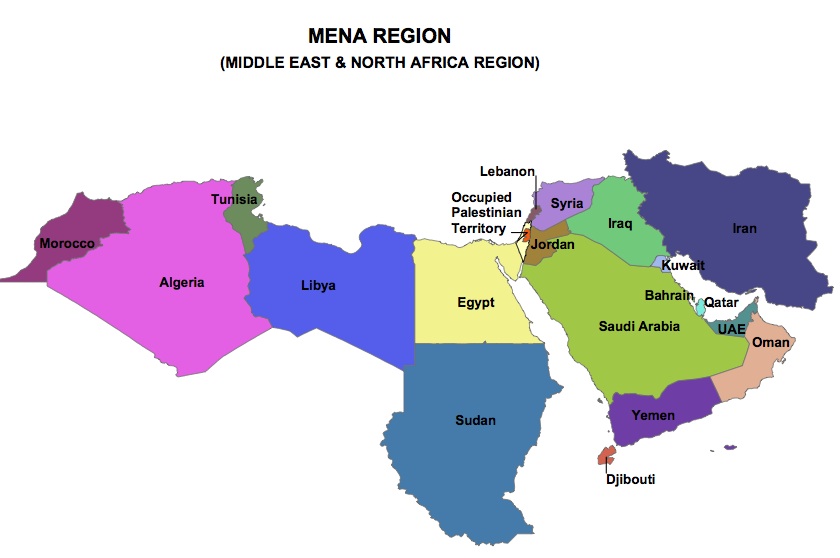
 The sunny MENA (Middle East- North Africa) region and its associated countries could solar power the world, Maurice reports. This map-maker left out Israel.
Middle Eastern and North African countries, often referred to under the umbrella term MENA countries, have the potential to create more than 3 times the world’s power needs, according to a new study reported in the Dubai-based Khaleej Times.
Countries that move fast, the study suggests, could have the competitive advantage. Who could take the lead: MENA countries, especially ones located on the Arabian Peninsula, as well as others like Jordan, Lebanon, and Israel could be. These countries are no strangers to the notion of solar energy, and Green Prophet has covered countless articles touting solar energy in the Middle East.
One of the region’s leading solar energy development countries, Israel, has even been asked by the UN to increase its development of solar energy. Despite being an instrumental innovator through companies such as BrightSource or Solel, Israel’s own use of solar power at home more closely resembles that of a developing nation.
The Khaleej Times article pointed out that countries in the MENA region have the “greatest potential for solar regeneration” supplying 45% of the world’s energy sources possible through renewable energy. Renewable energy sources of interest in this region include Abu Dhabi’s Masdar City as well as its hosting of the World Renewable Energy Agency headquarters . Known as IRENA, this center could fuel development in the whole region.
A big problem, however, is under-funding of renewable energy projects, due to a big abundance of oil and other fossil fuels, says Beirut based Ibrahim El Hussenei, a partner in the London based energy project development company, Booz & Company whose representatives were present at the COP 15 Climate Change Conference in Copenhagen.
“Renewables in much of the Mena region are underfunded or not funded at all, in part due to the region’s abundant supplies of fossil fuels,” said Ibrahim El-Husseini, a partner at Booz & Company.
Renewable energy industry developments combined with the region’s potential in wind and solar power could create significant advantage for countries that move to capitalise on them.
The worldwide demand for energy will result in the need for countries in both the Middle East and North Africa to turn to renewable energy, especially solar power, to help supply this growing energy need, he suggests. Walid Fayed, another Booz and Company executive, said that another 80 to 90 Gigawatts of power will be needed.
This power, according to both Fayed and El Houssenei, will be needed from solar and other forms of renewable energy to help satisfy world demand.
What we can squeeze from the sun?
The two most important forms of power from solar energy are from PV photovoltaic cells and concentrated solar power (CSP). The latter use mirrors and lenses to direct the sun and can be seen in the inventions of Israeli companies like Zenith Solar and Aora Solar.
The CSP mirrors and lenses are used in larger solar power plants such as those providing power for utility companies, while ones using photovoltaic (PV) panels are typically used for smaller power plants, according to the news report. The drawback for large solar plants in desert areas like in the MENA region, however, are sandstorms and other types of dust problems which have a negative impact on the efficiency of solar mirrors or panels. (But not if you use nano tech to self-wash the panels).
The Masdar City project in Abu Dhabi is one that will be using PV panels on a large scale. A number of smaller projects incorporating solar panels are also in use around the region, the Kaleej Times article noted.
The use of solar energy technology could be very beneficial by countries in the MENA region, and will “free more oil and natural gas for export and enhance oil producing countries positions as major energy exporters,” the author in the article noted, especially when these supplies become more scarce world wide.
Renewables could enhance the export value of the region’s traditional energy assets. Fossil fuels will remain the dominant source of energy for the foreseeable future. In addition, Opec’s share of world oil supply is expected to grow from its current figure of 42 per cent to 52 per cent by 2030, according to the Opec World Oil Outlook 2008.
Though not mentioned in the article (for obvious political reasons) solar energy technology cooperation between these countries and Israel, a major world solar energy innovator, could be very beneficial in the long run. It may already be happening, but behind closed doors, away from the sun. We can hope.
“Both solar technologies could be deployed widely throughout the region. The Masdar Initiative in Abu Dhabi recently commissioned the first large-scale PV installation in the region. Smaller installations are proliferating, mainly in areas far from the grid,” Fayad said.
More on Middle East solar energy:
Targets for Solar Deployment in the Middle East
California’s PG&E Looks to Invest $1.5 Billion in Bright Source
Simple Solar Solutions for Hot Water: Will Jordan Seize the Opportunity?
Image via Unicef


[…] Middle East and North Africa have adequate solar appetite to appetite a universe 3 times over, though drumming into that appetite is not so easy. At a new Desertec Conference in Cairo, we […]
[…] Middle East and North Africa have enough solar energy to power the world three times over, but tapping into that energy is not so easy. At the recent Desertec Conference in Cairo, we […]
[…] no surprise to regular Green Prophet readers that the Middle East has bountiful solar power potential. But it is surprising, given the dismal state of Turkish energy policy, to see a solar energy […]
[…] has long been established that the Middle East and North Africa (MENA) have enough solar energy to power the world. Trouble is, how do we get projects off the ground and keep them running? A new CSP Today free […]
Yes – the map is a bit problematic…
israel's left out because they consider themselves part of europe.. you can't have everything mate…
israel's left out because they consider themselves part of europe.. you can't have everything mate…
Middle East could solar power World 3 times over! http://www.greenprophet.com/2009/12/28/15169/mena-solar-power
Great report from the Khaleej Times on solar power in MENA countries. With the potential to produce more than 3 times the world’s needs, let’s hope these countries work fast to harvest the solar potential of the regions!If you’re interested in solar energy or any other alternative energies, check out http://www.greencollareconomy.com. It has hundreds of case studies on emerging green technology and solar power. It’s also the largest b2b green directory on the web.
RT @GreenProphet Middle East/Med Region Could Solar Power World 3 Times Over http://www.greenprophet.com/2009/12/28/15169/mena-solar-power/
RT @GreenProphet Middle East/Med Region Could Solar Power World 3 Times Over http://www.greenprophet.com/2009/12/28/15169/mena-solar-power/
Your map is missing the country that is leading the solar energy revolution – ISRAEL!
Middle East/Med Region Could Solar Power World 3 Times Over: Renewable energy sources of interest in this regio.. http://tinyurl.com/y8v5lx8
Hi Maurice, your map is missing Israel, though it shows the “Occupied Palestinian Territories”
#Solar #Power in #Mid-east and #Africa (#MENA countries) could supply entire world's #energy needs. http://tinyurl.com/y8lnht7
Middle East/Med Region Could Solar Power World 3 Times Over http://bit.ly/8LBNQA
Middle East/Med Region Could Solar Power World 3 Times Over http://bit.ly/5XzPjk
Middle East/Med Region Could Solar Power World 3 Times Over http://bit.ly/4zzzOI
Reading: Middle East/Med Region Could Solar Power World 3 Times Over …: The sunny MENA (Middle East- North Africa… http://bit.ly/8dTZGH
Middle East/Med Region Could Solar Power World 3 Times Over http://bit.ly/8dTZGH