
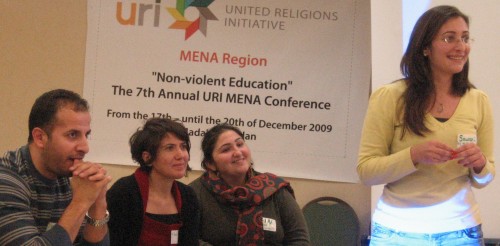

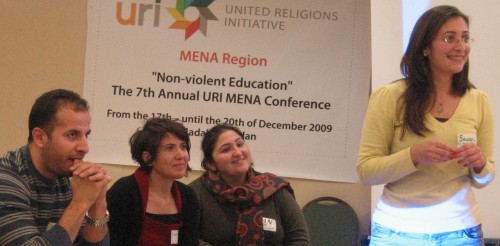
Osama, Khaloud, Zein and Sawsan (from left to right) present green projects from Jordan at Green Prophet’s Environment blogging workshop.
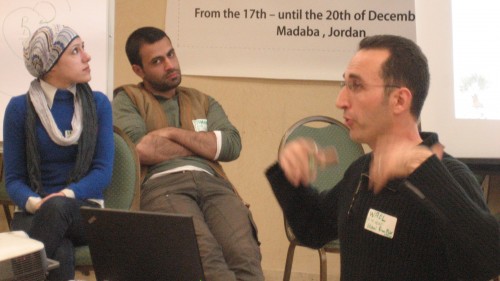
It was 20 hours we will never forget. Nineteen journalists, activists and bloggers from Jordan, the PA and Israel met at an international blogging workshop in Jordan intending to make better environment bloggers (and friends) out of all of us. Hosted by Green Prophet, Volunteers for Peace in Bethlehem and the Masar Center in Jordan, we shared, we ate, we danced and we wrote. Blog posts from the event are forthcoming.
Besides all of our mutual desires to share and to learn more about communicating our regional problems in the global blogosphere, each and every one of us all shared our local environmental issues, projects and dreams. Readers should take note: it’s very uncommon for Palestinians, Jordanians and Israelis to meet in such face-to-face encounters. We overcame our fears and stereotypes to broaden our worldviews and to make change.
In order of presentation, let’s start with Jordan:
It seems that all of the Jordanian participants had studied at the Arava Institute in Israel, so they were already attuned to the importance of cross-cultural dialogue in solving green problems.
We met Sawsan and Osama who have both studied at the Arava Institute (see them in the video below), and who are instigating a pilot project called “Thin Film” to see how thin, transparent and flexible solar panels from Arizona can be used on greenhouses in Jordan and the Middle East. The idea here is that the solar PV panels with limited efficiency can be used to collect light energy for electricity, while letting enough sunlight through for photosynthesis. The project set for 14 months has been underway for only 2 already.
For example, the electricity generated can be used for pumping water to the greenhouse plants. It works already on crops like algae. The Jordanian team, partnered with other locals in the region, are looking to see if thin films will work for other crops like tomatoes and cucumbers.
We learn that only 16% of the Jordanians use water solar heaters on their homes, while in Ramallah in the Palestinian Authority, about 80% of all homes use this method for heating water.
Meet Osama and Sawsan on film:
[youtube width=”560″ height=”425″]http://www.youtube.com/watch?v=BMt7UQ3tdfo[/youtube]
Zein tells us about an eco-schools project she is trying to create in Amman, by building environment clubs to create a culture of activism in Jordan, a culture that is lacking. “The best thing for the future is working with children,” she says. “They will watch what their moms and dads are doing at home.” Among some of the planned activities is a communal garden and recycling center.
Meanwhile Khaloud is taking a survey on what’s needed in environmental education in Jordan and is working on building a teaching curriculum.
Hug people not trees! Manal explains to us that water is relatively cheap in Jordan, and people don’t have awareness to conservation. On another note, she’s working on a countrywide campaign to collect money for planting trees in Jordan and the Palestinian Authority. People are mocking her work. Why are you collecting money for trees, they ask?
So far she’s help collect enough money to plant about 1 million trees, and hopes to plant 2 million more in the coming year or so.
The group then met Mohammad a fairly active blogger and social renegade for Global Voices Online. He talks about the need of reducing the cost of solar PV cells to a price point that’s reasonable for the Jordanians to consider using it. Today solar PV generated energy costs for about $3 per kilowatt hour in Jordan. While people pay about .9 cents per kilowatt hour in Jordan for power from the grid. In Germany, power plants can get the price point down to as low as .15 cents per kilowatt hour.
Can it be done in Jordan? Transmission costs will need to be lowered, he says. Solar powered water heaters, he adds, are something that can be used now in Jordan. They cost about JD 600 to install (about $850). He advocates the use of such systems.
Next up is our meeting with the group from Israel. Stay tuned.
Read more on our green workshop:
Multifaith Writers and Activists Unite in Jordan
Green Bloggers Page (with all updates)
Meet the green bloggers and activists from Jordan


[…] Environment Journalists, Bloggers and Activists From Israel, Jordan and the PA Unite: Let’s Me… […]
[…] workshop: Multifaith Writers and Activists Unite in Jordan Green Bloggers Page (with all updates) Meet the green bloggers and activists from Jordan Part I: Learn About Jordan Instigating Environmental Awareness in Palestine AKPC_IDS += […]
[…] workshop: Multifaith Writers and Activists Unite in Jordan Green Bloggers Page (with all updates) Meet the green bloggers and activists from Jordan Part I: Learn About Jordan Instigating Environmental Awareness in Palestine AKPC_IDS += […]
[…] workshop: Multifaith Writers and Activists Unite in Jordan Green Bloggers Page (with all updates) Meet the green bloggers and activists from Jordan Part I: Learn About Jordan Instigating Environmental Awareness in Palestine AKPC_IDS += […]
[…] workshop: Multifaith Writers and Activists Unite in Jordan Green Bloggers Page (with all updates) Meet the green bloggers and activists from Jordan Part I: Learn About Jordan Instigating Environmental Awareness in Palestine AKPC_IDS += […]
[…] Conference in Jordan earlier this week. We’ve recapped what we’ve learned from the Jordanian activists. Now Hiba Hamzeh from Volunteering for Peace living in the West Bank, Palestinian Authority, blogs […]
Palestinians do have control over their destiny. The situation in the Israel-PA story is not a one-way story, Tarawnah. Israel is the most developed among all three in the region; and hopefully the others will learn from Israel's mistakes, the way Israel is looking to the US now to learn from the mistakes of the Americans and Europe. Israel has advanced industry and a high standard of living, so naturally greenhouse gas emissions and pollution will be higher. That doesn't make it evil or justifying attack. You could say the same about Lebanon or Turkey. Or Greece. The idea of the workshop was to gather young thought-leaders, writers and activists dealing with and interested in the environment (all from the region) so we can pool our resources on overcoming media holes on environmental coverage. And share our personal projects. It wasn't meant to be a political forum to solve the Middle East conflict. We hope it is a first of many encounters. There were no barriers to break and we all became friends very easily.
Palestinians do have control over their destiny. The situation in the Israel-PA story is not a one-way story, Tarawnah. Israel is the most developed among all three in the region; and hopefully the others will learn from Israel's mistakes, the way Israel is looking to the US now to learn from the mistakes of the Americans and Europe. Israel has advanced industry and a high standard of living, so naturally greenhouse gas emissions and pollution will be higher. That doesn't make it evil or justifying attack. You could say the same about Lebanon or Turkey. Or Greece. The idea of the workshop was to gather young thought-leaders, writers and activists dealing with and interested in the environment (all from the region) so we can pool our resources on overcoming media holes on environmental coverage. And share our personal projects. It wasn't meant to be a political forum to solve the Middle East conflict. We hope it is a first of many encounters. There were no barriers to break and we all became friends very easily.
As far as I can tell, this workshop was meant to put Israelis, Palestinians and Jordanians in one room to discuss environmental issues that concern them all. In my opinion, to “forget about Israel for a sec” is to ignore one of the major contributors to the environmental damage that concerns all three parties – and more specifically Palestinians who have had very little control over their environmental destiny in the past 60 years, if any at all. Even a rational third-party with no “anti-israeli” sentiments would come to this conclusion.
Let's forget about Israel for a sec. The PA too. Ask yourselves what sort of environmental activities are happening in the Arab world in general, and use that as a meter stick for accusing Israel of environmental crimes. Your politics and anti-Israeli sentiments cloud your judgement.
ramsey, i think karin has a point. not all israelis are specialized in this area compared to US bloggers who blog about their army's contribution to global warming, especially with the israeli military arsenal being so vague as you rightly pointed out. i mean especially when it comes to the nuclear stuff – i dont think we want to open up that can of worms that include the leakages of the dimona reactor that has caused sicknesses in jordan, and the polluted water they've sent jordan's way. and yes, as karin pointed out, it is indeed wrong to paint all israelis the same.so let's stick to what we know. actually, let's stick to one small, segment of what we know. let's stick to the israeli government and its policies. and let's even stick to 2009for instance, we know that that overall environmental impact of trees is essential to the survival of palestinians in general, many of whom generally make their livelihood from them. and we know that israel has played a major role in destroying those trees and those livelihoods not only through the apartheid wall that has separated many farmers from their own orchards, but through the ongoing policy of uprooting trees in the occupied lands. we know that 2009 saw over 14,000 olive trees being uprooted or burned, with at least half of them being uprooted to clear the land and make room for illegal israeli settlements.we know that according to a report produced by israel's ministry of environment, israeli military bases in palestinian lands such as jerusalem, ramallah, herbron and others, have been polluting the lands they are situated on and the surrounding water sources with the use of diesel and other fuels. we know that israeli settlers who are currently living illegally on palestinian lands, are allowed the consumption of 5 times more the water allowance than the average palestinian in the occupied territories. and this is all of course to say nothing of the fact that israel controls what water the palestinians are allowed to consume – to say nothing of controlling their mobility, which includes freedom to access their farms. if that's not using the west bank as one's playground then i dont know what isand we can go on and on and on and on. israel's environmental crimes at the expense of palestinians, and indeed its neighbors, including Jordan and Lebanon, are ludicrous. and with the one year anniversary of israel's onslaught on gaza, which crippled the territory, it's people and it's environment, it is utterly disgusting that any organization in jordan would even think to host a workshop of this sorts in the midst of israel's ongoing environmental crimes – to say nothing of its many, many, many, many other crimes.
I don't think the Israelis are specialized in this area in as much as average bloggers in the US blog about the US Army's contribution to Global Warming around the world. It's not fair to paint every Israeli in the manner you do. But if you are a specialist in this area, go for it. We can give you the forum. It's also not fair to say that Israelis use the West Bank as their playground.
I would love to see the Israeli “eco-activists” talk about Israel's military contribution to global warming. How about those Merkava tanks, F-16s, constant military patrols, poisoning the earth with the depleted uraniam? Of course Israel talks about ecological friendliness, but only on one side of the wall. The Palestinian side is the playground for new weapons without any regard to the environment (or for human rights for that mantter).We won't even mention the nuclear ambitions of Jordan, and the “unconfirmed” nuclear capabilities of Israel, because of security and monetary reasons. Right?
News:: Environment Journalists, Bloggers and Activists From Israel, Jordan and the PA Unite: Let’s Meet Jordan http://bit.ly/6Sgdxx
Environment Journalists, Bloggers and Activists From Israel …: Blog posts from the event are forthcoming. Bes.. http://bit.ly/8v39jF