
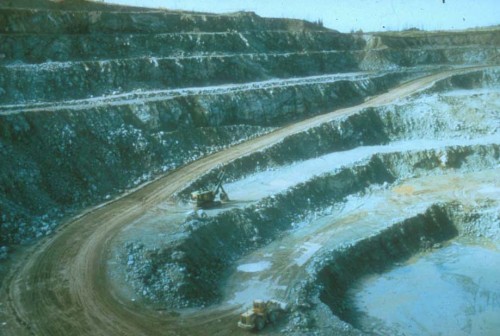

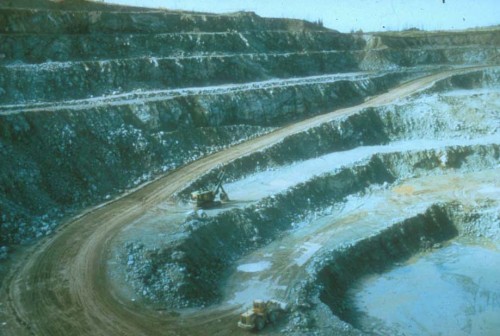
The news that Jordan “strikes it rich” by recent discoveries of high-grade uranium ore only five feet below the surface may come as a mixed blessing for this energy-strapped country of 6 million inhabitants.
In a recent article by the Jerusalem Post, the amount of uranium deposits said to be available for mining, and of course its easy proximity for open pit mining operations, may wind up being a environmental nightmare for a country that already has a severe water shortage problem and a very delicate ecological balance in regards to its plant and animal life; as has often been noted by representatives of Jordan Environmental Society established back in 1948 to preserve Jordan’s unique desert and mountain environment.
Jordan has entered into agreements with the French energy giant AREVA, which specializes in nuclear energy plants in Europe and other parts of the world, including Asia.
The Kingdom has also made agreements with Canada, the USA and France for the peaceful development of nuclear energy.
Jordan is planning to build a nuclear power station in an area south of the port of Aqaba, along the Red Sea coast, and has signed a $12 million agreement with a Belgian firm to survey the area where this nuclear plant might be built, a part of which borders with Saudi Arabia.
We know that nuclear facilities need to be built near water. So Jordan’s entire Red Sea coastline (and entire sea shoreline for that matter) is only 26 kilometers long; meaning that this nuclear power plant could endanger the fragile marine life in this area, as well as plant and animal life in the vicinity.
The possible environmental risks of such a move were explored in a previous Green Prophet article: Jordan Explores the Nuclear Option, which seems more real now that Jordan has found its uranium fuel.
Referring back to the Jerusalem Post article, and information concerning the mining of uranium ore, noted in an article written in 2004 by Peter Deihl, uranium mines are mostly the open pit type which involves very polluting mining processes, including the use of caustic chemicals to leachthe uranium from the mineral deposits in which it is found.
These chemicals include those such as sulfuric acid which is not very environmentally friendly. This type of mining is also very problematic in regards to ground water contamination, which could be permanent.
Taking these ecological risks into account, what large open pit uranium mines might do to Jordan’s already drastic water shortage situation is something that should definitely be considered by the Jordanian authorities.
Being an environmental news site covering the Middle East, the purpose of this article is not to explore the political implications of Jordan developing nuclear energy for its own purposes as well as the possibility of it becoming a major exporter of high grade uranium ore to whoever is willing to purchase it in the Arab world.
We are simply trying to point out what this move may do to the entire regional environment, not just that of Jordan. Imagine what could happen to beautiful Sinai?
And while the Kingdom could wind up making a lot of money from this venture, as well as producing more than 1,000 megawatts of electricity from a nuclear power plant, the resulting environmental damage could offset the positive aspects of the deal. Please think again, Jordan.
Photo via www.grahamdefense.org



[…] waste transport costs and decommissioning are factored in. The report also estimated Jordan’s uranium reserves at just 12,000 tons, less than 10 percent of the volume initially projected by pro-nuke […]
[…] bump around the internet looking for backstory. In 2007, 65,000 tons of uranium ore were discovered in the deserts near Amman. Efforts towards nuclear production to feed Jordan’s energy needs gained momentum. King […]
[…] claimed that the nuclear reactor will help the country become more self-sufficient. The country has massive uranium reserves that are estimated to be worth around $7 billion which could be utilized in nuclear power […]
[…] equipment to extract the tiny amount of uranium needed….. Uranium depletion is one issue. But the amount of fossil energy fuel needed to extract and then refine the uranium is even more reason that nuclear power will prove unsustainable in freeing the world from fossil […]
RT @batirw: Jordanian Uranium Discoveries Could Devastate Fragile Ecosystem http://bit.ly/q1WmV
Jordanian Uranium Discoveries Could Devastate Fragile Ecosystem http://bit.ly/q1WmV
RT @batirw #Jordan's #uranium reserves could turn into an #environmental threat – @greenprphet http://bit.ly/q1WmV
Jordanian Uranium Discoveries Could Devastate Fragile Ecosystem …: Jordanian Uranium Discoveries Could Devast.. http://bit.ly/NM7k
.@greenprophet Jordanian Uranium Discoveries Could Devastate Fragile Ecosystem http://j.mp/2pBGja http://www.jewpi.com
Great piece, if I don’t say so myself. Nuclear power has both it’s up and down sides and I’m very much afraid that in Jordan’s case, and possibly Israel, Egypt and Saudi Arabia’s case as well, King Abdullah might well consider developing solar energy over nuclear power. I would even be more inclined to endorse the Red-Dead canal option for generation of electic power (and fresh water)over building a nuclear power station – especially one on Jordan’s tiny Red Sea coastline.
And please – no open pit uranium mining for sure!
RT @greenprophet Jordan strikes uranium – scary for the environment and global stability? http://bit.ly/JktjI
News:: Jordanian Uranium Discoveries Could Devastate Fragile Ecosystem http://bit.ly/JktjI