

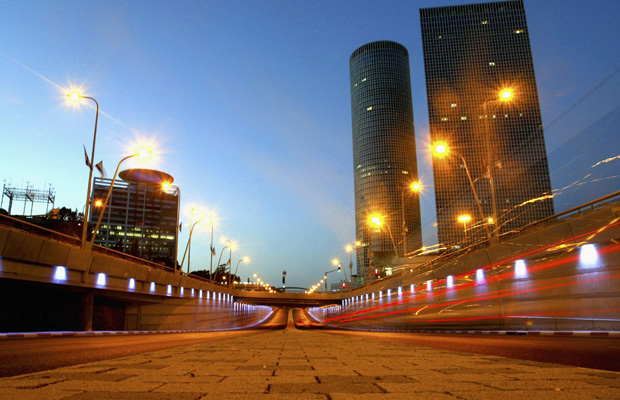
“Parasitic” energy harvesting systems. An Israeli company shows it can collect energy from Israel’s highways.
Think of the volume of traffic on your city highways. It’s just going to waste. But hopefully not for long: an Israeli company Innowattech has found a way to take the mechanical energy created by cars to convert it to power we can use.
I’ve interviewed Innowattech when they started releasing news about their pizoelectric harvesting system late in 2008 and earlier this year, and in a new Globes story, the Green Autoblog reports on the company’s progress.
Placing their power generating crystals underneath roads in Israel, Innowattech has been demonstrating how its technology works. In conjunction with the Israel National Roads Company and the Technion – Israel Institute of Technology (where the research behind the company first began), the company has installed its small piezoelectric generators five centimeters below the asphalt’s surface.
As the weight of the cars pass over the collection system Innowattech is able to capture energy that would otherwise just go to waste. The test site in Israel was at the Hefer intersection along the old coastal road of Route 4 in Israel.
Collecting some 2000 watts an hour in “regular” traffic conditions – that is not during traffic jams –– Innowattech stores the energy in its roadside batteries that can be used the power for street lamps and small neighbourhoods – or we suppose, when the technology allows it, the power collected could straight to the grid.
Drivers in Israel reported feeling no difference between roads with or without the system, and the technology could go much farther, the company admits, when battery storage technology improves.
Many Israeli companies including the electric car company Better Place (working with Ontario as Canada’s Israel reported earlier) find that Israel is the perfect playground for testing out new technologies. The government and local industry is quick to support new initiatives.
And if you are interested in what’s new, some projects and approaches will be unveiled at the country’s annual President’s Conference in Jerusalem this week.
According to Green Autoblog: Innowattech’s “first implementation was over a relatively small ten-meter stretch of road on Israel’s main north-south highway, and is now being placed in one-kilometer sections for further study.”
Innowattech, founded by Prof. Haim Abramovich, from the Faculty of Aerospace Engineering at the Technion Israel Institute of Technology, created a sensation last year when the company released news that it was planning a pilot plant in Israel to generate energy from cars as they drive down the road.
Prof. Abramovich tells me that he has no plans on limiting the technology to roads. The basic principle could be applied to city sidewalks, it could be put in McDonald’s stores as people stand in line, he says, or it could be used on airport runways or on train tracks. Electric burgers, electric runways, and electric avenues! Eddy Grant should be proud.
(This post first appeared on the Canada’s Israel blog)




OK five years have gone by, and Innowattech have clearly vanished from the radar. I told you so. It was baloney from the first day.
[…] role in driving investment in the low carbon economy. “Bond finance built America’s highways, Europe’s drains and funded the Allies through two World Wars,” he said. “Perhaps […]
and diego there is a loss due to compression or actually load transfer. in designing roadways the thickness of the road is based on the number of vehicles that are projected to use the road over its life span. the more vehicle the thicker the road. therefore this loading and unloading along the roadway is significant when looked at as a whole and the small amount of energy produced from the material multiplied by say 20,000 vehicles per day (a pretty normal freeway)could be something worth harvesting and or investing in.
in response to frank from 2009…there appars to be an error in his assumptions. He says that there are only 10 cars on any 1km of roadway at any given time, this is correct except he seems to forget all the cars wil paas the same point in the given hour hence the term 600 veh/hr. So as a start frank is off by a factor of 6. still not the 200 Kw quoted but still a good start and worth looking at further. Also this same tech is being researched in japan in subways so maybe there is something to it.
Well said, JFM. The issue that first makes me question the numbers is the author’s quote of “2000 Watts per hour”. Now, obviously 2KW/hr is a meaningless number. Might this be 2KW for 1 second? 2KW for a minute, continuously? 2 KW for an hour continuously (2KW-Hours/Hour)?
I would assume the latter, but knowing how companies love to inflate their capabilities and technology, I certainly wouldn’t invest based on this.
Obviously, we need to know the total amount of energy production claimed over a period of time. That means KWH/H.
Secondly, the claim that there is anything meaningfully lost in compressive losses is absurd. The energy would have to be lost in rolling friction, which is only a tiny amount of the energy lost in an automobile. If this amount of energy were being currently wasted our tires would be melting, and perhaps even our roads!
I do not know any of the staff of Innowattech; I certainly have nothing against anybody personally. I am a physicist with a keen interest in alternative energy but no financial involvement of my own. I have already made quite clear why this technology is going nowhere: The amount of energy that exists in the form of compression and vibration 5cm below a road surface is not enough to make harvesting it worthwhile, no matter how excellent the piezoelectric generators are. Certainly the amounts of energy claimed to be available by Innowattech are bloated to an absurd level. Simple calculations can show this, and any engineer at the Technion is easily able to do such calculations. I have already posted sample calculations, so there is no need for me to write a post on Green Prophet just to say it all again.
I have no reason to doubt that the Technion and Innowattech have scientists with great reputations, and with great achievements in the physics and engineering of piezoelectric generators.
But these people are ruining their own reputations when they make false claims regarding the financial viability of this form of energy, in terms of the amount of energy potentially available for harvesting. They are using the excellent reputation of the Technion to catch the attention of the public, and maybe investors do not feel the need to check the claims made by Innowattech precisely because of the fine reputations involved. It cannot be that with enough development, or a technology upgrade, that this will change, if the energy is not there in sufficient quantities in the first place. The potential simply is not there.
It is no secret that investors are really keen these days to find start-ups with new ideas for alternative energy. Every time I see that this valuable investment money is being taken by companies that make false claims, I will open my mouth and complain.
The person behind the company is a respected researcher from the Technion. I don’t see that he would have any reason to mislead people. It is his reputation on the line, Frank. And Israel is a very small country.
I am not saying they are denying. They are probably projecting – which is something that every company who writes a business plan does. They talk about potential, so when they get investment they can upgrade and develop their systems further. That’s what R&D is for.
Drug companies get millions even before clinical trials commence. And how many drugs pass clinical trials? Investment risk is why investors play the game, and others who don’t like the risk, prefer to keep their pennies in the bank.
It could be that they are not revealing every little thing that they have in the pipeline? I don’t know. What’s your interest or (dis)interest in this company? Would you be interesting in penning a post on Green Prophet, explaining why this concept won’t work? We are open to it.
Karin,
I’m glad that Innowattech are telling you that they are not going to power whole neigborhoods, but thier own web site speaks of the potential to get 200KWh per hour from 1 km of road at 600 vehicles per hour: see here
(http://www.innowattech.co.il/generalTechInfo.aspx)
and again here:
http://www.innowattech.co.il/images/pdf/brochure.pdf
The PDF brochure says that one lane of one kilometer can power 200-300 homes. If a “neighborhood” is 1000 homes, then you need just 4km of lanes to power a neighborhood!
The false claim of the amount of power available makes people think that there is something there that could eventually be financially viable, even if they cannot recover much of that energy yet. But the legitimacy of the company is seriously compromized when you realize that the energy in question does not exist in the first place.
Why do you think they are denying to you what they say on their own web site? If, as it seems, only a few hundred watts can ever be recovered from a lane of road, and even by Innowattech’s claims, this would require “3000 generators at $30 each” there is absolutely no viability in this idea. Why would one try to develop a system that could eventually yield a few hundred watts out of “$90K” of investment? This scheme would never cost less than $100 per peak watt, while present solar photovoltaic cells run at about $5 per watt today, and solar water heaters are presently cost about $0.4 per peak watt.
Frank,
This website reports numbers from Green Autoblog’s post.
I have interviewed the company and they are aware that their technology isn’t going to power entire neighborhoods, but it can be a solution that can pay for lighting the lamps along highways. I think any “real” and measurable effects will be seen once a long-term pilot plant collects energy over time.
If anything, this company has attracted a lot of interest in the possibility of collecting mechanical energy. If not to roads perhaps the tech can be applied somewhere else. . .
The claims of the amount of energy that can be harvested from a kilometer of roadway that Innowattech make are false, not just slightly false but very false indeed. They vary from 400KW (new scientist article) to 200KW (present web site). It is easy to see how absurd these claims are if you compare them with the total amount of energy of all the engines on the road at any one time. If you have 600 cars travelling on a road at 60KM/h, then there are only 10 cars on a 1KM stretch of roadway at any one time. The power transmitted to the axles of a car cruising at 60KM/h will not exceed 10KW, and in most cases will be significantly less. So the total power of all the car engines on a kilometer of road is at most 100KW, and the vast majority of this goes to air resistance. Of the remainder, the majority goes to tire losses, and the total amount of power going to compression and vibration of the road surface is going to total approximately 2KW for all 10 cars. If they could convert 40% of this to usable electricity, they would get 800W, about the same as a simple domestic solar water heater: So their claims are bloated by a factor of several hundred.
So let’s not give these guys too much attention, unless somebody has the energy to bring them to court and try them for deliberately misleading their investors with claims that are so obviously false.
News:: Innowattech Proves It Can Collect Energy From Highways and Byways http://bit.ly/2PFSxc
.@greenprophet Innowattech Proves It Can Collect Energy From Highways and Byways http://j.mp/1EPPEj http://j.mp/356Xt