

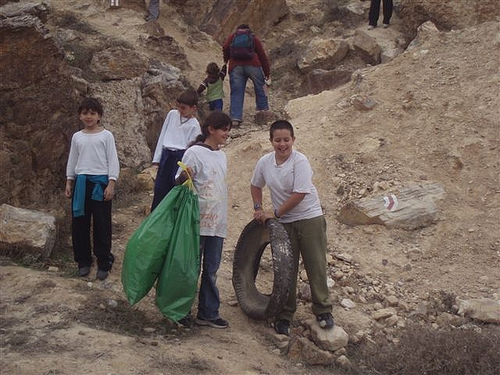
As a means to revive a development town, and a model for an entire country to follow, a super team of organizations have banded together to “green” Arad — an Israeli development town with a population of about 23,000 south of Tel Aviv in the Negev Desert.
While Israelis are generally following the “green trend” now taking the world by storm, basic infrastructure in the country is still missing, like blue bins for recycling tins and cans.
But a new recycling program in Arad, with the community at its heart, could be a new model for all of Israel to follow, and possibly the entire Middle East. Planners are hoping that a new green image in Arad will boost the development town’s fading status — in recent years it changed from a middle class town to one that’s depressed economically and socially.
Today in the city you’ll find clothes recycling programs, recycling bins for tins, paper and glass in the homes, a forum for helping industry nearby cut down on pollution, and educational programs for youngsters at school.
Kids in Arad are learning how to rehabilitate rivers, how to grow a community garden, and are getting to know what trees and plants work best in extremely arid environments like the Negev desert
Residents needs first
Over a year in place, and managed by the Or Movement, an NGO that works to develop the Negev Region, recycling in Arad puts the community first, and involves residents in planning every step of the way, and in overseeing the projects the city takes on.

[image via ixpix]
Over 700 locals came out to the first planning meeting, an overwhelming response to the vision put together by a US family foundation, the Ruderman Family Charitable Foundation, the Jewish National Fund, the Ministry of Environment Protection and a local environment group in Arad.
“Arad is a very unique place,” Roni Flamer, the director of the Or Movement tells ISRAEL21c. “People from the center of Israel established it of their own free will. They wanted to come and build a home in the Negev.”
Its clean dry air is sought by asthmatics worldwide who travel there for respite from respiratory difficulties.
But societal difficulties in the last 15 years have seen an exodus of Arad’s middle class residents from the city. So when representatives from the city were approached with the idea of turning the city into Israel’s first recycling city, they understood it could address a number of problems the city was facing. Essentially it could rebrand Arad’s rapidly fading image.
Enlisting the kids
One of the main focuses of the scheme is on the kids, who organizers believe will help educate their parents. “If students have a good attitude towards the “green” subject, they will carry this through to their lives,” says Flamer.
“Green ideas encourage people to look over their shoulders, and not only deal with their own individual needs, but to be aware of environmental problems as well,” he adds.
But many people can talk about green without knowing what it means. Teaching children in schools about planting trees and fruits that require little water, and how to create a community garden, are just some of the skills the younger residents of Arad are learning. They are expected to pass the green message onto their parents and neighbors.
“The green branding of Arad will help people take a second look at Arad,” says Flamer.
The idea to turn Arad into a recycling city came by way of Jay Ruderman, who manages his family’s foundation, the Ruderman Foundation, from Israel.
Super group oversees community efforts
Ruderman immigrated to Israel three and a half years ago with his wife and children, and noticed a strong parity between environmental activities in the Boston region, where he is from, to what’s happening in Israel.
“We were recycling before I immigrated to Israel — cardboard, glass, plastic — and were trying to throw away very little garbage,” he tells ISRAEL21c.
“In Israel, I first stayed with my in-laws in Rishon and they were recycling nothing, were throwing everything away. It felt like such a waste for a small country. With that in mind we decided to fund a project and fund a recycling project that would be the most comprehensive one in Israel. That’s what’s going on in Arad right now,” he says.
Thanks to a generous donation from the Ruderman Foundation, the project got an equal boost from the power-partners the family brought to the table, says Flamer.
Just a year into the project, the parties involved hope to have a bigger show and tell and launch party of the recycling activities in Arad, within the next few months.
Aiming to create sustainable programming
While the Ruderman family generally supports only local projects in the Boston area, Jay Ruderman saw that helping Arad get on its “green” feet could “create a vehicle to show it a new direction so then it could build on itself,” he says, reporting that the community is now working on solutions for grey water recycling.
There is a strong focus there on educating the kids at school: “I have four kids and know that the parents are often led by the children. They’re saying, c’mon dad you should be recycling this… it is a way to affect change,” he says.
Built to fit a community with a diverse population, including an ultra-orthodox Hasidic population, finding out what fits a community’s special needs is an important part of the recycling project in Arad.
And Ruderman hopes that some organizations taking part will eventually generate business and income from Arad’s recycling project: “Any philanthropic project has a shelf life,” says Ruderman. “One of our goals is to see some businesses taking parts of it over.”
(This story first appeared on the beyond the conflict news service ISRAEL21c – www.israel21c.org)


[…] about recycling in Israel:: Drinking Beer in Cans and Other Middle East Regional Recycling Problems Recycling the Depressed Development Town Arad Nike to Introduce Shoe Recycling Program in Israel AKPC_IDS += […]
[…] Recycling uses up the planet’s resources. You can do better than to recycle: consume less to begin with. […]
I’m trying to spread the word about recycling.
Find Recycling locations near you @ 1800recycling.com.