


Seventy-nine countries will send delegates to Sharem el Sheikh, Sinai next month to inaugurate the first session of the International Renewable Energy Agency (IRENA). The international project will spearhead a global effort to develop renewable energy projects all over the world.
The new agency was formulated in January, 2009, at a conference in Bonn, Germany, and has the backing of most European countries as well as emerging economies like India, and oil producing countries like Norway and Nigeria.
Israel, Lebanon and Syria will also be represented at the conference even though they are still in a formal state or war with each other. Despite their political issues, maybe working together on a joint concern like energy will help lubricate Middle East peace.
Originally 125 countries sent delegates to the conference in Germany, and 75 European and emerging countries signed the final agreement to fully participate in the new agency.
A number of major “energy players” including the USA, the UK, China and Brazil have not committed themselves yet, possibly due to economic concerns involved in devoting more resources to renewable energy development; but it is hoped they will also come on board soon.
Mr. Hermann Scheer, a member of the German Bundestag parliament and head chairman of the World Council for Renewable Energy, said that it is hoped that the new agency, to be known as “Irena” will be able to induce hold-out nations to join up by giving them special tariffs, such as those introduced in Germany by the passing of the Renewable Energy Act.
He said that the special tariffs will help countries to “override” the monopolies imposed by conventional power companies to enable to entry of ones utilizing renewable energy for their power grids. He went on to say in a New York Times feature that the passage of the new act in his country allows more than 100,000 households to sell surplus energy they had generated from renewable energy (solar power, wind turbines, etc) back to the electric company.
In Germany alone, 5% of the total electric power is now being furnished by renewable energy and that it is hoped that in both Germany and France this amount will increase to 20% by the year 2020. Global electric power from renewable energy has risen to 280,000 megawatts in 2008, a 17% increase from the previous year.
The idea is to convince countries that it is possible to formulate a plan to rely less on conventional energy sources, such as coal, oil, natural gas and uranium to generate electric power, Scheer said.
Utilizing renewable energy will be more beneficial to developing countries which now spend more on imported oil than their entire export earnings.
Irena will initiate training programs to help countries concentrate on renewable energy projects, and that eventually production costs will come down, making the use of renewable energy more worthwhile. Furthermore, the use of renewal energy will significantly reduce the level of carbon based emissions into the atmosphere.
Countries having to import most of their energy; including Middle East countries like Israel, Jordan, and Syria will see the advantage of using renewable energy to create electricity (Israel already has solar energy power projects as well as wind farms).
India, with wind turbine companies like Suzlon Wind Turbines has already taken a step in the right direction. Even oil producing countries, such as those in the Persian Gulf region, are seeing the necessity to rely less on oil and gas for their energy needs.
The utilizing of renewable energy instead of fossil fuels will be on the agenda of the U.N. Conference for Climate Change which will take place in Copenhagen this December.
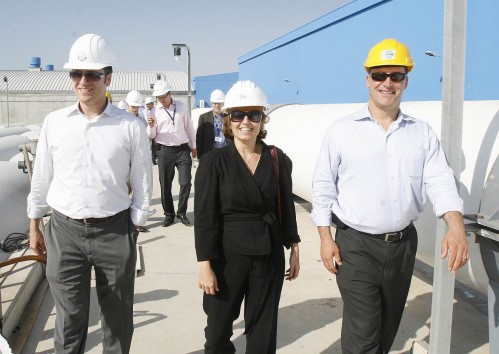
::NY Times [image via ecoworldly]



Hi just wanted to give you a brief heads up and let you know a few of the pictures aren’t loading correctly. I’m not
sure why but I think its a linking issue. I’ve tried it in two different internet browsers and both show the same results.
Thanks Ericka, we’ll look into it. Can you point us to specific images perhaps?
[…] more on IRENA on Green Prophet: Masdar City Is Home to New International IRENA Group IRENA Convenes In Sharem, Sinai AKPC_IDS += "16366,";Browse topics: Abu Dhabi, Israel, renewable energy, United Arab […]
Would like to receive background information and documents.
Rwanda would like to be part of this global and worthwhile innitiative of promoting renewable energy and thus protecting our plannet. Please notify us of all events and opportunities which we are happy to spread in the entire EAC countries(Uganda, Kenya, Tanzania, Burundi and Rwanda)
rm
The International Renewable Energy Agency Convenes in Sharem, Sinai, Next Month http://ow.ly/8VIL
The International Renewable Energy Agency Convenes in Sharem … http://bit.ly/Jjver
Solar Energy The International Renewable Energy Agency Convenes in Sharem …: Countries having to i.. http://tinyurl.com/qqpkjg
http://bit.ly/10NrOO The International Renewable Energy Agency Convenes in Sharem … http://bit.ly/eyiV9
The International Renewable Energy Agency Convenes in Sharem …: He went on to say in a New York Times feature .. http://bit.ly/t6S9S
The International Renewable Energy Agency Convenes in Sharem … http://bit.ly/AQR1L
The International Renewable Energy Agency Convenes in Sharem …: A number of major “energy players” including t.. http://bit.ly/rXb7c
The International Renewable Energy Agency Convenes in Sharem … http://bit.ly/mBtxo
The International Renewable Energy Agency Convenes in Sharem, Sinai, Next Month | Green Prophet http://ow.ly/8TeW