
Rishon LeZiyyon: “First in Zion” for water independence?

When a small group of Jews arrived on the shores of Ottoman-ruled Palestine in 1882, they named the sand dunes they purchased to build their new homes Rishon LeZiyyon – the First to Zion.

Never mind the poor soil fertility, lack of water (or the fact that Petach Tikva, aka “Opening of Hope”, was the first new Jewish village established in the Holy Land), but the community soon became famous for its agriculture and vineyards, eventually becoming Israel’s fourth largest city and home to over 240,000 people.

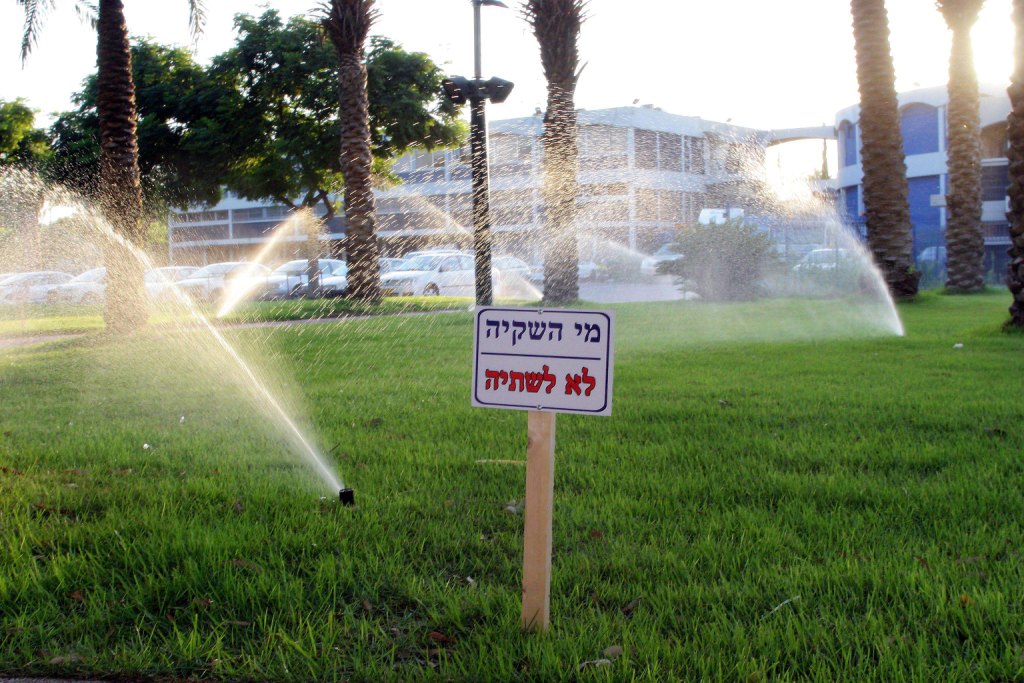
Even though it runs freely from taps modern Rishon’s apartment blocks, water is still on the minds of Rishon’s current leaders – who hope to make the city the first “independent water economy” in Israel. In other words: to supply all of their water from local sources in five years time, cutting themselves off from the national water supply (including the ailing Kinneret) delivered to Israelis by Mekorot, the National Water Company. Currently, Rishon LeZiyyon supplies 70% of its water from local wells and aims to make up the remainder from a new desalination plant, rainwater collection (pictured above watering municipal gardens) and, if red tape can be overcome, a waste water treatment plant. If their maths add up, this will mean both cheaper water for local residents (the already high cost of water in Israel is set to rise further in 2009) and reducing strain on the demand for national water supply. “The cost of water in Rishon LeZiyyon will go down. That’s one of the principal targets in the long-run: to make water cheaper for people,” says Daniel Low, managing director of the city’s municipal water company, Meniv Rishon, tasked with delivering the plan.

The concepts of local food and local energy are gaining ecological and economic credibility, so shouldn’t “local water” be the ideal bed-partner? The Water Authority, which sets Israeli water policy, and some environmentalists, are welcoming the Rishon scheme with a note of caution.

Prof Alon Tal of the Jacob Blaustein Institute of Desert Research at the Ben-Gurion University of the Negev says: “Access to water is a fundamental human right and we have to be careful that in the search for improved efficiency, which is a good thing, we don’t lose the infrastructure needed to provide services to the entire population. I’m not saying that it should be opposed. But with the National Water Carrier people pay the same amount whether they live right next to it or are on the other side of the country and I don’t want to lose that.”

:: Jerusalem Post. “Dig it!”
:: Jerusalem Post. “Big Tel Aviv looks to little Rishon for lesson in water conservation.”

Photo: Captured rainwater refreshing municipal gardens. Ronen Lidor.

Michael Green
Michael Greenhttps://www.greenprophet.com/
Born into a family of auto mechanics and engineers in east London’s urban sprawl, Michael bucked the trend and chose a bicycle instead of a car. A relative newcomer to Jerusalem, he works as a freelance journalist writing for the Jerusalem Post and other publications. Before moving to Israel, he worked for an environmental NGO in England where he developed a healthy obsession with organic vegetables and an aversion to pesticides and GMOs. Michael’s surname is pure coincidence. Michael can be reached at michael (at) greenprophet (dot) com.
2 COMMENTS
  1. Alon Tal is brilliant for incorporating the social element of fair access to water. Is Rishon’s measures an attempt at self-sufficiency or an act of protectionism?

Comments are closed.

Hot this week

How Renewable Energy is Revolutionizing the Way We Power Our World

Solar has become the star of the transition thanks to modular hardware and straightforward installation. It fits dense cities and remote towns alike. Many companies are turning to rooftop arrays and carport systems - and exploring commercial solar installation as a practical way to lock in future savings.

How does one start prepping?

Faced with an extreme winter storm this year, Americans wonder how to be prepared for catastrophe. Miriam has lived through wars in the Middle East - so she's prepared on giving you a guide to prepping.

Fishermen sue tire manufacturers on behalf of the salmon

A federal trial in San Francisco has brought US tire manufacturers, fishing groups, and environmental scientists into court over a chemical most drivers have never heard of — but which scientists say may be silently reshaping aquatic ecosystems.

Listening to Water: Tarek Atoui’s Next Work for Tate Modern

Born in Beirut, Lebanon in 1980 and now living in Paris, Atoui has spent years building instruments that don’t sit comfortably in concert halls. Many of them involve water, glass, and ceramics — materials that react to sound instead of simply producing it.

Leading Through a Dual-Energy Transition: Balancing Decarbonisation with Energy Security

Experience in one area of the energy industry isn't enough to guarantee readiness across all the others. That's where a structured program like an MBA in energy can come in. Today's advanced curricula explore energy economics, finance, policy, and strategic management alongside the technical subjects. And when pursuing an energy MBA online, professionals can skill up and retrain without having to step out of the labor market -- an important perk at a time when skilled professionals are already in short supply.

Topics

How Renewable Energy is Revolutionizing the Way We Power Our World

Solar has become the star of the transition thanks to modular hardware and straightforward installation. It fits dense cities and remote towns alike. Many companies are turning to rooftop arrays and carport systems - and exploring commercial solar installation as a practical way to lock in future savings.

How does one start prepping?

Faced with an extreme winter storm this year, Americans wonder how to be prepared for catastrophe. Miriam has lived through wars in the Middle East - so she's prepared on giving you a guide to prepping.

Fishermen sue tire manufacturers on behalf of the salmon

A federal trial in San Francisco has brought US tire manufacturers, fishing groups, and environmental scientists into court over a chemical most drivers have never heard of — but which scientists say may be silently reshaping aquatic ecosystems.

Listening to Water: Tarek Atoui’s Next Work for Tate Modern

Born in Beirut, Lebanon in 1980 and now living in Paris, Atoui has spent years building instruments that don’t sit comfortably in concert halls. Many of them involve water, glass, and ceramics — materials that react to sound instead of simply producing it.

Leading Through a Dual-Energy Transition: Balancing Decarbonisation with Energy Security

Experience in one area of the energy industry isn't enough to guarantee readiness across all the others. That's where a structured program like an MBA in energy can come in. Today's advanced curricula explore energy economics, finance, policy, and strategic management alongside the technical subjects. And when pursuing an energy MBA online, professionals can skill up and retrain without having to step out of the labor market -- an important perk at a time when skilled professionals are already in short supply.

From Green Energy to Healthy Societies: Why old systems thinking is becoming relevant again

Across the Middle East and North Africa, large investments are being made in green hydrogen, renewable energy, water infrastructure and sustainability. Most of these efforts are discussed in the context of climate change, decarbonization and economic diversification. That framing is important, but it may not capture their full value.

We saw peace – an interreligious encounter deep in our eyes

They came from Israel, Palestine, Jordan, Iraq, Yemen, Morocco, Tunisia, Lebanon, Egypt… There are Sunni Muslims, Shiite Muslims, Jews (Orthodox and Reform), Orthodox Christians, Coptic Christians, Protestant Christians, Druze, Baha'is, a Scientologist.

Can biochar reduce ‘Forever Chemicals’ in food if it’s used in farms?

Biochar is produced by heating organic material in a low-oxygen environment so it does not burn. This process, known as pyrolysis, transforms plant matter into a stable, carbon-rich material.

Related Articles

Popular Categories