

 Famous for his Orange Suspendu sculpture in Jaffa, I had the pleasure to interview environmental artist Ran Morin. Rarely granting interviews with the press, Morin spoke with me a little about living and working in Israel, and man’s place in the environment. Earlier this week Ran Morin sent me an invite to the launching of his 4-year project, at Hebrew University (Mt. Scopus Historical Botanical Garden, with some pictures below the fold).
The event is happening next week on November 25th. Below is a little bit more about the man, whose work translates some of the complicated political and spiritual reality in the Middle East.
Like many others who admire his work, Israeli environment artist Ran Morin’s favorite sculpture is a centerpiece of Jaffa’s Old City. Although the artist labors years, sometimes decades, over projects spanning a number of Jerusalem’s historic archeology sites, it’s the orange tree, Orange Suspendu that hovers both in situ and in the mind.
Created in 1993, Orange Suspendu hangs in an entranceway to a cobblestone path leading to galleries and art studios, where it is held about a meter above ground by wires. The unusual city landmark – only seconds away from the Mediterranean Sea – draws thousands of tourists each year who stand beside it, marveling.
Orange Suspendu
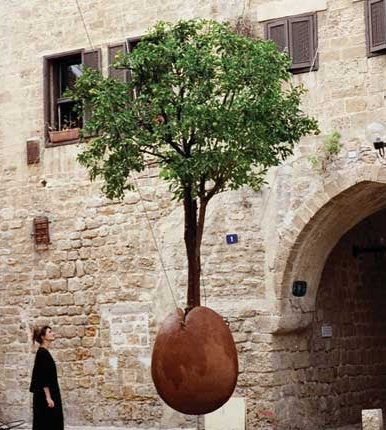
This is true even for those who don’t know the history of the famous Israeli export, the Jaffa orange which was packed and shipped from the Jaffa Port starting in the late 1800s, and which continues to be a favorite the world over. The Jaffa orange, now getting a carbon label, is also a symbol for the local Arab Israeli population, who share the multicultural city with their Jewish neighbors.
Not long after the installation, Morin started getting inquiries from people all around the world who wanted to commission their own hanging tree. It just wasn’t for him.
“I’m not a trademark tree hanger,” Morin says. “My projects need time.” Besides he explains, hanging trees require continual investment on the part of the owner: “These trees are living up there and the conditions are not easy to maintain. They need the right kind of soil and enough drainage, and a careful irrigation regime. It’s artificial – a bit like being in outer space.”
In comparison to the rest of Morin’s work, the orange tree was created very quickly. He calls it his baby. “It was the one that was easiest,” says Morin. “This one came as a flash, representing the end of a whole process.”
Sculptural gardens
It’s different with other works, where he labors over his art. Morin finds himself speaking to authorities from around the world to study the history of some of Israel’s overlooked archeology sites, and gain permission to rejuvenate with imaginative sculptural gardens that are literally acres in size.
This was the case with “Hypothetical Ruins”, located at an archaeological site at Kibbutz Ramat Rachel outside of Jerusalem where he connected with Prof. Oded Lipschits, an archaeologist from Tel Aviv University who continues to work at this important excavation today.
Olive trees on columns at Ramat Rachel
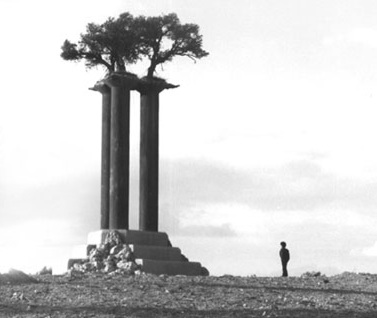
It’s also true of his work now at Hebrew University’s botanical gardens. All are backbreaking endeavors that require painstaking attention to detail. “They take the blood, these projects,” says Morin. “There are literally millions of screws that have to fit in place. I have spent years in the sun.”
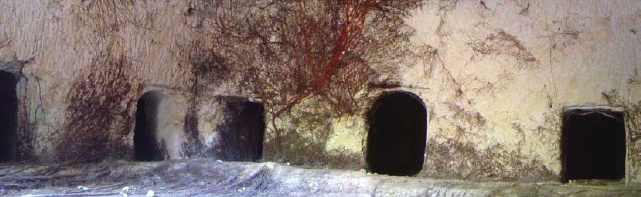
Some of his projects have political undertones, mainly because it can’t be avoided in Jerusalem and the areas where he works. Personally, however, Moran tries to stay away from such sensitive issues. It’s hard though: “I am dealing with earth and olive trees and actual places where there are borders. A Palestinian once told me, ‘Okay we don’t have to fight over the land; we can grow the trees in the sky’.”
Preserving Palestinian landmarks
Not long ago members from the Palestinian village Al Isawiya outside of Jerusalem called Morin. They wanted him to preserve their holy tree, believed by the locals to be a rainmaker. “And judging between people and all that,” says Morin, who proceeded to turn the immediate area around the tree into a sanctuary now called the “The Sacred Charub Tree of Isawyia.”
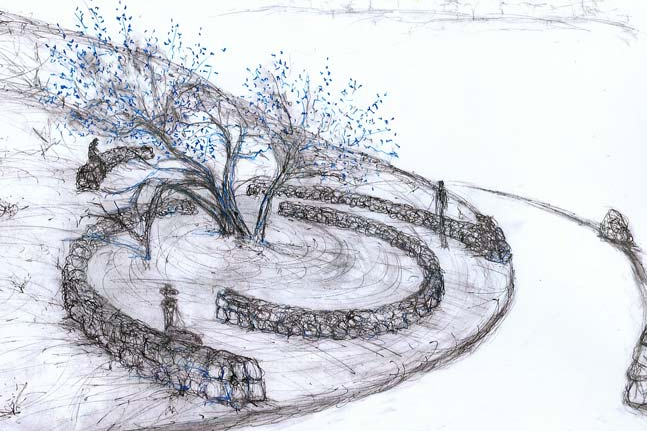
The sacred Charub tree of Isawyia is the main symbolic relic of the village. Christian tradition claims that Jesus (Isa in Arabic) sat underneath this tree with his disciples. Moslems maintain that the tree was the meeting place of Saladin’s generals (1187), one of which was named Elmuadem Isa – hence Isa-wyia. The tree is believed to posses supernatural powers and can fulfill wishes, judge between opponents and even produce rain in years of draught.
This project and the much larger ones created outside of Israel in locations such as London and Rome, – fulfil Morin’s vision of preserving the landscape in a creative way. As he sees it, “historical memories [are] one of the elements of ecology.”
This is especially true in Jerusalem, where Morin was born, studied and lives, and where contractors are developing “like crazy” what could be “one of the most significant areas of the world.”



[…] service_api = '0c4b6af1aba54fb228c924aab3353dbbcb348cceabf15d2a0ce7b3f7efdbeaa3'; Share Ramat Rachel is an ongoing archeological dig on the southern outskirts of Jerusalem. A 2,500-year-old garden at […]
The olive trees near Kibbutz Ramat Rachel and on the way to the Palestinian town,Tzur Bacher, are truly magnificent.
Environment Artist Ran Morin And How He Relates to the “Nature” of the Middle East http://tinyurl.com/69dzxt