
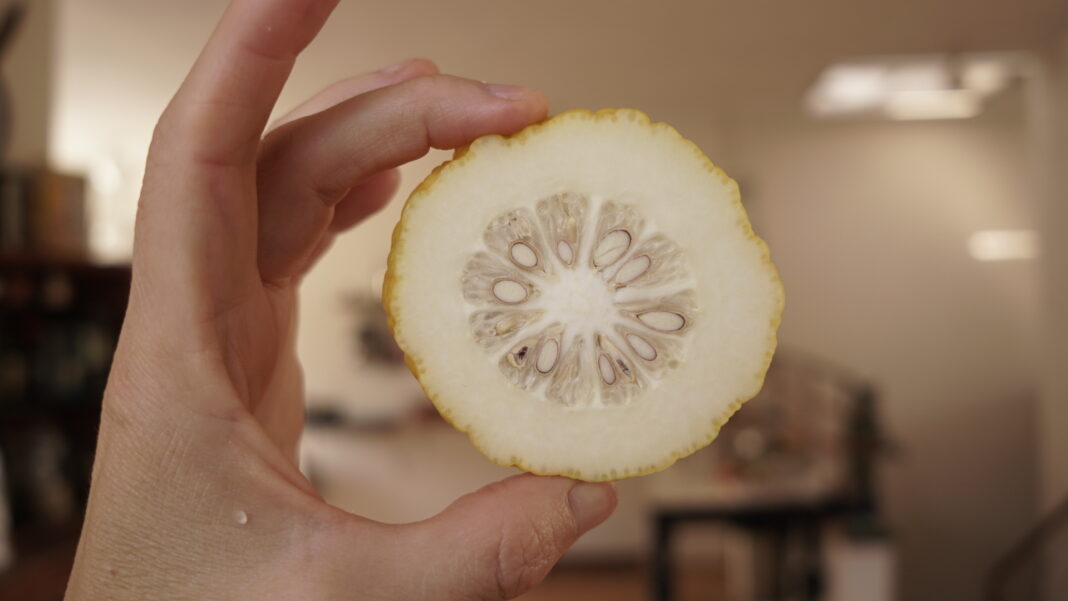


The etrog is a stunning fruit. It’s also known around the globe as citron ––but it’s not to be confused with the French word “citron” which just means lemon.
The etrog or citron is indeed a citrus fruit, so cousin to lemon and lime, but it’s a world away from that tangyness and in its own class. Warty, yes, but too lovely-smelling to be eaten. The fruit is pretty tart like a lemon but there isn’t much juice. Since the thick skin is extremely aromatic we suggest turning the whole shebang into a jam. And we will share the process here.

The citron’s textured and dimply exterior might fool you as being a mutated lemon, and as a peeled fruit there isn’t much to taste. But as a jam? The aromatic flavors are what some compare to the smell of the Garden of Eden.
So this is the Queen of all citrus fruits and it’s cultivated in regions of Morocco to be ready for the autumn and the Jewish holiday of Succoth, the feast of booths. It’s an ecological holiday at the root of things. And if you dig into history you will see archeologists found the etrog trees growing during Biblical times. Today be on the lookout for organic etrog because pesticide use growing etrog is high.
How the etrog is connected to Jewish holidays
After a small cabin is built in the yard for eating and living in for 8 days, Jewish people obtain 4 elements from nature to remind them of their roots.
Every day a ceremony involving a willow branch, a citron, a palm frond and a myrtle branch is enacted. The etrog is used just for its smell while the other elements have characteristics of their own.
Usually there is an etrog left over from Succoth which ended last week so one etrog is not going to make a pile of jam but it will make a small treat. We urge you to use an organic citron if you can find it to avoid any pesticides that might have gone into growing the fruit. As it’s prized for its smell as well as it’s unusual looks and is an ornamental there are few controls on pesticide use for this fruit.
After the Hebrew holiday Succoth, Jewish families everywhere will have an extra etrog which can make a delicious jam. Just make sure the etrog is organic so you will avoid eating unwanted pesticides. Since the etrog is not normally cultivated for eating there are no limits on the pesticides that are used on the fruit.
Here’s Green Prophet’s tried, tested and try recipe that we come back to every year so you can make your own etrog jam.
Making etrog jam
Ingredients for making etrog jam:
1 etrog (citron)
6 cups water
3/4 cup sugar, use organic cane sugar if you can
Method
Slice and remove as many seeds from the etrog as possible. Try slicing the etrog the long way into eighths to get seeds out as efficiently as possible. There are a lot of seeds in an etrog so allow at least one hour for this step. It can be tedious but the results will be worth it.
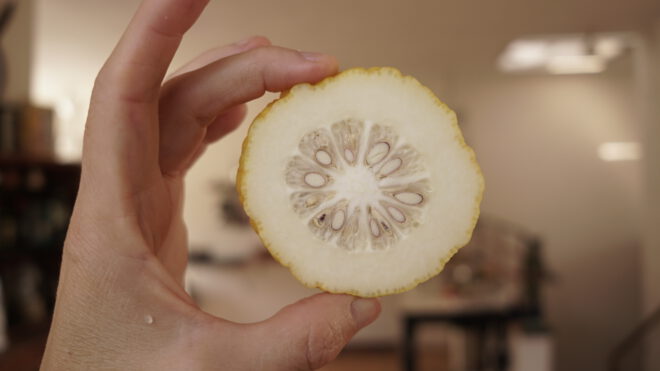
If you want to try and grow your own citron or etrog tree, save the seeds and put them aside for later.


Chop the etrog fruit into very small pieces, including the peel, consider using a food processor like a Vitamix for this step. Although cutting it up with a sharp knife is more pleasant. Just watch out for squirts of juice in your eye. Notice the scent. Cover cut up etrog fruit with water and refrigerate for at least 12 hours.
Next, bring everything to a boil, and simmer uncovered for 20 minutes. Drain fruit. Cover fruit with water and simmer again for 20 minutes, then refrigerate everything for at least 12 hours. Drain. Cover fruit with water and simmer uncovered again for 20 minutes. Drain fruit.
These steps are important because if you skip them the finished product will be bitter!
Cover your beloved etrog fruit with water and add most of the sugar. Bring to a boil and simmer uncovered for one hour. Be careful here, if you leave it for a minute it can burn on the bottom. If it does burn, do not stir up the burned parts into the jam. Dump the stuff into a clean bowl, wash out your pot, put the jelly back in and continue.
Taste to see if you need to add more sugar. Continue simmering for ½ hour or more. The temperature should be 220º–222º, the water should be syrupy and the fruit should be clear-ish.
It should cool and congeal. If it is still runny some people add ¼ – ½ cup of orange marmalade per quart to add “pectin” and cook 15-20 minutes more. Personally, I think that however it comes out is nice.
Now that the etrog is eaten…
More recipes for jam … and cucumbers:
Indulgence, Locavore Style: Homemade Strawberry Jam
Pickling 101 – Vinegared Cucumber Salad Recipe
Reader Feedback
“It’s true – the etrog is one of the most toxic, highly-sprayed fruits on the market, because it is usually purchased for ritual purposes, and not to be eaten. Don’t make any etrog recipes unless you know that the source of your etrog uses sustainable farming (and if you can find such a source, please let the rest of us know!).”


Rinsing produce with a mild apple cider vinegar solution removes pesticides.
This doesn’t remove grit from greens or soil from root vegetables – that is a different type of cleaning, but the apple cider vinegar leaves the produce smelling fresh and tasting better.
Add 1 Tablespoon or 15 ml. apple cider vinegar to 1 litre of water and soak produce for 15 minutes. Follow with a 15 minute rinse in fresh water. I wash large amounts of produce, including those I peel such as carrots, citrus, and squash. To a sinkful of water I add 1/2 C of apple cider vinegar, stirring to ensure even dissolving, and add all the produce. Enjoy the improved flavour.
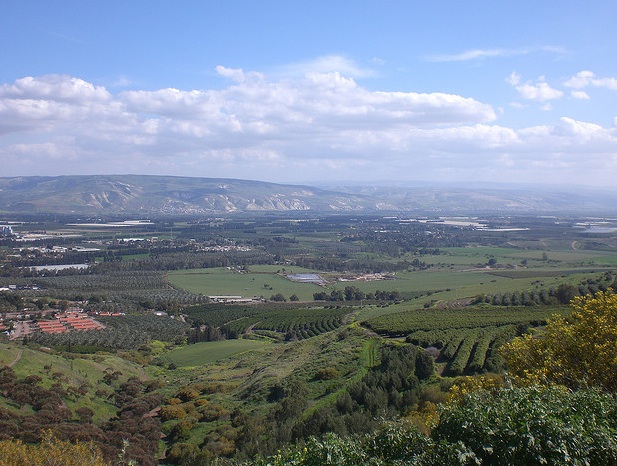
[…] determined by pollen analysis to have grown in the garden is the citron tree, known also at the etrog. According to the researchers, this pollen is evidence for the first cultivation of the citron […]
please can someone advise me of the halachic purpose of the jam. i have cooked 15 etrogim on a different recipe and am now bottling them. somthing about an easy birth. [email protected]
dont worry about pesticides, since you used the esrog for a Mitzvah all the bad stuff went out of it, and you wont come to harm.
And especially after boiling it and changing the water a few times, helps to clean all germs and poison.
[…] In my parent’s old-fashioned cookbooks are recipes based on the beautiful, fragrant etrog (citron). Etrog jam, etrog cake and cookies, even an etrog souffle. As tempting as it is to make jam out of the attractive yellow fruit after Sukkot, refrain. Non-organic etrogim are so full of pesticides that they are a danger to human health. (If you are sure your etrog is safe, here is our etrog jam recipe.) […]
The recipe calls for 6 cups of water and says to cover the fruit with water, refrigerate and drain 4 different times. Should the water JUST cover the fruit or should 6 cups be used each time and when it says cover with water and simmer how much water should be used?
Arlene Jacoby
It’s true – the etrog is one of the most toxic, highly-sprayed fruits on the market, because it is usually purchased for ritual purposes, and not to be eaten. Don’t make any etrog recipes unless you know that the source of your etrog uses sustainable farming (and if you can find such a source, please let the rest of us know!).
See here for more info:
http://jcarrot.org/the-toxic-etrog-read-before-you-eat
I have to say, that I could not agree with you in 100%, but it’s just my opinion, which could be wrong.
Anyone know how to make carob jam? I hear its delicious. The trees grow all over the emek haella region and you can eat the carob fruit right off the trees, a lot easier on the teeth than sugar. I can’t seem to find a recipe anywhere…
I don’t know about the pesticide levels but I love the vodka tip! Some people use their lulav as fuel for burning the hometz in order to connect one holiday to the next. this seems like a more eco-friendly way to tie things up =)
My friend Hillel Bromberg makes Etrog Vodka from his leftovers – he dices up the peels and adds them with sugar to a bottle of Absolut Vodka. At Purim he pulls out the bottle at megilla reading, and a good time is had by all.
I have heard that Etrogim may have high levels of pesticides in them. Since they are grown not to be eaten, but for the mitzvah of 4 minim, perfect looks will get the highest price. Therefore, they are much more likely to be grown with large amounts of pesticides in order to prevent any insect damage that will mar their perfection.
I don’t know this for a fact, since I haven’t found any studies that have tested pesticide levels in Etrogim.
Does anyone know how etrogim are grown and what the pesticide regime is for them? Does anyone know whether this should be a concern?