

Israel’s fastest-growing supermarket chain is the upscale Tiv Taam, where customers can browse shelves of international beers, pick through extensive cheese selections and even purchase pancetta to include in their gourmet dishes at home. At Hinnawi, a Yafo-based butcher with a branch inside the shopping mall in Ramat Aviv, customers can choose between 17 kinds of salt and pepper grinders. And silicon spatulas, Le Creuset pots, and KitchenAid mixers are fixtures at chefs’ stores around Tel Aviv.
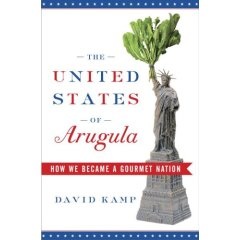
Yet despite all the signs of the Israeli food revolution, the movement has yet to be documented. On the other hand, in his new book ‘The United States of Arugula’ author David Kamp explains the birth of California cuisine, the rise of American celebrity chefs and the movements toward sustainable eating, which are now starting to influence Israeli cuisine, in esoteric and exciting detail.
This fast-paced and engaging 392-page tome examines America’s roots in a Puritan approach to food, which eschewed the French cuisine as too pretentious and instead relied on meat and potatoes, with the occasional monstrosity of fruit salads suspended in Jell-O. Kamp mined Food Network archives, sifted through food-related news reports and interviewed chefs and restaurant critics to find out how the USA went from such unpromising beginnings to become a country suffused with extra-virgin olive oil and truffles.
Kamp’s historical review tackles food as an inseparable part of American politics and counterculture. Kamp notes that the farm-to-table movement in Berkeley took place against a background of seething 1960s political activism that rebelled against the conformist 1940s and 1950s; political theorists were associating white rice with white domination, and marijuana played a supporting role in many restaurant histories.
He starts out with early magazine recipes and restaurant reviews to showcase the drab food and provincial attitudes Americans once had towards innovation in the kitchen. Then he tells of the revelatory moments in several chefs’ lives, mostly when they went to France and tasted things they had never seen at home. Kamp tells the story of Alice Waters going to a stream-side restaurant in France where the chef caught a trout, showed her the still-flapping fish, and then soon after returned with it cooked and surrounded by greens picked from the restaurant’s garden. This, to her, was ideal.
Like many of her contemporaries, Waters returned from France enchanted and began teaching herself to cook. She started hosting dinners for the revolutionary set in Berkeley, and eventually established the Chez Panisse restaurant with the mission of serving local, fresh, organic produce in season. Waters was so eager to serve regional food that she often had local farmers and cheese makers show up unsolicited on the restaurant’s doorstep with boxes of their produce. She patronized the first goat cheese maker in America, and had a standing order with one of the country’s first grass-fed cattle ranchers.
Other food pioneers Kamp notes are James Beard, the first male chef to achieve stardom and help cooking cross the gender divide; Julia Child, who codified French cooking into an easy-to-follow cookbook, and Mollie Katzen, who created vegetarian restaurants with food designed to avoid the “remorse cuisine” of pious non-meat eaters. Katzen’s ‘The Enchanted Broccoli Forest’ is a classic of gourmet vegetarian cooking, and can be found on many cooks shelves.
Above all, Kamp captures the love of food for the sake of food that animated the lives of most of his subjects. Giorgio DeLuca, one half of the gourmet food boutique chain Dean and DeLuca, started an upscale cheese store in Manhattan “in reaction to the processed food that America was starting to live on… Americans were losing their ability to taste. I wanted to show that some things are better than others.”
Kamp renders the talents of celebrity chefs with detail that would wither most people who consider themselves talented in the kitchen, such as a chef at Chez Panisse who would dice twenty pounds of mushrooms in ten minutes with two cleavers. He dabbles in the debate between French and Italian gourmet, then moves on to chronicle the birth of the Cuisinart food processor.
He does however get bogged down by endless name dropping; in a section on the rise of Italian extra-version olive oil and balsamic vinegar, he mentions ten different people or restaurants in one paragraph.
Particularly interesting to me were Kamp’s stories about American farmers’ markets, such as how Seattle’s 101-year-old Pike’s Place Market withstood serious threats in the 1960s in the face of encroaching developers. He also tracks the growth of similar markets in New York and California. As a Tel Aviv resident with only a small, expensive and woefully lacking farmers’ market once a week, I found myself imagining where the ideal place for a real market is – Kikar Rabin. Maybe one day….
This book is best saved for when you are hungry; the pages pop with descriptions of quests for the perfect sun-dried tomatoes or new dishes like lamb chops injected with Madeira, brandy and tangerine juice.
The greatest achievement of Kamp’s book is that he makes the ideas behind a green food industry exciting, charismatic and contagious. He traces how a few determined visionaries transformed the American food experience from one of sustenance to one of savory enjoyment, in the process weaving a closer web between urban diners and the farmers who sustain them, something we here in Israel would do well to study and learn from.
Guest Reviewer Daniella Cheslow is a Tel Aviv based freelance writer & photographer. Check out her witty and erudite blog ‘The Truth Herzl’ for more of her writings about experiencing & engaging with Israeli culture. She specializes in writing about food & environmental issues, with recent articles in the Jerusalem Report.
Check out more reviews in our Green Prophet summer eco-reads festival series:
‘Animate Earth’ by Stephan Harding
‘Field Notes from a Catastrophe’ by Elizabeth Kolbert
‘The Emerald Planet’ by David Beerling
‘Confessions of an Eco-Sinner’ by Fred Pearce




[…] Review of ?The United States of Arugula? by David Kamp By James Israel?s fastest-growing supermarket chain is the upscale Tiv Taam, where customers can browse shelves of international beers, pick through extensive cheese selections and even purchase pancetta to. … Green Prophet – http://greenprophet.com […]