We had just settled into a quiet cottage near the Dead Sea. Despite the intense heat outside our windows, we were still excited about getting out to float in the mineral-rich salty water. My friends had their swimsuits on and were just out the door. But wait a second, I said. All the lights are all still on. And the air conditioner. So what, my friends remarked. We aren’t paying for it. Why should we care?
In theory they were right. But in the end, everyone will pay for needless wasting of energy. When I was young, I could never get my Scottish mother’s accent out of my head: Turn off the lights, it wastes electricity, she would harp incessantly. You’re not paying the bills, we are!
Motivated by her spendthrift ways, my mother’s constant badgering eventually set into my brain. Her arguments became clearer when I moved out of the house for college and had to pay my own electricity bills. You can be sure that I turned off every single light in the house when I wasn’t in the room – sometimes I worked in the corner of one room with a small desk lamp to be the most conservative electricity user.
Today, my spending budget has increased, and while I also want to save money, it is important to not forget that we have a new issue that we must bring into our consciousness: Global Warming. Until we can find a way to harness clean energy from sources like the sun in a widespread way, it might be wise to be vigilant on energy use and impact on our planet.
If you read the newspapers a few years ago, articles about Global Warming were rare. Today, mainstream media, large companies and even your government is advocating that everyone conserve energy by using new kinds of light bulbs known as CFLs or compact fluorescent bulbs: They are those long-life corkscrew bulbs that cost at least twice as much as your standard incandescent bulb. Some people say they look like a soft-serve ice-cream cone.
Bring on the CFLs
They come in a variety of shapes, colors of light and sizes and use about one-quarter of the energy as your standard light bulb. Lasting several times longer (about 10,000) hours, this environmentally-friendly bulb starts paying for itself after 500 hours of use. They also keep your room cooler, which means you can turn down the air conditioner a bit in the summer or maybe use the fan instead.

Recognizing the immediate effects on energy consumption (about 20% of our electricity bill goes to lighting) some cities across the world are even giving away CFLs for free.
And the large department store Wal-Mart (in the US) which has adopted a new ‘green’ consciousness, is planning to sell 100 million of them by the end of this year. The company has joined forces with General Electric (they own about 60% of the home lightbulb market in the US), and together Wal-Mart plans to double US sales for CFLs in 2007.
Diane Lindsley, a buyer for Wal-Mart, thinks 100 million CFL bulbs is a good idea. “It’s rational,” she said in an interview for Fast Company. Before she started working at Wal-Mart a few three years ago, she had never heard of CFLs.
Every swirl bulb sold equals six to eight standard light bulbs. And if we use the law of large numbers, of the 110 million American homes – if every single home-owner bought just one CFL bulb and replaced it with a 60-watt incandescent bulb, the amount of energy we would save could power a city inhabited by 1.5 million people.
New LED Lights
The equivalent in Greenhouse Gases spared, predicts experts, is like keeping 1.3 million cars from driving on the roads. But CFLs are just the first step. A new kind of bulb just hitting the consumer market and brightening up design and trade shows are LED lights – or light emitting diodes.
They are expensive compared to CFLs so at this point tend to attract the refined tastes of modern architect and designer types. But the upside of their high cost is that even though they cost more than CFLs, they use less energy (about 90% less than an incandescent bulb), can last 100,000 hours (or almost two years of burning continually!) and light up faster than other bulbs – that’s why they are used in brake lights.
Today when you find LED-compatible lamps and fixtures, they already have the bulbs built into them. Companies such as Mule, Ledtronics and Eniux are already selling models for the home, while Sylvania and Koncept sell some beautiful desk-lamp designs. Lastly, top end designers such as Herman Miller and Knoll offer deluxe fixtures.
Creative Lighting Solutions
Which brings me to the next topic. Greening your lighting isn’t only about the bulbs that you choose. It’s also about the lamps that you put them in.
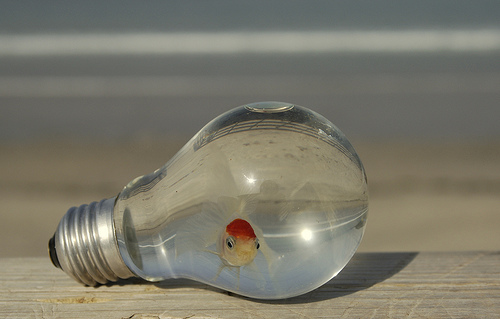
Are they made from natural, recycled or reused materials? Have you found where to dispose of your bulbs in an eco-friendly way once they have died? Most cities in the world have light bulb disposable facilities, so that we can make sure that the chemicals in the bulbs don’t end up in our groundwater.
6 Easy Green Lighting Tips
- Getting into the habit of switching off your lights, is an important part of the process, as is getting the most out of daylight (sunlight is also healthier for you!), and using wall warts.
- There are products on the market that can let you switch off your entire house with one main switch, while leaving your bedside alarm clock and other appliances like the fridge running when necessary.
- Just like new standards exist for idling cars, you too can turn out an idling light bulb. Here is my recommendation: if you leave the room only for seconds, it is more efficient to turn off your incandescent bulb. CFLs should be switched off if you are out of the room for three minutes and if you are not in the room for more than 15 minutes, you should turn off your LED light.
- Outdoor lights – use motion sensors and timers and save your finger energy at the same time.
- Be creative. Light up your life in a unique way. Make your own lampshades out of recycled fabric; build yourself a light-beam casting table lamp at pottery class.
- Most of all take your lighting habits seriously and share them – by telling all your friends and family how to light up their lives with a clear consciousness.
Want more ideas for greening your life? Visit greening your wardrobe. It will lead you to ways you can green your whole house.