

 Ridley Scott’s, The Martian is based on Andy Weir’s best-selling novel. It was filmed in Jordan’s beautiful Wadi-Rum desert.
Hollywood loves adventure stories, especially tales of humans struggling to survive in the wilderness. The Martian has  something in common with The Life of Pi, 127 Hours, Castaway, Into the Wild and All is Lost.
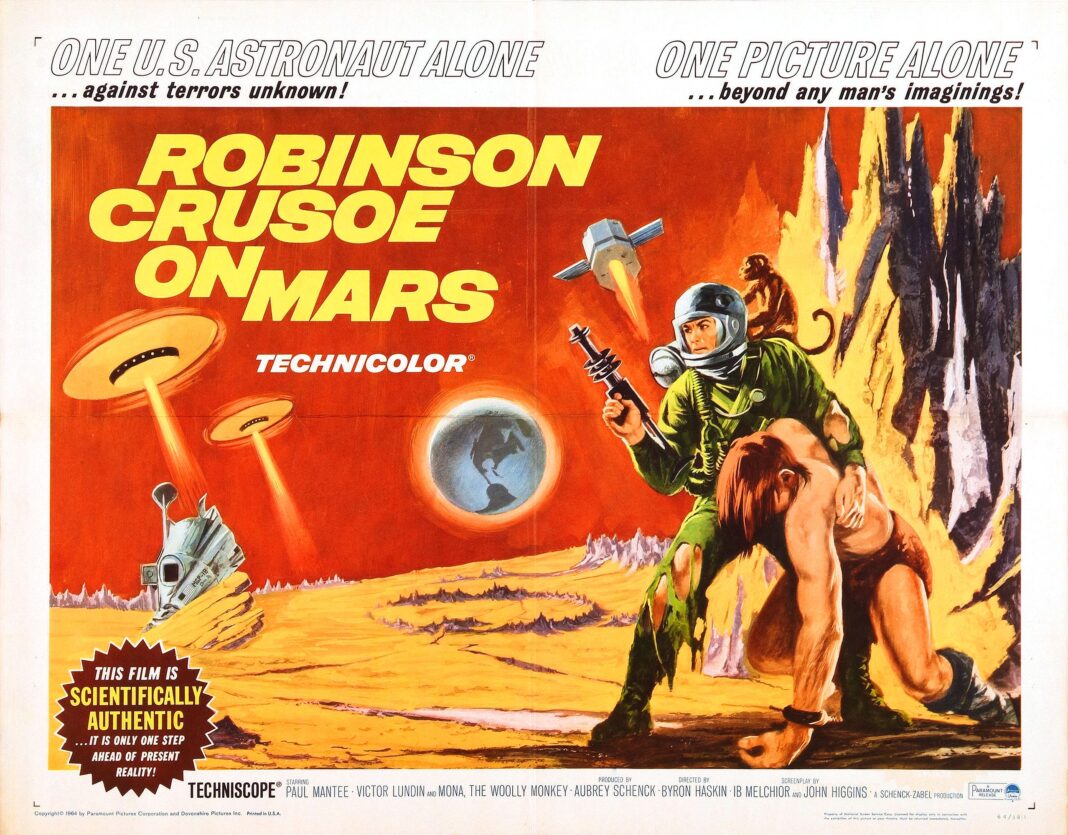
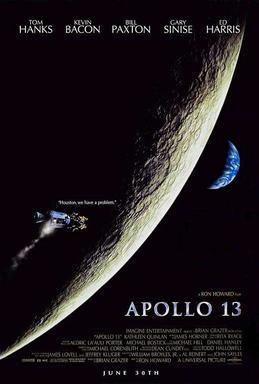
But a much more direct comparison can be made to two much older films, Apollo 13 (1995) and Robinson Crusoe on Mars (1964.)
 Matt Damon plays botanist, terraformer and extreme survivalist Mark Watney in The Martian, a film directed by Ridley Scott and based on the best-selling novel by Andy Weir.
When Drew Goddard wrote the screenplay for The Martian, he wisely chose to use the novel’s first-person journal format. This gives the reader a glimpse inside Mark Watney’s head, something we would miss if the film had used the third person point of view as in All is Lost. This also works well for the YouTube generation, already familiar with the wide-angle views of video blogging and what appears to be an authentic-looking GoPro camera strapped to Mark’s spacesuit.
Even with this adaptation, we know much less about the character’s backstory than we did in the novel. Matt Damon’s expressions and colorful language fill in some of the gaps.
Robinson Crusoe on Mars also uses this first-person narrative technique when Commander Kit Draper finds himself alone on Mars. He begins to record his experiences into an authentic-looking early 1960s tape recorder. Something about the film’s creepy etherphone music, the fire-colored sky and the sound of the clanging in the Martian wind gives this movie an atmosphere of loneliness beyond what we see in The Martian.
Kit explains, “All right, here’s another note for you boys in Survival…for you geniuses in Human Factors. A guy can lick the problems of heat, water, shelter, food. I know. I’ve done it. And here’s the hairiest problem of all – isolation, being alone. Boy, here’s where he’ll crack. Here’s where he’ll go under. I know, I know. I had great training, including two months in the isolation chamber. But when I was in that chamber, I knew I was coming out. I knew I’d be with people again. But up here on Mars…”
Is it OK for kids?
Except for an opening scene involving adult behavior at a party, Ron Howard’s Apollo 13 is good fun for kids of almost any age. There were no presidential visits to strip clubs that made The Right Stuff the wrong stuff for less LB-jaded eyes. The Martian also aims at a younger and broader audience than has been usual in recent years. Anyone sensitive to seeing people hurt, should probably go out for popcorn about ten minutes into the movie. But there is nothing that you wouldn’t see in an average TV medical show.
The movie withheld some of the book’s salty dialog. “Like”, “Dude” and “F***” may make up a growing proportion of the YouTube generation’s vocabulary, but their overuse can be distracting or offensive to some people. Jane Hawking was distracted by the profanity in The Theory of Everything even though their own children admitted to adding swear words to Stephen Hawking’s voice synthesizer. This movie could have easily aimed for a profitable 18+ rating, but that would have prevented it from inspiring a younger generation.
Is it as good as the book?
Matt Damon does a good job of translating some of the novels jokes and curses into something we can watch on the screen. He tones down the character’s abrasiveness enough to make him believable as a crew member on a long voyage. The movie does miss some of the novel’s humor and scientific detail, especially regarding biology, energy flow and maintaining a terraformed environment.
But it is fun and it adds some beautifully interesting visuals. It is amazing to see the color and landscape of Mars especially when we have photographic evidence that Mars actually does look like that. The movement of shadow and light in the scenes depicting the centrifugal artificial gravity of the Hermes ion drive spacecraft is a beautiful detail until someone starts trying to calculate if the spin rate and position of the sun are correct. The way weightlessness and artificial gravity are portrayed along with the physics of tethered bodies in microgravity is realistic enough to make us wonder whether this was filmed aboard the ISS or inside a CGI computer. The Martian was filmed in 3D but this wasn’t overused. In fact it was barely noticeable except for a few scenes inside the spacecraft.
Robinson Crusoe on Mars was filmed in technicolor at a time when electromechanical rocket fuel gauges, zippo lighter flames, models, strings and gelatin filters were pushing the bleeding edge of Hollywood special effects. The movie is apologetically campy with a supporting cast that includes monkey named Mona and Colonel Dan McReady, played by Adam West – aka Batman and a man named Friday.
The movie’s poster boldly claims, “This film is scientifically authentic… it is only one step ahead of present reality!” Well– maybe a couple of steps. But given that this was filmed before any probes had photographed Mars, the landscape and the color of the sky was realistic enough, Ignore the orbiting flameballs and flying saucers. Unlike sparkling Ceres and Technicolor Pluto, Mars isn’t so very different from what we imagined more than 50 years ago. Even the production of oxygen and water by heating rocks might be plausible now that we know a little more about the chemistry of Mars.
Is it believable?
As with the book, you’ll find endless online debates over the scientific accuracy of The Martian. The fact that people are complaining about the force of Martian winds and the color of Hydrogen flames gives a clue as to how little suspension of disbelief is required for those of us without PhDs in Astrophysics. Some have noted that it is probably safer to be a castaway on Mars than it is to be exposed to interstellar radiation while on board the spacecraft on its way home.
Apollo 13 was filmed in 1995 when CGI wasn’t nearly good enough to simulate weightlessness. So the more fun/nauseating comet comet option was necessary. The weightlessness was realistic because it was real. Director Ron Howard had the support of NASA engineers and astronauts and history to guide him in making a film about a story that didn’t need any Hollywood embellishment to be compelling. Other than the need to fit this storyinto a 2 hour and 20 minute, there was no reason to change anything and it probably the most accurate fictionalization of Apollo era spacecraft. But when Ron Howard talked to audience members after its first screening, many people told him that it was unrealistic. “There’s no way those guys would have survived.” Indeed, truth is much stranger than fiction.
The Martian faces the opposite problem. Many people left this movie assuming that it was non-fiction. That’s right, they believed that we already had a large ion-drive spaceship like Hermes and habitats on Mars. This film strays furthest from reality in its portrayal of our culture and politics. Humans first set foot on another world with Apollo 11. Only eight months later when Apollo 13 launched, the mission wasn’t even broadcast on the America’s TV networks until things started to go wrong. How will we maintain our cultural attention span when a single Mars mission could take as long as the entire Apollo space program?
NASA’s current budget is anemic, less than 1/50th the amount spent on the first bank bailout, less than what will be spent on mudslinging in America’s 2016 election campaign. The movie imagines a 1960s NASA transposed into the near future with no sign of the private space companies such as Elon Musk’s SpaceX. Hopefully we won’t have to repeat the failures portrayed in the movie in order to convince ourselves that global cooperation will be necessary to make this happen. Hopefully someone will be inspired by watching this movie. Maybe it will be you.
Photos are from the movie posters of Apollo 13, Robinson Crusoe on Mars and The Martian.

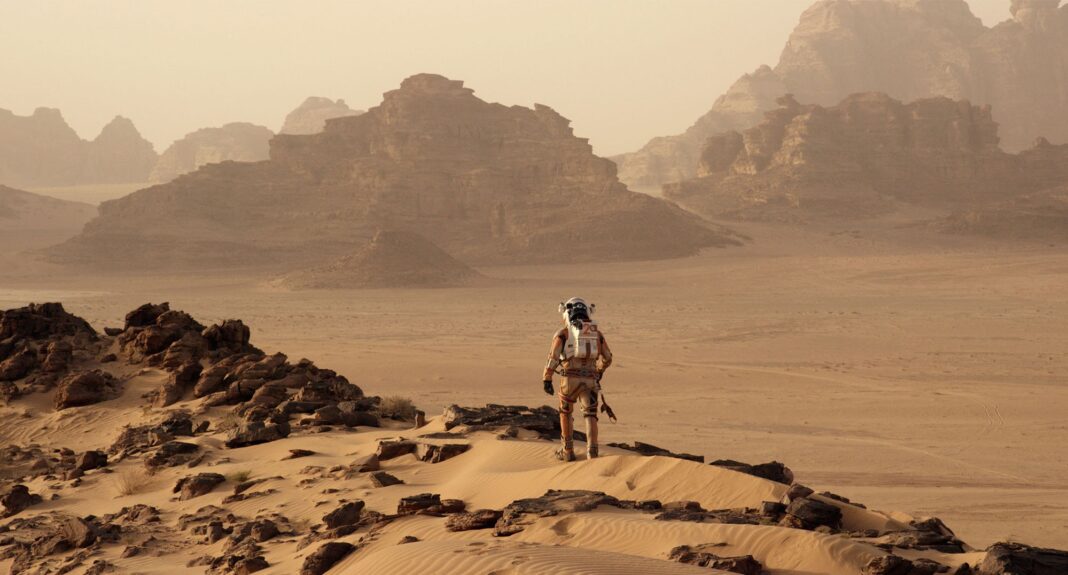


Ummmm, there’s a plant in the “Martian soil” in the lower left corner of the Martian poster–the one where we’re behind him staring off into the topography. Does anyone else see that? Talk about a photoshop fail!