

 In Egypt, people often have to line up for hours to fill their cars and trucks with diesel fuel – particularly during summer months when it comes at a premium.
Concerned to ease these shortages, as well as pollution and climate change, Egyptian agricultural engineer Wadad Khaireddine is pushing to grow a desert full of “Laxative Nut” trees. More commonly known as the Jatropha, this wonder tree has multiple benefits: it fights desertification, requires very little water, and – most importantly – can be used to provide biofuel.
Speaking with Al-Shorfa, Khaireddine said that the Jatropha tree is a wild plant native to South America that belongs to the Euphorbiaceae family.
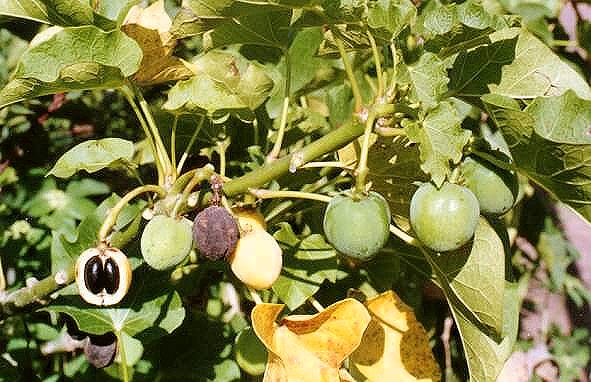
The tree has yellow flowers that first turn into seeds and then a fruit that resembles olives. Seeds inside the fruit are comprised of up to 45 percent oil that can be used as biodiesel.
“Unfortunately, the plant’s oil is unsuitable for human consumption because it contains toxic substances,” Khaireddine told the paper.
She says unfortunately, but the fact that the oil is not fit for human consumption is a benefit since it ensures that hungry people are not being denied food because of fuel, which is a common complaint in the biofuel industry.
Also, while some crops are water intensive (and Egypt doesn’t have much H20 to share), the Jatropha tree is said to be a low maintenance species that requires very little water to thrive.
The wood is strong and can be used for building projects, and essential oils can be used to make candles, soap and glycerine.
“The tree can be planted twice a year, at the beginning of spring and autumn,” Khaireddine explained to Al-Shorfa in a recent interview.
Plus “… it can be planted densely in desert areas, with one tree per every two metres, and it does not require any sort of pesticide or organic and mineral fertilizers, especially if irrigated by treated wastewater.”
She adds that a forest of Jatropha trees could stave off desertification by acting as a wall that prevents wind from sweeping away the desert sands.
Through her land reclamation company Al-Wadad, Khaireddine has raised some money from private sources in order to develop a pilot project that will prove to potential investors and the Egyptian government that Jatropha is a viable solution for Egypt’s energy and pollution crisis.
It can also provide a host of jobs in a country that has at least a 13 percent unemployment rate (though we suspect those numbers are a lot higher.)
But she is still looking for land, which she hopes to acquire under the government’s land reclamation scheme.
Image via Wikipedia


Have you ever thought about writing an e-book or guest authoring on other websites?
I have a blog centered on the same ideas you discuss
and would really like to have you share some
stories/information. I know my audience would enjoy your work.
If you’re even remotely interested, feel free to send me an e-mail.
Here is my web-site :: flappy bird hacks [Stephan]
The only long term way to lessen traffic problems is to peacefully reduce the humen population with family planning programs. But people are addicted to the growth of money and economic power, while the Earth is slowly shrinking — a trip toward ecocide and self-extinction. They could live in peace and balance on this planet
for thousands of years, but it wouldn’t be as much fun as trying to conquer the universe.
Nice article. Too bad its basicly nonsense. for the reason why check this link.
http://blogs.discovermagazine.com/80beats/2009/06/09/jatropha-not-a-miracle-biofuel-crop-after-all/#.UYPp0rXa8uA
There are companies working to commercialize jattropha for biofuel. Maybe you could comment rather than just provide a link.
because the link explains far better than I ever could why this will never be a replacement for petrolium. It will require a lot more water and energy to produce a biofuel than its worth. The painful truth is that there is no practical replacement for the energy density and low cost of petrolium. Read the link, its not that hard.
[…] via Superpower “Laxative Nut” Tree Could Solve Egypt’s Fuel Crisis | Green Prophet. […]
This idea seems to have a very high probability of success. It seems like the provenance could already be completed by simply taking the nuts, planting them in a very small area, and watching them thrive. Why do you need to acquire land and make a huge project out of it in order to prove it? Perhaps in my naivete I am over-simplifying this.