
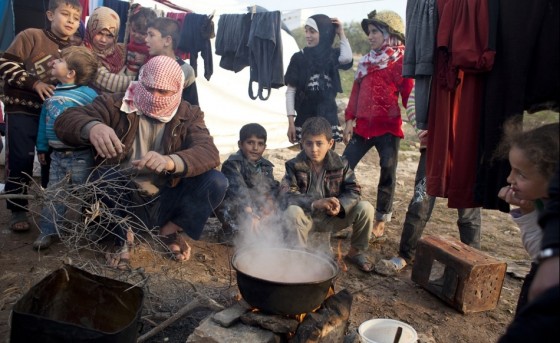

Tomato and potato soup being cooked on an open fire at Qah Camp for displaced Syrians. Camp officials say they are hoping they will receive the money needed to run electrical systems so that heaters can be used © Jodi Hilton/IRIN
Residents of Syrian towns that have run out of heating oil say they are getting sick after resorting to burning crude oil to keep warm. The nearly two-year conflict in Syria made fuel widely unavailable, and though spring is drawing nearer, cold spells are still intermittently hitting some parts of the country.
“The smoke stinks terribly, and many people are suffering from respiratory problems and skin irritations because of it,” said a dentist in the eastern governorate Deir-ez-Zor, calling himself Abu Adnan. “But what can we do? We need warmth and we need something to cook our food with.”
Residents of rebel-held areas of Deir-ez-Zor, Idlib, Aleppo, Hama, Homs and Rural Damascus governorates say heating oil, known as mazout, as well as diesel and gasoline have all but disappeared from the market.
“Last winter, the problem was that fuel became very expensive,” said Abu Adnan. “This winter, you almost can’t find it any more.”
“People are coming to me with lung problems from inhaling the smoke,” said Hassan Hamidi, a doctor in the town Apamea in Hama Governorate. “There are also a lot of bad burns because the oil is easily flammable, and so accidents are frequent.”
Mohamed Elmi, regional adviser for food and chemical safety at the World Health Organization (WHO) says burning unhealthy products is an unfortunately common coping mechanism in conflict zones.
(Related: Why Not Use Biodiesel – Green Prophet reports from Syrian refugee camp)
“Whenever there is an emergency situation, people typically respond by burning crude, wood or furniture – whatever they can get their hands on.”
While it is difficult to determine the health risks without knowing the specific qualities of the crude delivered in Syria, he said, the smoke is generally harmful.
“Now, the FSA makes sure that only some branches of the trees are cut. We don’t want to turn our country into a desert.”
“It usually contains higher levels of sulphur and carbon monoxide, which is very bad for the respiratory system and can cause headache and nausea – particularly because people tend not to open their windows while they are heating.”
Several other factors, including lack of hygiene, dirty water, and stress – could also be at play.
In recent months, rebel fighters have made considerable gains in the northern and eastern governorates, where all of Syria’s major oil fields are located. According to opposition sources and media reports, the opposition has captured four out of five oil wells in Deir-er-Zor, and one out of two in Hassakeh Governorate in the north.
However, nobody is running the wells held by the opposition because almost all oil workers have fled, according to Samir Seifan, a prominent Syrian economic analyst who used to advise the government but is now in Dubai and affiliated with the opposition.
While oil production has slowed dramatically, crude oil pirated from wells is available in moderate amounts. Where crude is not accessible, people have found other means of keeping their houses warm – but at a long-term cost.
Manhal,* a fighter with the rebel Free Syrian Army (FSA) in Hama Governorate, said people have even started cutting down trees from the orchards. “We are losing our trees, and this means our lives will be much harder in the future. We are regressing.”
Residents of Hama also started burning desks and chairs from schools, Manhal said: “Survival is the only thing people are thinking of now.”
In some opposition-held areas, rebels are regulating where residents can cut firewood. In the northwestern governorate of Idlib for example, FSA fighters have started policing the olive groves, said Ibrahim, a resident in Maaret al-Numan.
“This winter, people cut down 500 hectares of olive groves around our village because the cold can be very cruel. Now, the FSA makes sure that only some branches of the trees are cut. We don’t want to turn our country into a desert.”
Still, different groups are trying to benefit from the oil wells in opposition-controlled territory.
“Some people use their connections to obtain oil from the FSA, and then they sell it,” said Abu Emad*, an activist in Rural Damascus. “So, you now find merchants offering crude in many regions.”
*not a real name
This article is reprinted from the humanitarian news source IRIN
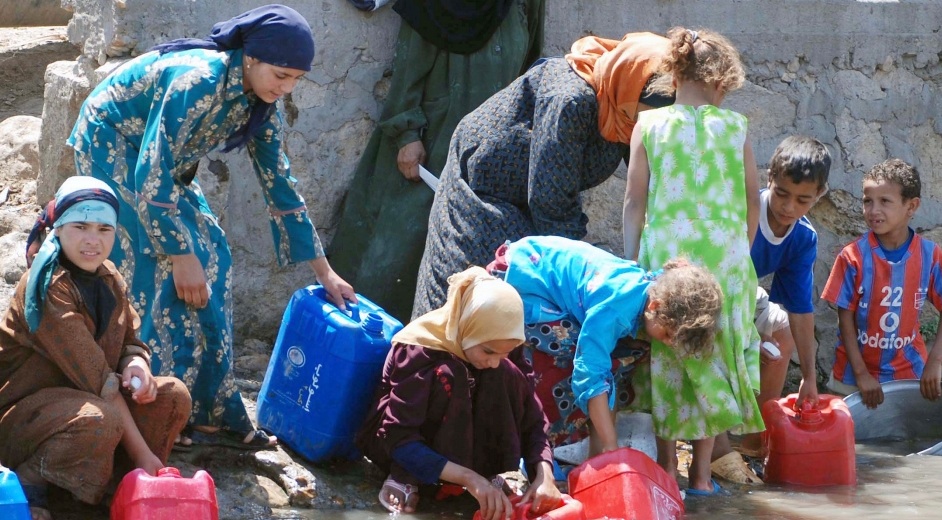


The civil war in Syria, like such wars almost everywhere else, is between two male-dominated factions, while the suffering is mostly upon women and children. I don’t see any solution to this dilemma other than placing educated women in leadership around the World.