

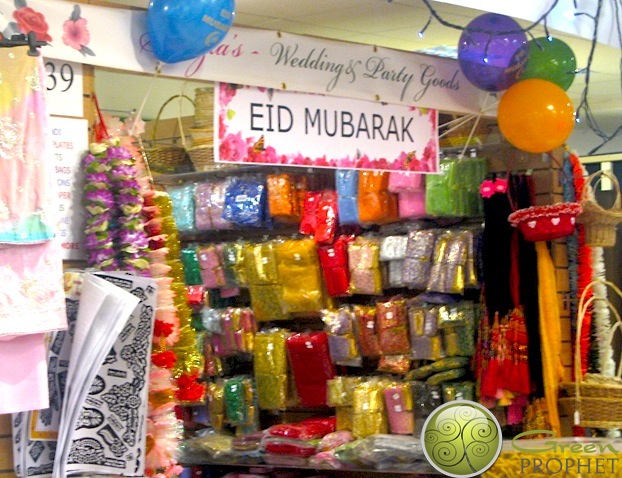
 Zaufishan gives 7 tips on making the Muslim Eid festival more sustainable.
I’m overjoyed and giddy like a child on Christmas eve. As a Muslim, my year is punctuated with two religious festivals, or Eids. Eid-ul-Fitr ended the 30-day fasting in Ramadan two months ago, and Eid-ul-Adha which marks the end of the Hajj pilgrimage in Makkah with a sacrifice.
A sacrifice of meat is an emphasised ritual for the pilgrims, while Muslim families all over the world slaughter an animal to commemorate Prophet Abraham’s sacrifice, and distribute it to the poor nearby. This is the ultimate offering: giving your most loved riches to those without, for God’s sake.
It creates a balance of wealth and unites the faithful.
After a day experiencing ever-growing consumerism attached to the Muslim celebration and on the eve of “Eid-mas”, my family already sponsored a meat-drive for British locals and abroad in Pakistan.
Yet, I am wondering what it is exactly I was supposed to sacrifice. Got any ideas?
Sacrifice is an ethical component of Islamic faith. Pilgrimage too is a journey of preservation – reminding the inner-self of an organic fate all the while using environmentally friendly transportation, the Makkah Metro, to get there. Prophet Muhammad of Islam called these days of pilgrimage the “days of Sacrifice”, saying that selfless actions would be rewarded multifold.
How to give back sustainably for Eid Adha
Without sacrifice, fasting during Ramadan every year becomes a mere diet phase for Muslims. Without sacrifice, the compulsory 2.5 zakat tax intended to purify one’s use of wealth, is nothing more than an economic burden. Hajj, the fifth pillar to Islam’s 5 after belief, prayer, fasting and charity (zakat), is also fundamentally based on the ultimate act.
But our sense of giving is lost when our focus is on providing for ourselves. Charity is an everyday act, yet on the day of sacrifice, a simple donation to the local mosque is not enough. In popular custom, a general view is accepted that the Eid festivals are like a ‘free-pass’, what we consume and wear is not going to be tallied against us, provided of course what we consume is Halal and healthy.
Instead of dishing out the usual charity, do more and do something different. Invest in kindness, reach out to a new organisation, challenge yourself to commit the ultimate sacrifice.
7 ways to make your Eid Adha sustainable
1. Give your Eid outfit away: A rich culture of ornate clothing prevails in Arab people and in my own African heritage. But instead of buying the top-end price of suits, go one band lower and donate the difference to a charity. Better yet, follow a Sunnah (prophetic action) by wearing your new suit once and giving it away. Find a regional clothes bank at Islamic Relief who ship clean clothes to disaster areas.
2. Fairtrade Eids: Take is a step further and buy your next Eid outfit from a Fairtrade store, buy Islamic tops that are organic, and look into swapping one item of clothing for hijab-friendly ethical outfits. Your clothing will carry the trademark of fair business, alleviating working conditions in third world countries, and you don’t lose out on the fabulousness.
3. The 3/3 food rule: Reduce that food baby. Save your expenses and make less food for Eid. Keyword: Less. Instead of having a gigantic Eid feast of meats and fats brimming with heart-attacks, opt for more fruit salads and grow your own vegetable. Check out how to make maklubah, an Arabic upside-down chicken and rice dish. And follow the 3/3 rule: Eat till your stomach’s full one-third, drink till your full one-third and leave the rest to breathe!
4. Eid gifts with value: Money is a standard Eid present but it’s so bland. Coupons and vouchers come second, but that money can make a bigger impact. Plant a tree in Palestine (or Britain) with Trees4Life, on behalf of someone or as a group of friends. Handcraft your own upcycled Eid cards. Read the Islam and Water story of Hajrah and son Ismail, who were the originators of modern day Hajj. And take your children to a soup kitchen on Eid day to instill community love.
5. Use less water: Muslim women, I’m talking to you. On Eid day, take part in water management by dedicating one set of dishes for everyone so that less water is used for washing up. Save unused clean water for tea or coffee and if you drop an ice-cube onto the floor, don’t chuck it in the sink, drop it into a plant pot.
6. New Year Resolutions: Hajj occurs in the last month of the Islamic calendar, Dhul Hijjah. Instead of making a dozen new year’s resolutions just make one. And stick to it throughout the year. My resolution is to (God willing) become a full-time volunteer worker, and you can start by giving just 5 minutes a week to your local environmental campaign or disability home.
7. Zabiha or Halal? Animal slaughter: Finally, ask your butchers where they get their meat from. Are the animals well fed, treated humanely? If the meat’s zabiha, it’s slaughtered according to religious law, but is it halal (Islamically permissible) and organic? Princess Ali of Jordan supports advancements such as stunning the animal before slaughter so be wise and ask.
Watch Almaghrib’s video on Zabiha Man vs. Halal Man to figure out the difference:
I’d love to hear what you gave up for Eid-mas. Comment below!
From the Green Prophet team and I, عيد مبارك / عید مبارک
Eid-ul-Adha Mubarak.
Want to do do more to make Eid Adha more sustainable? Read:
Nominate Your Green Prophet Eco Hero for 2011
Some Tips to Help Break Your Coffee Habit
The Do’s and Don’ts of Green Blogging for Muslims



@ ali ,u r right,bt it wil nt b easy,bcoz we r used to it.even quran told us to eat meat except d unclean ones lik pig nd dog
@Sonia – As human beings, the food chain always places us on top. If we look at the theory of evolution, the first humans hunted animals as well as eat plant food. Comparing it to slavery however, for me personally, is a drastic comparison. If we want to “free” animals we should abolish zoos, safari parks and prevent animal extinction.
@Karin, that’s a really interesting and spiritual view: being at one with nature so that it is never wasted. Muslims believe Paradise is built on that premise, but even then, meat is served up above! {http://quran.com/52/22}
Very necessary. 😀
Evolutionarily humans are all omnivors and the quran permits muslims to eat most meats except pork. I believe proteins from meat are an essential part of diet. When you look at the animal kingdom and you see the hierarchy the herbivors are not as quick or smart as carnivors. Eg. Lion vs antelope.
Plus a charbroiled steak is SO tasty
Jk but seriously i do agree. Gandhi said that you can judge a nation by how well it treats its animals. I think less meat consumption would be ideal. However butchers will also have to adapt to lower business.
@Sonia
Youre a vegetarian or vegan I presume. Thanks for being a debbie downer. Im going to eat an extra lamb just for you.
@Ali. Was that necessary?
There can be no excuse for killing an animal except for self defense. A majority of people supported slavery and segregation until just a couple centuries ago. As civilization advances, slaughtering any animal on any day for food, pleasure, or for superstitious rituals, will be considered unacceptable. These things take time, but that doesn’t mean any effort should be spared to push for them.
@Sonia: I think people have the right to eat meat if they choose. Maybe you are right – that civilization will advance to a level of spirituality where we will all be at one with nature, talking with the trees, and dancing with dolphins, but until that happens, man will be man. Meat will be eaten. Some religions believe that an animal’s soul can be raised to a higher level if eaten by man. Is it possible that there could be some truth in that? Just asking.