New Jellyfish Species Tells a Tale of Global Warming

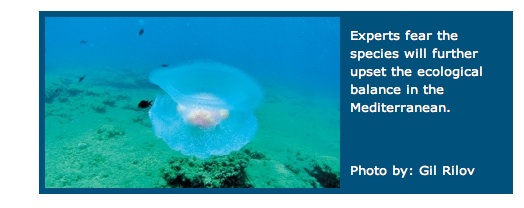
jellyfish marivagia stellata
The new species, marivagia stellata, previously not known to science, doesn’t sting but is symptomatic of the environmental woes facing the Mediterranean Sea

A new species of jellyfish found off Israel’s coast the summer poses no threat to bathers but should serve warning to the countries bordering the Mediterranean Sea about the dangers posed by global warming and damage to the environment. Named Marivagia stellata and marked by a translucent hue of blue, patterned with red stars, dots, and streaks, two specimens were caught on the southern edge of Haifa Bay and off the coast of Beit Yannai beach this summer. Measuring 15 centimeters (six inches) in diameter, the fish does not sting humans.

Swimmers view them as a nuisance because of their toxic and painful sting, but scientists have much bigger problems with jellyfish.  Hardy survivors, jellyfish thrive in places where overfishing, chemical pollution and rising sea temperatures have killed off other species. Indeed, they serve as a barometer of ocean health.

“It’s bad news,” says Bella Galil, a senior scientist at Israel’s National Institute of Oceanography in Haifa: “We don’t know how this particular species will develop, but the phenomenon causes the displacement, and replacement of native local communities with invasive species, and can destabilize the food chain.”

Surrounded by countries with more than 400 million people, the Mediterranean is one of the most heavily used bodies of water in the world – a fishing grounds, a transportation corridor, and the receptacle for sewage and industrial waste. About a third of the world’s total merchant shipping travels on Mediterranean waters and many species have nearly disappeared because of pollution, including the Mediterranean monk seal.

Marivagia stellata is just the latest in a series of invasive jellyfish species that has been discovered in the eastern Mediterranean over the years. Galil said the new species had probably originated in the Red Sea or Pacific Ocean and had arrived after traveling through Egypt’s Suez Canal, which connects the Red Sea with the Mediterranean.

“The Mediterranean is a very well-studied sea,” said Galil, who was among the team of scientist to identify the new species. “Because the jellyfish was found so close to shore, it is very unlikely that this jellyfish would escape notice in a sea studied so extensively.”

In fact, Marivagia stellata probably found its way in to the Mediterranean at least a few years ago. Galil said a specimen was discovered off the Israeli coast in 2006, but was lost before it could be positively identified.  Another specimen was probably caught off the coast of Lebanon in October, according to local media reports, which Galil termed a “bad omen.”

“It means that it just arrived and already has established in a fairly wide population and that it has the potential to increase and go further,” she said.

The Mediterranean has been invaded by successive waves of outside species, a process that began after the Suez Canal opened in 1869 and linked the Mediterranean to the Red Sea and from there to the Indian Ocean, according to Professor Menachem Goren, a marine biologist at Tel Aviv University. Among the more infamous interlopers, is the jellyfish Rhopilema nomadica, which is called “hutit” in Hebrew and began swarming southeast Mediterranean in the 1980s, inflicting painful injuries on unwary swimmers.

“Recently this phenomenon has accelerated and the number of invasive species has increased sharply,” said Goren, who attributed the increase to rising water temperature resulting from global climate change.

Scientists say it is too soon to tell what impact the new species will have. But jellyfish are blamed for clogging water intake pipes at desalination plants and coastal power plants. Marivagia stellata  and the increased jellyfish population could disturb the underwater food chain, scientists say. Jellyfish consume the plankton that other fish eat and prey on fish larvae.

Goren was careful not to speculate on the threat posed by Marivagia stellata, but noted that, “another jellyfish almost completely destroyed local fisheries in the Black Sea ten years ago.”

Reprinted courtesy of the Middle East News Source, The Media Line


LEAVE A REPLY

Please enter your comment!
Please enter your name here

TRENDING

Earth building with Dead Sea salt bricks

Researchers develop a brick made largely from recycled Dead Sea salt—offering a potential alternative to carbon-intensive cement.

Farm To Table Israel Connects People To The Land

Farm To Table Israel is transforming the traditional dining experience into a hands-on journey.

Remilk makes cloned milk so cows don’t need to suffer and it’s hormone-free

This week, Israel’s precision-fermentation milk from Remilk is finally appearing on supermarket shelves. Staff members have been posting photos in Hebrew, smiling, tasting, and clearly enjoying the moment — not because it’s science fiction, but because it tastes like the real thing.

An Army of Healers Wins the 2025 IIE Goldberg Prize for Peace in the Middle East

In a region more accustomed to headlines of loss than of listening, the Institute of International Education (IIE) has chosen to honor something quietly radical: healing. The 2025 Victor J. Goldberg Prize for Peace in the Middle East has been awarded to Nitsan Joy Gordon and Jawdat Lajon Kasab, the co-founders of the Army of Healers, for building spaces where Israelis and Palestinians — Jews, Muslims, Christians, Druze, and Bedouins — can grieve, speak, and rebuild trust together.

Peace hospital opens between Jordan and Israel

The proposed medical centre, described by Emek HaMaayanot Regional Council head Itamar Matiash as “a centre for cancer treatment, so that people from Jordan or further away could come and receive treatment,” would become the flagship of a wider cluster of medical, academic and innovation-based services planned for the Israeli half of the zone.

Qatar’s climate hypocrisy rides the London Underground

Qatar remains a master of doublethink—burning gas by the megaton while selling “sustainability” to a world desperate for clean air. Wake up from your slumber people.

How Quality of Hire Shapes Modern Recruitment

A 2024 survey by Deloitte found that 76% of talent leaders now consider long-term retention and workforce contribution among their most important hiring success metrics—far surpassing time-to-fill or cost-per-hire. As the expectations for new hires deepen, companies must also confront the inherent challenges in redefining and accurately measuring hiring quality.

8 Team-Building Exercises to Start the Week Off 

Team building to change the world! The best renewable energy companies are ones that function.

Thank you, LinkedIn — and what your Jobs on the Rise report means for sustainable careers

While “green jobs” aren’t always labeled as such, many of the fastest-growing roles are directly enabling the energy transition, climate resilience, and lower-carbon systems: Number one on their list is Artificial Intelligence engineers. But what does that mean? Vibe coding Claude? 

Somali pirates steal oil tankers

The pirates often stage their heists out of Somalia, a lawless country, with a weak central government that is grappling with a violent Islamist insurgency. Using speedboats that swarm the targets, the machine-gun-toting pirates take control of merchant ships and then hold the vessels, crew and cargo for ransom.

Leopoldo Alejandro Betancourt López Turned Ocean Plastic Into Profitable Sunglasses

Few fashion accessories carry the environmental burden of sunglasses. Most frames are constructed from petroleum-based plastics and acrylic polymers that linger in landfills for centuries, shedding microplastics into soil and waterways long after they've been discarded. Leopoldo Alejandro Betancourt López, president of the Spanish eyewear brand Hawkers, saw this problem differently than most industry executives.

Why Dr. Tony Jacob Sees Texas Business Egos as Warning Signs

Everything's bigger in Texas. Except business egos.  Dr. Tony Jacob figured...

Israel and America Sign Renewable Energy Cooperation Deal

Other announcements made at the conference include the Timna Renewable Energy Park, which will be a center for R&D, and the AORA Solar Thermal Module at Kibbutz Samar, the world's first commercial hybrid solar gas-turbine power plant that is already nearing completion. Solel Solar Systems announced it was beginning construction of a 50 MW solar field in Lebrija, Spain, and Brightsource Energy made a pre-conference announcement that it had inked the world's largest solar deal to date with Southern California Edison (SCE).

Related Articles

Popular Categories