
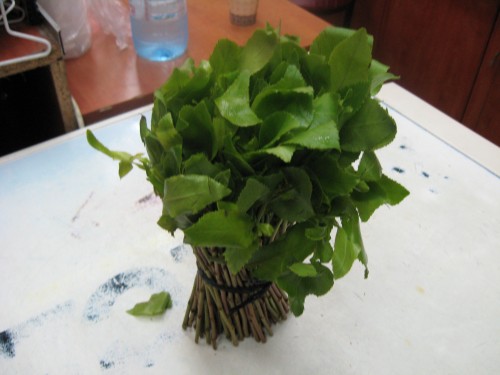

 Miriam interviews store owners who sell legally addictive substances: soft drinks, cigarettes, junk snacks – and Gat.
Some folks chew gum. A lot of Israelis chew seeds: sunflower, pumpkin, watermelon seeds. Some people put a plug of tobacco into their cheek and chew away, only pausing to spit once in a while. But for maximum chewing pleasure, there’s Catha edulis, popularly known all over the Middle East as gat, qat, khat, or ghat. Chewing the fresh green leaves produces a mild euphoria, yet heightens awareness. The energy boost experienced is different from caffeine, in that one is more alert, yet relaxed.
Or so the owners of this store say. They should know. They import and sell gat.

Gat is legal in Israel, and in countries like Yemen where gat is being blamed for environmental problems. If were to be made illegal, thousands of people would immediately start breaking the law every day. Members of the Yemenite and Ethiopian communities regard the habit as harmless and ordinary.
But a Yemenite woman told us:
“Gat is the bane of Yemen. The husbands go to the shuk and spend all their money on it, while their wives and kids go hungry at home.”
In the Israeli store, the older brother looks tired, worn thin. He wears a sweaty T-shirt and his jaws move incessantly, working the Gat in his mouth. The younger cultivates a hip look, with a blond streak in his gelled black hair, a sharp black shirt, and an impatient manner. Removing his sunglasses, he revealed blood-shot brown eyes.
We asked which ethnic groups buy Gat.
All kinds. Russians, Ethiopians, not only Yemenites. But the majority are Yemenites.
“Do women also chew Gat, or is an exclusively male pastime?”
Women also chew. They don’t send their husbands either, they come here themselves.
“What’s the attraction in Gat?”
It keeps you awake, but feeling relaxed. Your mouth feels parched, all the time, but you drink a lot of water and get used to it.
“Does it have side effects besides thirst?”
There are no side effects, just a good feeling. Some people say Gat’s addictive, but that’s ridiculous. I don’t believe it.
“How much Gat do you chew a day, yourself?”
Half of that package is enough to keep me going for eight hours.
The older brother added, “For some people, that’s not enough; even a whole package isn’t enough.”
“Can you tell us about the quality of the Gat you sell?”
We sell two kinds: local stuff grown in people’s gardens, and stronger leaves flown in from Ethiopia. We keep the leaves moist and wrapped in cloth, and they last 5-7 days. The Israeli Gat, we have in stock every day. The Ethiopian leaves come in three times a week.
“How much does it cost?”
The local leaves are NIS 50 for a bundle. Ethiopian gat costs NIS 80.
By today’s exchange rate, this is $14 and $22.26 respectively, per bundle.
This link from al-bab.com describes the dreamy effects of Gat. And the British-Yemeni Society has an article describing how the gat habit impacts health. Fairly scary stuff, those gat side effects.
Non-addictive? That’s debatable.
Harmless? Hardly.
Expensive? Well, look at the figures above.
And does chewing gat contribute anything valuable to society? It sure doesn’t look like it.
More from Green Prophet on drug use in the Middle East:
Photos of Gat leaves by Miriam Kresh.


Go for it, Idris!
Salam,
Here in East London UK our local mosque Al-Huda, has told
The local community that Khat is Haraam. And that its destroying the
The local Community. I’m going to campaign for it to be outlawed
Even from a purely ethical perspective, gat is bad for being addictive, damaging to the environment and harmful to the health of those who use it.
This reminds me of the ‘paan’ chewing culture from Bangladesh and Pakistan, where betel leaves are wrapped with tobacco and chewed for its addictive flavour.
In the Islamic faith, anything that puts the environment, economy, health and well-being of people is “makruh” – disliked – and a bad, bad thing.
Smoking?