
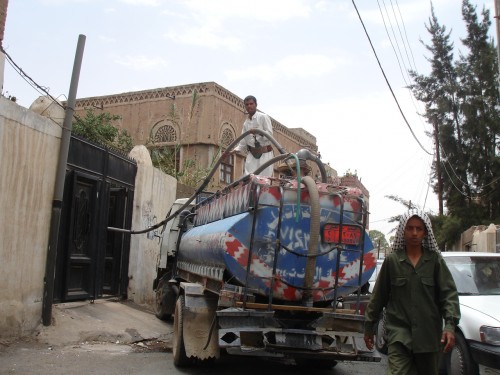


(Rapidly depleting water resources has forced residents of Sana’a to buy water from private sources. Water levels are dropping by 6 metres a year in the Yemeni capital. © David Swanson/IRIN)
If you think things seem pretty dicey in the Middle East right now with Israel and Hamas fighting, according to IRIN, expect tensions to become a whole lot worse, once global warming comes into play. Rising sea levels, they say, will have severe environmental, economic and political implications for the already water-stressed Middle East.
The report they site is called “Climate Change: A New Threat to Middle East Security,” written by Friends of the Earth Middle East (FOEME), who we’ve blogged about extensively.
The report produced by FOEME details that climate change is something of a “threat multiplier,” meaning that the forecasted changing weather patterns brought on by global warming, will exacerbate water scarcity and tensions over water between nations. In particular between those in Jordan, Gaza and Egypt.
“Poor and vulnerable populations, which exist in significant numbers throughout the region, will likely face the greatest risk”, says the study.
A half metre rise in sea levels could displace 2 to 4 million Egyptians by 2050, it says.
According to IRIN: Rising sea levels would also contaminate the drinking water of 1.5 million Palestinians in Gaza due to sea water intrusion contaminating their only water source, the coastal aquifer, the FOEME report says.
To counter the pressures, the director of FOEME’s Amman office, Munqeth Mehyar, has asked Jordan’s government “to assist rural communities in Jordan that are currently dependent on agriculture to diversify their income sources to rural tourism and small cottage industries.”
Positive environmentalists see the dreary future could lead to cross-border cooperation.
“Being left unprepared will affect not only economic, physical, and environmental security, but national, regional, and global security, if actions are not taken now to mitigate, and adapt to the projected impacts of climate change,” Palestinian Director of FOEME Nader Khatib concluded.
The annual UN Climate Change Conference in Bali, which started on 3 December with the participation of over 180 nations, ended on 14 December.
::IRIN (Hat tip: MIDEASTENVIRONET)
Read up more about conflict and the Middle East’s delicate balancing act with water resources:
FoEME to Hold Conference on Shared Mountain Aquifer
Jordan River Peace Park Coming Soon?
Lifesource is Looking For Water and Justice in Israel and Palestine



[…] These emissions could become a problem for the rest of the Arab world, which the World Bank predicts will suffer extreme economic hardship as a result of climate change. Global warming is also likely to increase water and food scarcity, which some argue could destabilize the entire region. […]
[…] the novel takes place in an un-named country in the far distant future, it’s a book for climate activists and general readers in Israel and other parts of the Middle East to ponder, because the dystopian future MacDonald writes about could very well happen anywhere on […]
Water shortages, ha! You don’t know the half of it. By 2040 the average summer will be as hot as the summer of 2003 in Europe (it is the record high temperatures and heatwaves). That means that non-heavily irrigated crops and natural ecosystems will die. Can you say world-wide famines and massive civil unrest/migration? The alternative to geoengineering is a massive natural cull of humanity (think I’m a nut-do the research-I bet you’ll come to agree with me).
Al Gore has really stepped in it this time. He could have spent the rest of his global warming career collecting money by spreading fear over events that were a centure or at least half century in the future. Oh, but that wasn’t good enough for Big Al. He’s now told the biggest global warming whopper of his alarmist career:
AL GORE HAS GUARANTEED THAT THE NORTHERN POLAR ICE CAP WILL BE COMPLETELY GONE IN FIVE YEARS!!!
When I heard this I assumed it was a rumor started by skeptics to make Gore look bad. It wasn’t until I viewed the video that I realized what Gore had done. Gore has started a five year credibility countdown timer ticking and it’s up to all of us to make sure that he is held accountable and proven to be a fraud when his dire prediction aimed at drumming up support doesn’t come close to comming true.
The mainstream media isn’t going to let this video see the light of day because they, unlike Al, understand the precarious position in which he has placed himself.
It is therefore up to us to spread the word about Big Al’s prediction. He must be exposed for the fearmongering opportunist that he has become.
To view the video, please visit the following site and click on the picture of Big Al holding up five fingers.
http://www.hootervillegazette.com
While visiting this site, you might want to watch a preview of the film “Not Evil, Just wrong” or watch “The Great Global Warming Swindle” which is found in the video section. Happy Viewing!!!