“In the midst of uncertain time, renewable energy remains consistent and steadfast in its expansion,” said Francesco La Camera, IRENA’s Director-General. “A more decentralised energy system, with a growing share of renewables and more market players, is structurally more resilient.”
Health insurance is a regulated financial product. Insurers operate under binding contracts, overseen by state insurance commissioners, that legally obligate them to pay claims meeting policy terms. Policyholders who believe a covered claim was wrongfully denied have legal recourse through state regulatory channels.
The New Zealand Merino Company, now rebranded as Zentera, has quietly removed the phrase “world’s leading ethical wool brand” from its website, a notable change that comes after a disturbing investigation by PETA Asia-Pacific into the company’s ZQ-certified wool supply chain, PETA reports to Green Prophet.
Somehow vegetables with short seasons excite the imagination and appetite more sharply than produce that’s available all year around. Good Middle Eastern cooks have many recipes for delicate fava beans, and this turmeric-fragrant soup is one.
“In the midst of uncertain time, renewable energy remains consistent and steadfast in its expansion,” said Francesco La Camera, IRENA’s Director-General. “A more decentralised energy system, with a growing share of renewables and more market players, is structurally more resilient.”
Health insurance is a regulated financial product. Insurers operate under binding contracts, overseen by state insurance commissioners, that legally obligate them to pay claims meeting policy terms. Policyholders who believe a covered claim was wrongfully denied have legal recourse through state regulatory channels.
The New Zealand Merino Company, now rebranded as Zentera, has quietly removed the phrase “world’s leading ethical wool brand” from its website, a notable change that comes after a disturbing investigation by PETA Asia-Pacific into the company’s ZQ-certified wool supply chain, PETA reports to Green Prophet.
Somehow vegetables with short seasons excite the imagination and appetite more sharply than produce that’s available all year around. Good Middle Eastern cooks have many recipes for delicate fava beans, and this turmeric-fragrant soup is one.
“In the midst of uncertain time, renewable energy remains consistent and steadfast in its expansion,” said Francesco La Camera, IRENA’s Director-General. “A more decentralised energy system, with a growing share of renewables and more market players, is structurally more resilient.”
Health insurance is a regulated financial product. Insurers operate under binding contracts, overseen by state insurance commissioners, that legally obligate them to pay claims meeting policy terms. Policyholders who believe a covered claim was wrongfully denied have legal recourse through state regulatory channels.
The New Zealand Merino Company, now rebranded as Zentera, has quietly removed the phrase “world’s leading ethical wool brand” from its website, a notable change that comes after a disturbing investigation by PETA Asia-Pacific into the company’s ZQ-certified wool supply chain, PETA reports to Green Prophet.
Somehow vegetables with short seasons excite the imagination and appetite more sharply than produce that’s available all year around. Good Middle Eastern cooks have many recipes for delicate fava beans, and this turmeric-fragrant soup is one.
“In the midst of uncertain time, renewable energy remains consistent and steadfast in its expansion,” said Francesco La Camera, IRENA’s Director-General. “A more decentralised energy system, with a growing share of renewables and more market players, is structurally more resilient.”
Health insurance is a regulated financial product. Insurers operate under binding contracts, overseen by state insurance commissioners, that legally obligate them to pay claims meeting policy terms. Policyholders who believe a covered claim was wrongfully denied have legal recourse through state regulatory channels.
The New Zealand Merino Company, now rebranded as Zentera, has quietly removed the phrase “world’s leading ethical wool brand” from its website, a notable change that comes after a disturbing investigation by PETA Asia-Pacific into the company’s ZQ-certified wool supply chain, PETA reports to Green Prophet.
Somehow vegetables with short seasons excite the imagination and appetite more sharply than produce that’s available all year around. Good Middle Eastern cooks have many recipes for delicate fava beans, and this turmeric-fragrant soup is one.
“In the midst of uncertain time, renewable energy remains consistent and steadfast in its expansion,” said Francesco La Camera, IRENA’s Director-General. “A more decentralised energy system, with a growing share of renewables and more market players, is structurally more resilient.”
Health insurance is a regulated financial product. Insurers operate under binding contracts, overseen by state insurance commissioners, that legally obligate them to pay claims meeting policy terms. Policyholders who believe a covered claim was wrongfully denied have legal recourse through state regulatory channels.
The New Zealand Merino Company, now rebranded as Zentera, has quietly removed the phrase “world’s leading ethical wool brand” from its website, a notable change that comes after a disturbing investigation by PETA Asia-Pacific into the company’s ZQ-certified wool supply chain, PETA reports to Green Prophet.
Somehow vegetables with short seasons excite the imagination and appetite more sharply than produce that’s available all year around. Good Middle Eastern cooks have many recipes for delicate fava beans, and this turmeric-fragrant soup is one.
“In the midst of uncertain time, renewable energy remains consistent and steadfast in its expansion,” said Francesco La Camera, IRENA’s Director-General. “A more decentralised energy system, with a growing share of renewables and more market players, is structurally more resilient.”
Health insurance is a regulated financial product. Insurers operate under binding contracts, overseen by state insurance commissioners, that legally obligate them to pay claims meeting policy terms. Policyholders who believe a covered claim was wrongfully denied have legal recourse through state regulatory channels.
The New Zealand Merino Company, now rebranded as Zentera, has quietly removed the phrase “world’s leading ethical wool brand” from its website, a notable change that comes after a disturbing investigation by PETA Asia-Pacific into the company’s ZQ-certified wool supply chain, PETA reports to Green Prophet.
Somehow vegetables with short seasons excite the imagination and appetite more sharply than produce that’s available all year around. Good Middle Eastern cooks have many recipes for delicate fava beans, and this turmeric-fragrant soup is one.
“In the midst of uncertain time, renewable energy remains consistent and steadfast in its expansion,” said Francesco La Camera, IRENA’s Director-General. “A more decentralised energy system, with a growing share of renewables and more market players, is structurally more resilient.”
Health insurance is a regulated financial product. Insurers operate under binding contracts, overseen by state insurance commissioners, that legally obligate them to pay claims meeting policy terms. Policyholders who believe a covered claim was wrongfully denied have legal recourse through state regulatory channels.
The New Zealand Merino Company, now rebranded as Zentera, has quietly removed the phrase “world’s leading ethical wool brand” from its website, a notable change that comes after a disturbing investigation by PETA Asia-Pacific into the company’s ZQ-certified wool supply chain, PETA reports to Green Prophet.
Somehow vegetables with short seasons excite the imagination and appetite more sharply than produce that’s available all year around. Good Middle Eastern cooks have many recipes for delicate fava beans, and this turmeric-fragrant soup is one.
“In the midst of uncertain time, renewable energy remains consistent and steadfast in its expansion,” said Francesco La Camera, IRENA’s Director-General. “A more decentralised energy system, with a growing share of renewables and more market players, is structurally more resilient.”
Health insurance is a regulated financial product. Insurers operate under binding contracts, overseen by state insurance commissioners, that legally obligate them to pay claims meeting policy terms. Policyholders who believe a covered claim was wrongfully denied have legal recourse through state regulatory channels.
The New Zealand Merino Company, now rebranded as Zentera, has quietly removed the phrase “world’s leading ethical wool brand” from its website, a notable change that comes after a disturbing investigation by PETA Asia-Pacific into the company’s ZQ-certified wool supply chain, PETA reports to Green Prophet.
Somehow vegetables with short seasons excite the imagination and appetite more sharply than produce that’s available all year around. Good Middle Eastern cooks have many recipes for delicate fava beans, and this turmeric-fragrant soup is one.
I love the rain. It cleanses the city. Everything looks and smells clean and fresh. My biggest problem, though, with the rain is that so much of it goes to waste. With Israel’s future rain forcasts in question waiting for rain can be nerve-wracking. And when it finally comes, so much of it goes to waste. It’s sad.
If there were a way to collect all of that rain and make sure that it goes where it needs to go… Now we’re talking! If we could collect all of the water that falls in the streets and rooftops of a city during a rainy season, could we live off of that for the coming year?
Not much different from political views or soccer favorite, people are very conservative when it comes to their laundry, or at least on how to dry it.
Those who favor laundry lines claim that the tumbling electric dryer damages the clothes, (the residues left in the filter prove that), consumes electricity, which is bad for the carbon dioxide footprint (global warming) and unfriendly to the wallet too.
The other group says that hanging the laundry in the sun causes the colors to fade and exposes the laundry to the mercy of birds and to dust; one cannot hang clothes when it rains and it simply is unaesthetic to display all your underwear for people to see. Plus it takes a lot longer and there is no softener so clothes come out a little rough.
An Israeli company, Aytec Avnim, offers a compromise in the form of a solar clothes dryer.
The dryer, made of lightweight materials looks like a bright box from the outside; the laundry is hanged within and therefore invisible and is not subject to direct sun light which fades colors. It is also protected from dirt and weather. There is no tumbling and therefore no wear. The construction inside the box enables the utilization of the sun’s heat for drying the clothes within a time period which resembles that of the electric dryer, and electric backup enables drying at night and even when it rains.
The dryer comes in two configurations; Foldable and mobile, for easy storage and for putting out of the way while in use. This format is for the DIY market. The other option is more rigid and involves adding the dryer to the building construction itself either as a laundry drying balcony-rail or as substitute for the building’s laundry cover, which is actually often used as air-conditioner cover and not for hanging laundry because it blocks the sun and not always installed facing it.
According to the company, the electric backup can be replaced by the use of the apartment’s hot water tubing and thus reduce heat energy loss when nobody uses the hot water in the house.
Hanging laundry out from a window in Sicily to dry
All in all it is a green gem which reduces the use of electricity even when using it for backup. And therefore the Green Prophets expect it to have a bright green future.
College students don’t usually need a justifiable reason for studying abroad. And study abroad in Israel? There’s the sun, the beach, the good food, the beautiful people… all very educational, of course. But for those students who are looking for a justifiable reason (at least one they can tell their undergraduate advisors or parents), how about a study abroad program with a conscience?
Living Routes, a program that coordinates study abroad in eco-villages all over the world, has a wonderful program in Israel based out of Kibbutz Lotan. The program is titled “Peace, Justice, and the Environment” and focuses not only on various aspects of environmentally friendly living and farming practices, but upon non violent communication and cooperation between Palestinian-Arab, Bedouin, and Jewish Israeli communities. Essentially, the program focuses on sustainability in Israel on a very broad scale.
We’ve seen that environmentally conscious tourism is becoming more than a buzz word, what with government initiatives stepping in, and the various alternatives in eco-tourism that Israel now offers–including Kazakh yurts!
Australian-born tour guide Zel Lederman customizes personal tours for groups and families with Israel Travel Company: Israel Off the Beaten Track, including tours with environmental themes. Tours can include an exploration of organic agriculture, clean technology, walks along the Israel National Trail, bike riding adventures, and tours on horseback.
One of Lederman’s tours was covered in Maariv (in Hebrew) — a five-day walk in the Golan for 15 members of a UIA Mission of Australian Jewish Doctors who walk every year both in Australia and Overseas. “They wanted to walk in Israel rather than in Tuscany or France,” says Lederman.
Lederman explains what an environmental awareness in touring Israel means to him:
“My personal experience with travelers has been that walking the land helps people connect both more deeply to themselves and to the land of Israel, and perhaps to understand more the environmental issues that we face–not as a heavy ideological issue, but as a walker who sees, smells and feels the beautiful and historically saturated landscapes and is confronted up close with the environmental challenges that confront us. ”
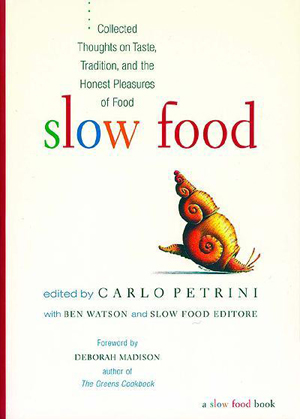
‘Slow Food’ is one of those elusive yet still useful terms: we’re able to grasp what it’s gesturing at even though we can’t define it precisely. Most of us recognize slow food experiences when we have them and feel, moreover that they are genuinely special and distinctive – this is proof enough that term, and the movement which gave rise to it, are onto something important.
Slow Food was founded by Carlo Petrini in Italy about twenty years ago; its membership now numbers tens of thousands and spans over more than 100 countries, including a chapter in northern Israel. The Slow Food collection, first published in 2001, gathers together some of the best writing from the movement’s quarterly journal, and includes short pieces on everything from wine to cheese-making to biotechnology. Taken together, these stories and articles offer something more complex and ambitious than a mere definition, an accounting of what slow food is through a cataloguing of its principles (though the principles are included as well): they are rhetorical, aiming to inspire by painting pictures so lush we cannot help but be drawn in.
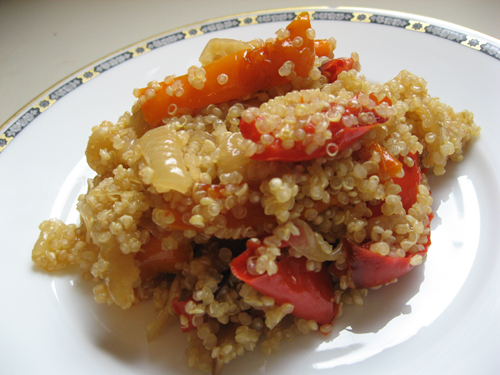
Quinoa isn’t just for Passover anymore. Revered by the Incas as sacred, quinoa looks like a grain but is actually a plant related to beets, chard, and spinach. Its tiny seeds cook up into fluffy, nutty goodness in fifteen minutes, and can be used in any number of ways. Quinoa is fantastic for vegetarians and vegans because it is a complete protein (i.e. it has a full complement of amino acids). It also possesses the virtue of being rather seriously tasty.
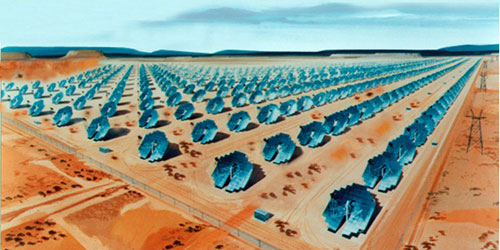
Israel touts some of the world’s best solar technology advances (see our extensive solar energy company guide here), but its Middle East neighbor Dubai, says it is planning to set up the region’s largest solar energy manufacturing plant. They are expected to start producing by the last quarter in 2010, and will manufacture photovoltaic panels that can generate 130 megawatts of power annually.
The building plans call for a 1 million square foot plant, with solar panels to be produced as big as 5.7sqm. Similar plants will be built in China, Mexico and Bulgaria. The announcement was made during this week’s Green Dubai World Forum 2008.
The best way to defrost food is in the fridge. It not only keeps the fridge cool, meaning the fridge itself will use less energy to stay cool, but often people leave food out too long with defrosting which causes their food to collect unwanted bacteria.
Many other people use their microwave to defrost food. While it’s debateable whether microwaves are bad for your health it certainly is energy-wasteful.
The only problem with defrosting in the fridge is that you have to decide the night before what you would like to eat for the next day…
Looking to green your life? Find out more! Have a green-living tip to SHARE?
Friends of the Earth Middle East (FoEME) is a longtime advocate of sustainability and environmental peacebuilding in the region. Fresh off the pages of Time Magazine, where FoEME’s directors were recently named Heroes of the Environment 2008, FoEME is hosting a conference next week as part of the Pro-Aquifer project.
Over the past two years, the Pro-Aquifer team has worked with pilot municipalities in both Israel and the Palestinian Authorities to assess threats to the shared Mountain Aquifer and develop policy guidelines for pollution prevention. From these initial case studies in Umm el Fahem on the Israeli side (seen above) and Tulkarm on the Palestinian side, FoEME developed general policy guidelines for all communities in the Mountain Aquifer recharge area.
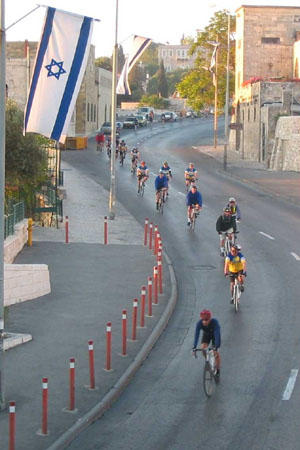
You first heard it here on Green Prophet a few months ago – the Israeli Ministry of Tourism is spearheading initiatives to promote eco-friendly, green bicycle tourism. You may also remember that it announced in August that it would be allocating 100 million shekels towards developing the field (which, ahem, is not the number that appears in the title of this post). But have no fear – 100 million shekels have been allocated overall and 20 million will be invested in the first five years (2009-2013).
According to Tourism Minister Ruhama Avraham-Balila, “the Tourism Ministry is leading the way in promoting the cycling tourism industry with the objective of turning it into an essential component in the leisure and entertainment culture of Israel.”
The Ministry of Tourism has already got the wheels turning (so to speak) on this project and an interim report on the project was recently presented. The report includes plans to:
World Usability Day was founded in 2005 as an initiative of the Usability Professionals’ Association to ensure that services and products important to human life are easier to access and simpler to use. Each year, on the second Thursday of November, over 225 events are organized in over 40 countries around the world to raise awareness for the general public, and train professionals in the tools and issues central to good usability research, development and practice.
The local Israeli chapter will host the day’s events at the Open University campus in Raanana (see the UPA website for more information; discount price for registering until November 4th).
Each year holds a special theme and then every local event focuses lectures and other initiatives around the subject. This year’s theme is transportation. This follows the Public Transportation Day held in September.
Since transportation has a vast impact on the environment it was decided to raise awareness through a personal challenge.
The Global Transport Challenge is an easy way for you to understand how YOU USE transportation every day and the impact it has on our environment.
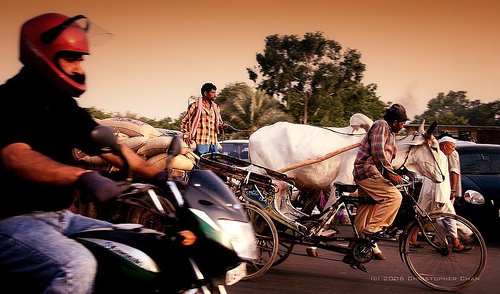
When thinking about the Israeli army (or any other army, for that matter) becoming more “green” or environmentally conscious, skepticism is unfortunately the first thing that comes to mind. Military activity is nasty business, leaving detrimental traces on human relationships, governmental spending, and the environment – to name a few.
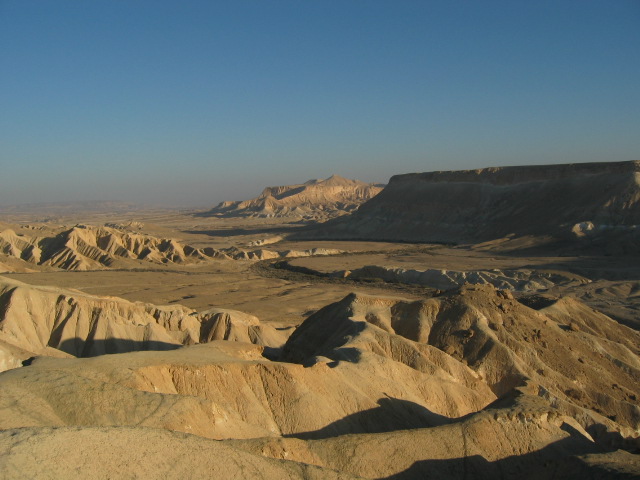
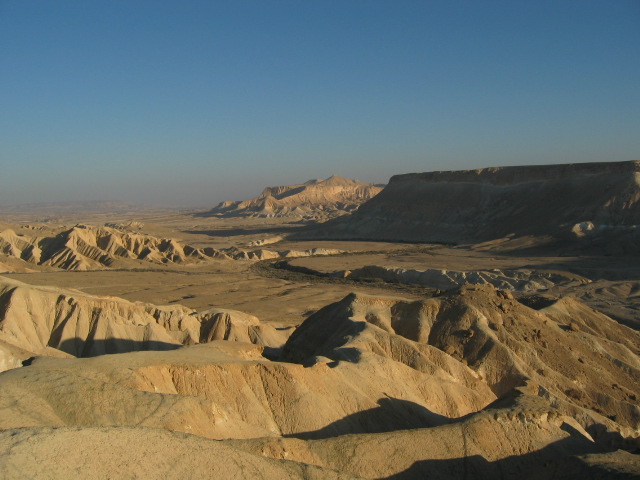
Sobelman’s article, which refers to specific experiences of individual soldiers, explains the specific impact of the IDF on the Israeli environment. Fifty percent of the Negev is fire zones, with the IDF practicing occasionally in an additional 20 percent overlap area in the Negev. Translation: there’s army activity going on all over that desert.
For Palestinians in the West Bank and Gaza, lack of infrastructure is a big obstacle for protecting the environment. Old and malfunctioning infrastructure (or often none at all!) for properly managing things like solid waste and sewage is a major threat to the Palestinian (and Israeli!) environment.
Luckily, however, the European Union announced earlier this week that they awarded 5.2 million Euros to the Palestinian Authority help improve solid waste infrastructure, and therefore help keep the environment healthy and clean.
The donation will go to 26 municipalities in eleven different Palestinian governorate, which were marked as those most urgently needing support for the solid waste management. The money will go towards the procurement of garbage collection vehicles, containers, and equipment to help manage dumpsites properly, and will be managed by the Palestinian Ministry of Local Government.
Businesses play a huge role in our everyday impact on the environment. The way that businesses conduct themselves – ranging from what services or products they provide, to what means they use to provide them, and what kind of energy consumption habits they have – all effect their carbon footprint. And since we live in a society where businesses are greatly relied upon to do things for us – our carbon footprint is directly related to what businesses we choose to support.
Maala – Business for Social Responsibility, a non-profit organization founded in 1998 to promote socially responsibile corporate behavior, understands the importance of improving our impact on the environment and is integrating this issue into an upcoming conference this Tuesday in Tel Aviv.
Among the many questions that the conference will address, the 600 conference participants will discuss whether sustainability can be a basis for a profitable business model.
The conference’s agenda includes a round table discussion, titled “Who is Responsible for the Environment?” chaired by Dr. Miki Haran, former Director of the Ministry for the Protection of the Environment, and Jerry Greenfield’s speech (that’s right, of Ben & Jerry’s ice cream), “If It’s Not Fun, Why Do It?”




 College students don’t usually need a justifiable reason for studying abroad. And study abroad in Israel? There’s the sun, the beach, the good food, the beautiful people… all very educational, of course. But for those students who are looking for a justifiable reason (at least one they can tell their undergraduate advisors or parents), how about a study abroad program with a conscience?

 You first heard it here on Green Prophet a few months ago – the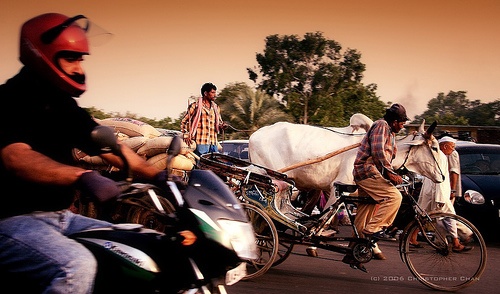
 When thinking about the Israeli army (or any other army, for that matter) becoming more “green” or environmentally conscious, skepticism is unfortunately the first thing that comes to mind. Military activity is nasty business, leaving detrimental traces on human relationships, governmental spending, and the environment – to name a few.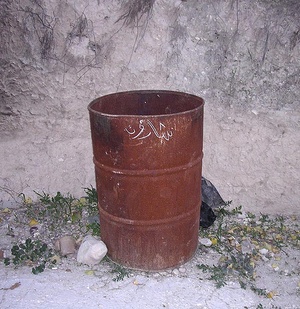
 For Palestinians in the West Bank and Gaza, lack of infrastructure is a big obstacle for protecting the environment.
 Businesses play a huge role in our everyday impact on the environment. The way that businesses conduct themselves – ranging from what services or products they provide, to what means they use to provide them, and what kind of energy consumption habits they have – all effect their carbon footprint. And since we live in a society where businesses are greatly relied upon to do things for us – our carbon footprint is directly related to what businesses we choose to support.