Home Blog Page 721

Impressions of the Eilat Energy Conference in Israel

1

eilat
Two things were clear from attending the International Renewable Energy Conference that took place in Eilat this week. The first is that Israel is now a world leader in clean energy.

The second is that there is a small but growing group of players in the field who see this not just as a huge business opportunity, (though it certainly is that), but also as an ethical, or spiritual mission.

Israeli leadership in the field was manifested by a list of “firsts,” “biggest evers,” and breakthrough technologies that were heralded immediately before and during the conference. Brightsource announced that it had signed a contract with Southern California Edison to build the largest ever solar thermal generating field, which will produce 1.3 gigawatts in California.

The Arava Power Company went public on an agreement with the Israel Electricity Company that will enable it to build the world’s largest photovoltaic solar field on kibbutz-owned land in the Arava desert. The site will produce 80 MW of power, double the output of the current largest PV field in Germany.

High Radioactive Content Found in Jordanian Groundwater

3

radioactive

The Middle East is pretty thirsty right now.  Headlines from all over the region chronicle the increasingly serious drought conditions affecting agriculture, industry, and health.

Unfortunately, new research from the peer-reviewed journal Environmental Science & Technology adds reason for even more concern. In their study, “High Naturally Occurring Radioactivity in Fossil Groundwater from the Middle East,” Duke University’s Avner Vengosh and colleagues from Israel, Jordan, and the Palestinian Territories found that fossil groundwater in southern Jordan contains levels of radioactive radium isotopes up to 2000% higher than international drinking water standards!

Can the Cedars of Lebanon Survive Climate Change?

2

lebanon

“So Hiram, King of Tyre, gave King Solomon timber of cedar and timber of cypress according to all his desire.”-Book of Kings vs. 24

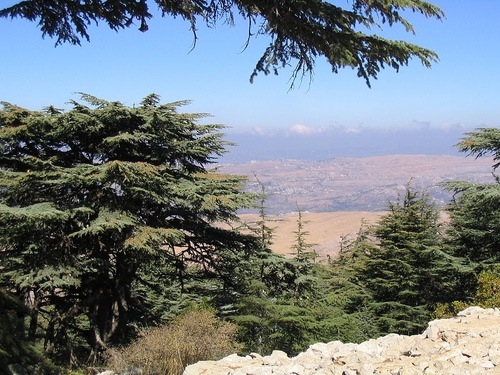
A recent article by Ahmed Khatib in the Lebanese Daily Star emphasized the dangers of climate change and global warming to Lebanon‘s remaining cedar groves, which have been a historic national symbol in the country since its founding. According to the article, about 2,000 hectares of cedar trees remain there, with the largest grove located in the Al-Chouf Cedar Nature Reserve, located in the Chouf Mountain area southeast of Beirut.

Besides being the country’s national symbol and prominently situated on Lebanon’s national flag, the cedar trees of the country formerly known as the ancient Kingdom of Tyre, have been famous for their strong and durable wood which was prized by the Ancients for the construction of boats, stately buildings, and (in the case of the ancient Egyptians) for the preservation of the dead. Perhaps the most renowned use of these majestic trees was in the construction of the Israelite Temple in Jerusalem over 2,700 years ago.

The construction of the Temple, said to have been one of the grandest edifices of ancient times, included inner chambers made entirely of cedar and other woods that King Solomon received from King Hiram of Tyre who had the cedar logs “made into rafts to go by sea unto the place that thou shall appoint me, and will cause them to be broken up there.”  What must have been a grand feat of engineering and construction for those times, involved bringing these large tree trunks overland to Jerusalem, cutting them into beams, and then constructing them “with neither hammer nor axe nor tool of iron heard in the House.”

Groundbreaking Wind Energy Project to Power Palestinian Hospital

0

As the resting place of the Abraham and (unfortunately) a hot spot for conflict, the West Bank city of Hebron (or Hevron or al-Khalil, depending on who you ask!) is pretty notorious.

Soon, this city will also become an important part of the Middle East’s ongoing clean energy revolution!

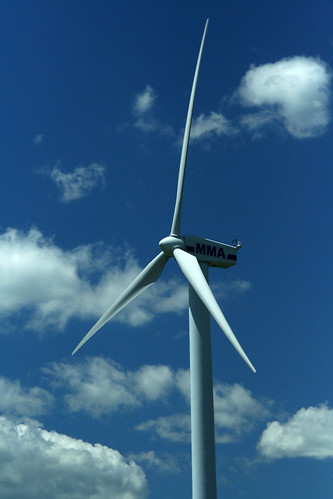
Last week the European Commission signed an agreement with the Patient’s Friend Society Al Ahli Hospital in Hebron to finance a wind-energy production system for over 40 percent of the hospital’s energy needs.

“This will be the first institution in Palestine to generate its electricity from wind power, and it is hoped that this project can serve as a model for others,” organizers said in a statement sent to Ma’an News Agency.  “This landmark project will constitute a model for green energy systems in the region.”

Permaculture and Green Communal Living Through Eco-Israel

2

eco_israel_north organic farm volunteer israel photo
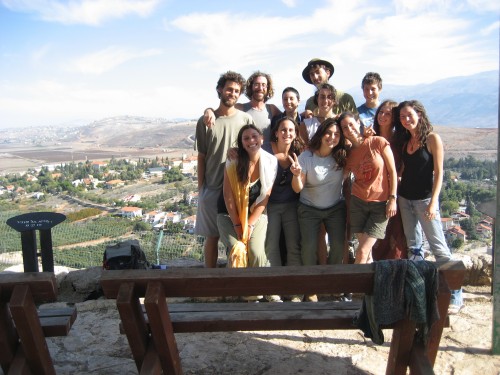
Last year’s Eco-Israel group on a trip to the North. Photo courtesy Naomi Katz.

Although winter has come to Israel belatedly in the season’s heaviest rainfalls this weekend, the ecological farm Hava Ve’Adam outside of Modi’in is now accepting applications for the fall term of its Eco-Israel program.

For the uninitiated, Eco-Israel is a chance to get deeply involved in producing “beyond organic” food. Farm staff Naomi Katz, Yigal Deutscher and Chaim Feldman have crafted a space where ducks peck at weeds, then provide fertilizer for the plants through their droppings. Woven into the small crop space in central Israel are several trees of varying heights; these help shade more delicate plants from the scorching Middle Eastern sun.

Using Black Gold to Build a Greener Future: A Visit to the UAE

3

abu-dhabi-world-future-energy-summit-2009 photo

Last month, I had the unexpected pleasure of visiting Abu Dhabi and Dubai, two of the seven tiny kingdoms that together make up the United Arab Emirates. I was there to cover the World Future Energy Summit, an international conference on renewable energy technologies.

This was my first visit to the Emirates, which have a reputation for being a nation of oil-drenched spendthrifts, building surreal fantasy projects unlike anything seen in the West and having a larger ecological footprint per capita than even the US and China. However, I knew that Abu Dhabi was also building Masdar City, an attempt to design a “carbon-neutral” city, while building a new sector of the economy from scratch based on renewable energies.

Building new industries from scratch is nothing new in the UAE – thirty or so years ago there was absolutely nothing there, and now the place is a regional economic powerhouse. But an oil state using its wealth to plan ahead for the post-petroleum world – there was a novel idea.

Below are some impressions from my visit to a land described by one colleague as “the greenest gas guzzler.”

Guy Lougashi’s Dumpster Diving Designs Inspired By Buttons, Baskets and Brakes

6

guy lougashi dumpster diver israel photoIsraelis are no strangers to dumpster diving. Here’s a story on one of the country’s latest, who’s turning his finds into a design business:

When he’s not traveling around Holland or Germany, you’re likely to find Guy Lougashi creating art and crafts from other people’s junk. Or jumping inside a dumpster looking for new raw materials.

“There is nothing like creating in Israel. I know the garbage. I know the people,” the 32-year-old says.

While most of us see things we don’t need anymore as garbage, pure and simple, Lougashi looks at thrown-away objects as something valuable. “I don’t see garbage as garbage,” he tells Green Prophet.

“I see it as gold.”

The self-trained craftsman who’s been working in the area for eight years has recently created a sensation — weaving together baskets with mentally challenged people.

Going beyond pure environmentalism, Lougashi designed and crafted beautiful basketware from recycled paper. They were first showcased at a night flea market — Pish Pish Lila iLevan n Jaffa last year, where a local furniture design house bought a number of them, selling the baskets for hundreds of dollars a piece.

Weaving in life’s experiences

It got Lougashi thinking. “I know about people with disabilities because my brother is handicapped. And he’s working in a factory for the disabled,” says Lougashi, who with a friend, approached the craft-rehab organization Shekulo Tov (so that we will all be good) to see what could be done. He ended up spending five months training mentally disabled people in an Arab-Jewish factory in Baqa Al Garabia, Israel.
lougashi-baskets
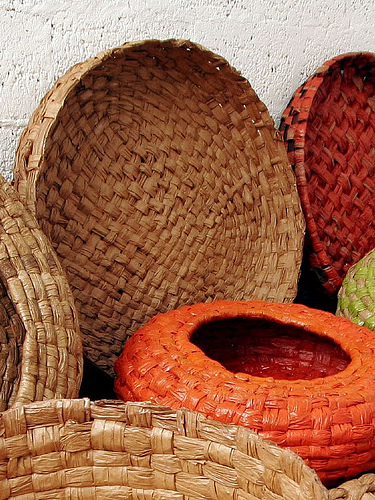
(Recycled paper baskets).

There, the people mastered Lougashi’s techniques of weaving baskets from paper — a process which requires special know-how, such as how to glue the paper, to achieve a desired aesthetic.

Normally baskets are woven with straw. To make sure the baskets made from recycled paper last, Lougashi dips paper strips in glue — like papier-mache — and lacquers them with a final coat of paint. Lougashi’s basket project, as a result, adds another dimension to his story. For the first time in many years, these people in Baqa Al Garabia are now able to make a decent living.

A recycled paper movement in Israel

Lougashi is not the first one to design goods from recycled paper in Israel. Green Lullaby is producing EcoCradles out of cardboard paper; Amit Brilliant takes used paper and creates trendy wallets, while Erez Mulai rolls up wasted paper and use it to create wastepaper baskets.

Putting the baskets behind him, Lougashi is now working with buttons and brakes, creating new lights out of the unlikely materials.

lougashi-brake-lights
(Brake lights.)

But like other Israelis who work with recycled materials, Lougashi became a “green” designer as a matter of course, not through some sort of idealism. “I am green because I spent so many years collecting and repairing [garbage],” he tells ISRAEL21c.

lougashi-lights
(Lights from buttons.)

“It’s something you find in the materials — it pops into your eyes and you see something else,” he says. He is keen that his work with lighting and baskets and such, be seen as craftwork, and not art. “I prefer doing my art as installations and sculptures. I just get carried away once in a while to make beautiful things, because I have an attraction to these materials,” he says.

Update in 20025- Guy is in Berlin. The place where the last global nomads hide.

More on recycled design:
Dumpster Diving, Tel Aviv Style
Amit Brilliant’s Recycled Wallets
Erez Mullai’s Recycled Waste Bins

Squeezing Energy From a Plant's Metabolism at Hebrew University

2

plants hebrew university biofuel photo bubblesUse of plants of various kinds to produce biofuels is a topic of ever-increasing importance in the world as a means to combat an energy crisis and to deal with increasing concern over atmospheric pollution from the use of fossil fuels. Scientists the world over are involved in advanced research aimed at discovering and developing the most practical and cost-efficient plants for cultivation and conversion into fuels.

To examine the various scientific and economic aspects of harnessing bioenergy, the Otto Warburg Minerva Center for Agricultural Biotechnology of the Hebrew University of Jerusalem, in cooperation with Yissum – the Technology Transfer Company of the Hebrew University, the Israel Ministry of Agricultural and Rural Development, CBD Technologies, Evogene Ltd. and the Israel Academy of Sciences and Humanities, will be sponsoring a symposium entitled “Bioenergy: Harnessing Plant Metabolism” from Tuesday and Wednesday, Feb. 24-25, on the campus of the Hebrew University’s Robert H. Smith Faculty of Agriculture, Food and Environment in Rehovot.

Prof. Shmuel Wolf, director the Otto Warburg Center, headed the organizing committee for the symposium.

Expert from Germany, the US, and Ireland will be participating in the symposium, in addition to those from Israel. The symposium, marking the 25th anniversary of the Otto Warburg Minerva Center, will be held in the Ariowitsch Auditorium at the Agriculture Faculty and will be conducted in English.

Eco Rabbi: Parshat Mishpatim – Fair Trade of the Ancient World

2

coffee-plantation
Each week Orthodox Jews read one segment of the Five Books of Moses so that they can complete the entire Five Books within the course of a year. In last week’s Eco-Rabbi post we discussed trees and the receiving of the Bible (Torah) on Mount Sinai, this week I’ll discuss free trade and the commandments.

In this week’s parsha there are A LOT of laws. There are laws about slaves, laws about borrowing and guarding and helping people on the street. This list is somewhat of an ethical manifesto, and it is pretty impressive considering what the world looked like when God gave these laws, according to Jewish tradition, some 3400 years ago.

While the past few decades were about globalization, and finding the cheapest ways to manufacture for the greatest profits, the Fair Trade movement IS building momentum. In a nutshell, Fair Trade is about making sure that people are getting treated properly. How are their working conditions? Are children being forced to work? Are they workers getting paid legitimate wages?

Environmental Issues and the Israeli Election Results

0

Israel beach tel aviv polluted sea sign photo
(“Polluted Sea – Bathing is Forbidden.”)

The outcome of Israel’s parliamentary elections weren’t a great surprise for many people living in this country of 7+ million people. But now that the coalition government wrangling among the larger parties has begun, the big question among environments is whether any of important “green” issues will be dealt with by either a Likud  or Kadima party based coalition government. Judging by what is currently happening, with issues like security and the economy getting most of the attention during the campaigning, the question now is whether the many ecological and environmental problems Israel is immersed in will receive any serious attention at all.

Israel has several extremely serious environmental problems that need attending to, including heavy air pollution in the big cities (especially Haifa and Tel Aviv), a water pollution problem that is bordering on the brink of being irreversible, and a ticking hazardous waste ‘time bomb’ at the large Ramat Hovav hazardous waste disposal center in the Negev. Although some effort has previously been made to deal with environmental issues, including the creation of a Ministry for the Environment several years ago, overall governmental attention to these problems have been ambivalent at best and substandard at worst.

When your pets help you recycle

8

RichieMost of us (I hope) recycle all the plastic bottles we use. But do you also recycle the many other small plastic containers you use daily, or do you just throw them away?
Cheese and other dairy containers, small salads, yogurts and the occasional hummus container used to make up a large part of my garbage… Turns out, they can all be recycled just as well as the PET bottles I’ve been collecting for recycling.

The reason the recycling companies don’t advertise this fact is a sound one. Throwing these containers in the recycling bin (at home or on the street) and having them stay there for days, or sometimes weeks, can be a serious sanitary hazard and health risk. On the other hand, asking the public to rinse all containers before throwing them is a huge waste of water.

If you have a healthy active dog, cat or another pet that is willing to help, you can increase the amount of plastic you recycle instantly.

Ingredients:

  • 1 or more pets
  • 1 or more plastic containers

Instructions:

  • Place plastic container in front of pet.
  • Watch as your pet helps the recycling effort by making sure that plastic container is so clean, it shines.
  • Optional: Grab a camera and take some photos/video. You won’t be disappointed.
  • Collect plastic containers and place in recycle bin.

As always, use your own discretion when deciding what your pet can and should eat. Chocolate puddings are of course out of the question, but so are foods that are too sugary, spicy or contain artificial sweeteners. Many foods are usually fine, especially considering the relatively minuscule portion size your pet gets from just cleaning the container.

If your pet is overweight or obese, this tip is not for you! Obese and overweight pets constitute an estimated 48% of all pets in the USA, I encourage you to learn more about the risks, which include Osteoarthritis, Type 2 Diabetes, heart disease, hypertension and even cancer. Even if your pet is not overweight, you should spend at least a couple of minutes online learning about the potential risks of an overweight pet.

I am still in negotiations with my dog regarding his offer to help make our compost heap smaller… he’s such a helpful character.

Final note: What materials are actually recycled changes from country to country and from town to town. Do a web search for your local recycling rules and see what is actually accepted. Filling the recycling bin with stuff that isn’t actually recycled just lowers the efficiency of the recycling center.

Palmachim: Battle of the Beach Revisited

1

palamahim beach battle israel photo

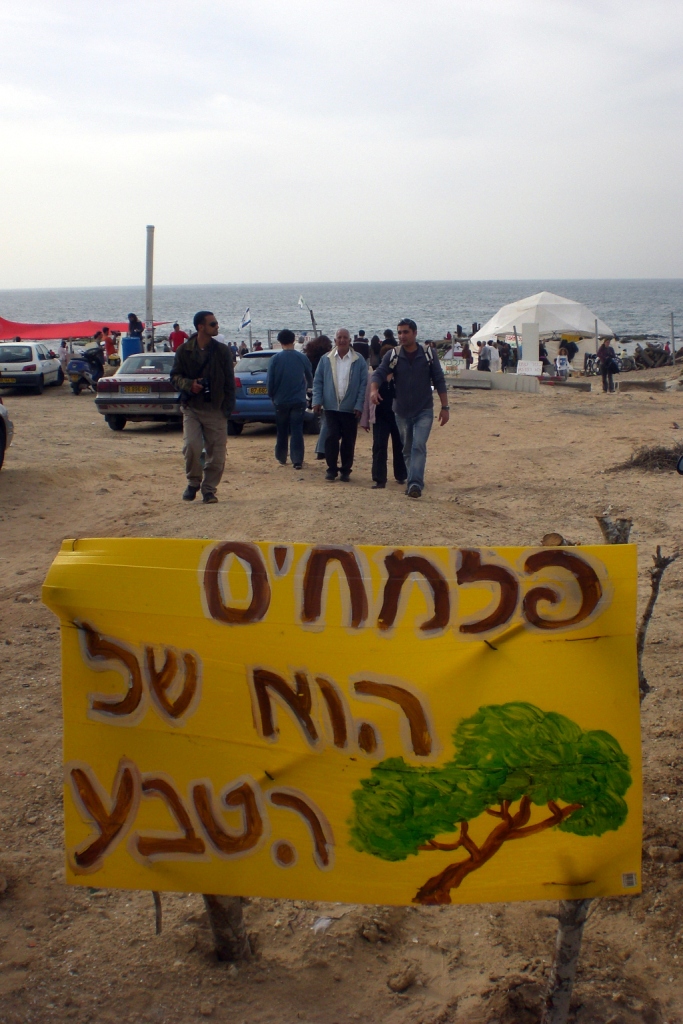
I have to admit I thought they were fighting a losing battle. Despite the justice of their cause, it seemed that the odds were stacked well against the rightfully outraged Israelis who set up camp at the unspoiled Palmachim Beach just over a year ago.

Equidistant from the coastal cities of Tel Aviv and Ashdod lies Palmachim, home to a kibbutz, commercial beach, national park and an army base.

Somewhere between them all lies a small bay known as the “fisherman’s beach,” a beautiful spot on the Mediterranean coastline which has become a magnet for both wildlife and city dwellers coming for a healthy dose a nature.

That was until the bulldozers moved in.

New Energy For America Might Be In Israel: Top US Energy Leaders In Israel Now

13

obama-green change poster photo
The Obama administration has committed to supporting renewable energy sources and to mitigate domestic and international climate initiatives.

At the dawn of Obama’s new presidency, influential energy leaders from America visit Israel to expand their worldviews to learn about the country’s unique technological opportunities.

Among the American guests in Israel now are top energy officials from the U.S. Government, the business world and the not-for-profit sector.

While in Israel, the guests will meet similar leaders to share information, such as how to take action towards a post-fossil fuel economy.

Hosted by Project Interchange, an Institute of the American Jewish Committee, the hand-picked group of 11 American specialists, include Adam Zellner, the Former Director of Policy of New Jersey; Gregory Fox, the Director of Business Development at Constellation Energy; Geoffrey Brown, the Legislative Director of Pew Charitable Trusts; Seth Portner, the energy representative from the office of the Governor of Colorado, as well as Tamra Spielvogel, the national Energy Director from the National Conference of State Legislators, and several more.

A Look-See At High-Priority Field

“Timed to coincide with the Eilat Energy Conference, this special Project Interchange seminar gives our guests an opportunity to interface with those attending the conference on possibilities for future collaboration,” says Ida Singelenberg, the U.S. program director for Project Interchange. “This group is coming for a look-see at Israel at the dawn of a new U.S. administration that has established energy and sustainability as a high priority. Some are already attracted to the clean technology opportunities in Israel; this seminar might take their involvement to another level.”

Lead-free, green toys

2

wind energy, solar energy, cleantech, Iran, oil, gas, sanctions, alternative energy

It seems like every day there is yet another toy recall in the news, the odd one was scary, but at this rate it’s downright terrifying.

Do not let yourself be discouraged: there are plenty of safer options around and a big freebie too –– our imagination. Unfortunately, toy makers are so aggresive in their marketing, not just targeting the parents but the children too, that we often are left feeling that if we do not buy these toys for our children that we are somehow depriving them of the fun of growing up.

Well folks, it just ain’t true! Some of the best loved toys and games are often the homemade variety and whatever you are made to believe your children really wouldn’t miss half the toys they have these days.

Saudi Oil Minister Calls Renewable Energy a "Nightmare"

6

oil drums saudi arabia photo

This week, executives of major oil companies met at the Cambridge Energy Research Associates (CERA) annual conference in Houston, Texas and (finally!) expressed a willingness to help combat global climate change.  This is a major step, because these companies denied the existence of global warming and deliberately tried to obstruct political progress on the issue for decades.

Unfortunately, not everyone was equally supportive of transitioning to a renewable energy economy.  In a speech to conference participants, Saudi Arabia’s Oil Minister Ali Naimi warned that promoting the rapid growth of renewable energy without continuing to invest in oil would create a “nightmare scenario.”

“We must be mindful that efforts to rapidly promote alternatives could have a ‘chilling effect’ on investment in the oil sector,” he said. “A nightmare scenario would be created if alternative energy supplies fail to meet overly optimistic expectations, while traditional energy suppliers scale back investment.”

Although Mr. Naimi, an influential voice in the Organization of Petroleum Exporting Countries (OPEC), acknowledged that the world is moving away from fossil fuels, he indicated renewable energy technologies may be unable to grow to the same scale as crude oil.