For many tourists to the Israeli Negev desert, a visit to the Bedouins includes a commercialized camel ride and perhaps an afternoon spent in a tent near Mitzpeh Ramon.
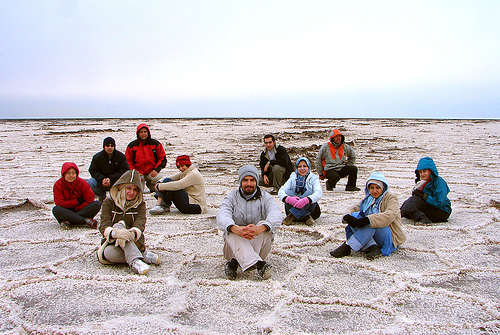
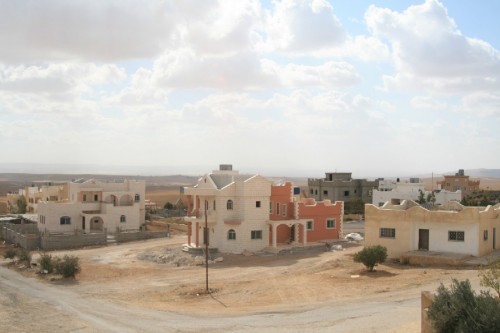
But as the Jerusalem Post writes, the Desert Sites tourist company is offering a revolutionary immersion Arabic course in the last week of July in the Bedouin township of Darajat (also spelled Dirgat), known as Israel’s first solar village.
Israel has 160,000 Bedouin Arab citizens. Between 50-60 percent of them live in recognized communities and the other are strewn about the landscape in unrecognized villages in tin-roofed shantytowns. Darajat is a recognized village with a population of approximately 800.
Most residents have solar water heaters and electric systems, the school is powered by wind and sun, and students learn hands-on about alternative energy by reading the power meters in their classrooms. The village also boasts a solar mosque, below.
Alfa, Lebanon’s chief mobile phone service company, is now operating on solar energy to power its transmission network.
The company recently installed its fifth solar powered station in the Hourata Reserve, and the station’s new solar powered generator is expected to be in full power by next month.
Alfa, a state owned communications company, managed by Orascom Telercom, began making the decision to switch to solar energy even before the 2006 war in Lebanon, which severed damaged the country’s electricity grid.
The new power station is designed to provide energy even in the worst winter weather, when normal solar power stations would not be functioning.
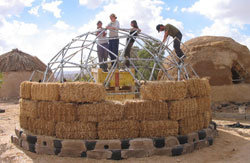
Tucked deep into the Arava desert at the southeastern border of Israel, Kibbutz Lotan‘s Center for Creative Ecology has announced two programs for the late summer and fall, including detailed information for funding on its Web site.
The first is the Peace, Justice and Environment course, which is run in conjunction with the Living Routes organization and runs August 31-December 9, 2009. Students in the course will work with Jewish and Arab environmental leaders, from the ecological straw-bale builders on Kibbutz Lotan to a permaculture site in the Bedouin town of Segev Shalom. The course includes a tour of the Separation Barrier in Jerusalem The 14-week course is accredited by the University of Massachusetts, Amherst and is worth 16 credits. The program costs $14,200.
Did Rambam’s (Maimonides) ancient book of herbal recipes give clues to finding new anti-cancer vitamin?
Dr. Fuad Fares has a huge secret. It’s big enough to make sure his laboratory is locked tight when he’s not there. The Israeli scientist has been looking into the potency of ancient herbal treatments, and has discovered what he believes is a new family of antioxidants.
He’s tested the secret compound based on an inedible plant that grows in Israel, and has found it shows excellent results in stopping prostate and colon cancer in mice, and in human cancer cells in vitro.
Unable to disclose the plant’s variety until further tests are made, Fares is hoping that this plant, first described for its medicinal value in Arabic centuries ago, produces an entirely new antioxidant molecule which can stop cancer in its tracks. It could be ingested as a food additive, or like a vitamin, he hopes.The body of research in scientific literature on antioxidants to stop the spread of cancer is growing. Scientists know that antioxidants such as lycopenes, found in tomatoes, fight free radicals, which can lead to cancer. They also know that glucosinolates found in cabbage varieties have anti-cancer properties too.
New tests on the mystery compound done at the University of Haifa lab, in the Carmel Medical Center in Israel, have been overwhelmingly good, and in the future could be added to our arsenal for fighting cancer.
A significant difference in fighting cancer
Using a crude extract of the plant, Israeli-Arab Fares gave his test plant to mice as a preventive “medicine.” Then the mice were introduced with cancer.
Those that were given the crude extract were able to fight off the cancer tumors much better than the control group — only 20 percent of the treated mice developed cancer, while 80% of the control developed cancer.
An additional point to note, Fares tells ISRAEL21c, is that in the test group, the tumors were significantly smaller than the control.
In a second test, mice with cancer were given the plant-based extract as a medicine. “When we looked at the cells inside the tumors we saw these compounds induced cell death and decreased the tumors by 70 to 80% compared to the control group,” Fares says.
He also tested the extract on human cancer cells in vitro and saw “a dramatic effect.”
After Fares purifies the compound, he hopes it will yield a brand new class of antioxidants.
Inspired by Kabalistic cures?
“Just used as an extract it seems to be effective,” says Fares, who besides hunting for the next plant-based drug, is also a director of Modigene, a company he created while doing postdoctoral work at Washington University.
Modigene is a biopharmaceutical company using patented technology to develop longer-lasting, proprietary versions of approved therapeutic proteins that currently generate billions in annual global sales.
Now Fares is working on identifying the mystery substance, and will apply for a patent — and release the secret — if the compound is indeed unique.
After purifying it, he might get even more startling results. And it could well be a medical breakthrough, agrees Fares, who found mention of the plant in an ancient herbal remedy book written centuries ago in the region.
“It’s known that antioxidants help cancer prevention and treatment. We are focusing on plants not known in the literature. It’s not food, but a medicinal plant,” says Fares, who declines to say whether or not inspiration came from a book by Rambam – Moses Maimonides, a famous Jewish doctor writing medical treatises in Arabic in the 12th century.
The plant he says, is something that grows in Israel and it’s something that people don’t eat. As for more details, he is sorry, but we will just have to wait.
Al Gore may have given us a frightening picture of climate change and our future, but now new research suggests that even his predictions could be too modest, after an Israeli scientist discovered that cracks in the earth are emitting unrecorded greenhouse gases into the atmosphere.
This is the first time this phenomenon has been observed, and since gases from these cracks have never been included in previous measurements, the new findings could change the model of how science calculates the impact of greenhouse gases on climate change.
We’d written about this research on cracks in the earth earlier. Now for an update:
The discovery was made by hydrologist and soil physicist, Dr. Noam Weisbrod from Ben Gurion University. While he was studying fractures in the earth in the Negev Desert, he encountered an unusual phenomenon occurring on a daily basis – an unexpectedly quick accumulation of salt within fractures between flood events.
The phenomenon was even more pronounced in winter.
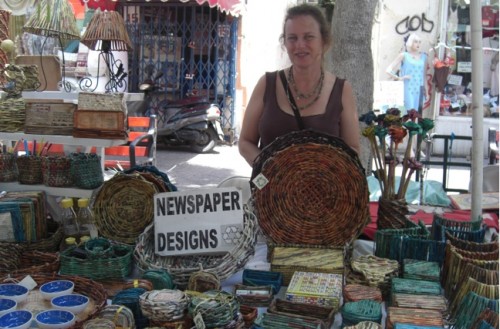
Strolling through the Nachalat Binyamin artist market in Tel Aviv, there are signs of recycling and eco friendly design all around. Old glass bottles are turned into clocks, kitchen objects are converted into sculptures, and recycled paper becomes creative stationary.
These are just a few of the creations that fill the artist market that runs for several blocks on Tuesdays and Fridays next to the Carmel Market.
Passing by a shaded booth filled with colorful baskets, picture frames, pencil holders, lampshades, and many creative designs, I noticed that everything was made from newspaper.
During the week of June 14, 2009, news continued that equity index provider, MSCI Barra would likely upgrade Israel’s current “Emerging Market” status to that of “Developed Market” before the end of 2009. Globes reported that the Israel United States Binational Industrial Research and Development Foundation (BIRD-F) is creating a new program to fund joint projects in the cleantech sector and it was suggested that greenhouse gas emission predictions might be too low. For these and the rest of this week’s stories, see below.
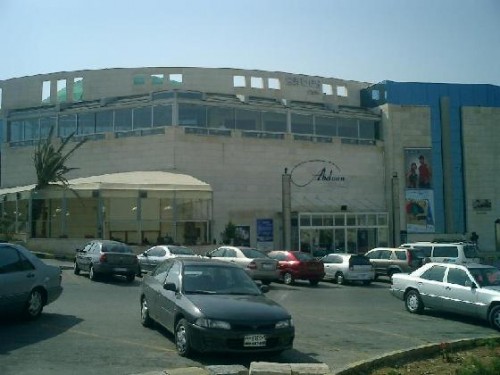
One of America’s most enduring gifts to the Middle East is the suburban indoor shopping mall. Israel’s first was the Ayalon Center outside of Tel Aviv (1986). Istanbul saw the Atakoy Mall go up in 1987. Jordan’s pioneer was Amman’s Abdoun Mall in 2001 (Picture from virtualtourist.com), and Beirut‘s ABC Mall opened its doors in 2003.
This month, a new luxury mall opened on the outskirts of the northern West Bank city of Jenin. Haaretz reports that the five-story Hirbawi Home Center cost $5 million to build and is filled with foreign brands carrying upscale products, from espresso machines to plasma screens.
Most of the products are priced on par with Israeli figures, but furniture is a bargain in Jenin.
Recent political turmoil in the Islamic Republic of Iran, is only part of the problems facing this country of more than 70 million. The country’s fragile eco-cycle is also at risk, much of this due to developmental aspects which have been occurring in many parts of county, while environmental issues have taken a back seat.
A good example of this is the 4,000 sq. kilometer Kavir National Park, located in north-central Iran. Established years ago in 1964 as a protected area, the semi-arid reserve was declared a national park by Shah Reza Pahlavi.
The park is home to a number of rare and now endangered animal species, including Persian leopards and Asiatic cheetahs.
Although Israel and Jordan have not come to a joint stance on the Red-Dead Canal, Haaretz’s tenacious environmental reporter Zafrir Rinat reported Sunday that the two nations have banned the use of chicken manure as fertilizer in an effort to cut down a population of houseflies that thrives on manure and makes life miserable for both countries on the southern end of the Dead Sea. Regional environmental organiation Friends of the Earh Middle East brokered the deal, under which farmers will replace the traditional fertilizer with compost.
In 2006, I spent a summer working in the Amman office of Friends of the Earth Middle East, where I researched a housefly population that bred in Jordan and crossed the border to southern Israel.
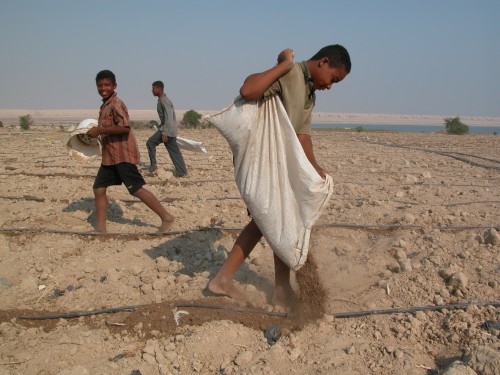
The research took me to Ghore Safi, the area of Jordan south of the Dead Sea where the sons of poor families walked barefoot through fields, spilling chicken manure behind them as a cheap fertilizer (photo above by Daniella Cheslow).
If the combination of the words “vegan” and “bar” doesn’t make sense to you, you’re not alone.
Because beer is made of hops, malt, and yeast, right? No animals harmed or used in the production of any of those.
But The Rogatka (or “Slingshot”), a new “vegan” bar that opened up last week, defines itself not according to the content of its goods but by the ideals that it encourages.
And so for all you meat and dairy avoiders out there – you are welcome with open arms at the bar’s location on Yitzhak Sadeh street.
The ideologically focused bar was opened by the same “anarchist collective” that used to run the Salon Mazal bar off of King George street. The founders of the bar say that they hope their watering hole will attract environmentalists, left-wing activists, and other likeminded people with their cheap drinks and fair trade products.
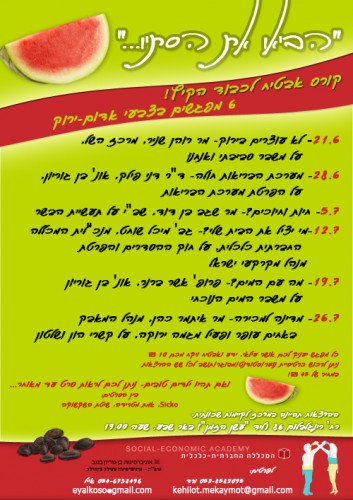
If you’re in the South today and haven’t yet seen An Inconvenient Truth, the Watermelon series of six “Green and Red” lectures at Beer Sheva‘s Ashan Hazman cafe/bookshop kicks off with a movie screening and discussion (in Hebrew) at 7 p.m.
For the last few months, Ashan Hazman (The smoke of time) has gradually become a neighborhod sustainability center thanks to the tireless work of local Matan Golan.
He put up a compost heap in the cafe’s yard, replaced the bathroom sink pipes with a bucket for collecting grey water, and made benches by slathering mud on stacks of books that couldn’t be sold.
The Watermelon Series is sponsored by Ben-Gurion University and the Social-Economic Academy (SEA) a national organization which offers lectures on social issues around the country.
Next week’s lecture, also at 7 p.m., covers the Israeli health system and features Michael Moore’s Sicko. Other topics include the meat industry, the Israel Lands Administration reform (see GP post here), the water crisis and the rising power of Israel’s capitalist class, featuring the movie Shitat HaShakshuka.
Each lecture is NIS 10, or you can buy tickets for all six for NIS 45. For more information, contact SEA Beer Sheva Director Eyal Kosowski at eyalkoso[at]gmail[dot]com.
And if you’re in Beer Sheva all week long, don’t forget about the upcoming Eco-Thiopia festival at Earth’s Promise.
Israeli NGOs, such as Earth’s Promise, are involved with helping Ethiopian populations within the country (check out the Eco-Thiopia festival in Beer Sheva next week). And the Israeli government, apparently, is involved with helping Ethiopian populations… in Ethiopia.
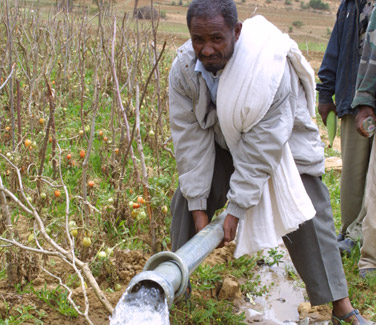
On Wednesday the German Environment Ministry announced that Israel and Germany have launched a joint irrigation project in Addis Ababa, the Ethiopian capital. The initiative is the result of an agreement signed last year between former Israeli foreign minister, Tzipi Livni, and the German Environment Minister. The project aims to provide advice and assistance in implementing efficient and environmentally sustainable irrigation among Ethiopian farmers.
If you are planning to be in Beer Sheva next week, make it Thursday and drop by the Earth’s Promise community garden for a festival of Ethiopian culture.
Earth’s Promise founder Isaac Hametz started the garden about a year ago as a way to help newly arrived immigrants adapt to life in Beer Sheva.
The immigrants, who come from a farming background, tend 50 plots planted with vegetables from Israel and other plants from Ethiopia.
While they plant, their children play in the garden (photo below, by Daniella Cheslow). It’s one of the few green spaces around the Kalisher absorption center.
Instead of using synthetic sponges for your shower and dishes use a luffa! Sponges tend to collect bacteria and for heath reasons should be thrown out 1-2 times a week. But if they are not biodegradable, that is a LOT of waste filling up landfills. Additionally, the “antibactirial” sponges have a chemical called Triclosan which is officially a pesticide. Do you really want to be using that on your dishes? The best part about Luffas, are that they can be grown in your own backyard!



 Alfa, Lebanon’s chief mobile