“In the midst of uncertain time, renewable energy remains consistent and steadfast in its expansion,” said Francesco La Camera, IRENA’s Director-General. “A more decentralised energy system, with a growing share of renewables and more market players, is structurally more resilient.”
Health insurance is a regulated financial product. Insurers operate under binding contracts, overseen by state insurance commissioners, that legally obligate them to pay claims meeting policy terms. Policyholders who believe a covered claim was wrongfully denied have legal recourse through state regulatory channels.
The New Zealand Merino Company, now rebranded as Zentera, has quietly removed the phrase “world’s leading ethical wool brand” from its website, a notable change that comes after a disturbing investigation by PETA Asia-Pacific into the company’s ZQ-certified wool supply chain, PETA reports to Green Prophet.
Somehow vegetables with short seasons excite the imagination and appetite more sharply than produce that’s available all year around. Good Middle Eastern cooks have many recipes for delicate fava beans, and this turmeric-fragrant soup is one.
“In the midst of uncertain time, renewable energy remains consistent and steadfast in its expansion,” said Francesco La Camera, IRENA’s Director-General. “A more decentralised energy system, with a growing share of renewables and more market players, is structurally more resilient.”
Health insurance is a regulated financial product. Insurers operate under binding contracts, overseen by state insurance commissioners, that legally obligate them to pay claims meeting policy terms. Policyholders who believe a covered claim was wrongfully denied have legal recourse through state regulatory channels.
The New Zealand Merino Company, now rebranded as Zentera, has quietly removed the phrase “world’s leading ethical wool brand” from its website, a notable change that comes after a disturbing investigation by PETA Asia-Pacific into the company’s ZQ-certified wool supply chain, PETA reports to Green Prophet.
Somehow vegetables with short seasons excite the imagination and appetite more sharply than produce that’s available all year around. Good Middle Eastern cooks have many recipes for delicate fava beans, and this turmeric-fragrant soup is one.
“In the midst of uncertain time, renewable energy remains consistent and steadfast in its expansion,” said Francesco La Camera, IRENA’s Director-General. “A more decentralised energy system, with a growing share of renewables and more market players, is structurally more resilient.”
Health insurance is a regulated financial product. Insurers operate under binding contracts, overseen by state insurance commissioners, that legally obligate them to pay claims meeting policy terms. Policyholders who believe a covered claim was wrongfully denied have legal recourse through state regulatory channels.
The New Zealand Merino Company, now rebranded as Zentera, has quietly removed the phrase “world’s leading ethical wool brand” from its website, a notable change that comes after a disturbing investigation by PETA Asia-Pacific into the company’s ZQ-certified wool supply chain, PETA reports to Green Prophet.
Somehow vegetables with short seasons excite the imagination and appetite more sharply than produce that’s available all year around. Good Middle Eastern cooks have many recipes for delicate fava beans, and this turmeric-fragrant soup is one.
“In the midst of uncertain time, renewable energy remains consistent and steadfast in its expansion,” said Francesco La Camera, IRENA’s Director-General. “A more decentralised energy system, with a growing share of renewables and more market players, is structurally more resilient.”
Health insurance is a regulated financial product. Insurers operate under binding contracts, overseen by state insurance commissioners, that legally obligate them to pay claims meeting policy terms. Policyholders who believe a covered claim was wrongfully denied have legal recourse through state regulatory channels.
The New Zealand Merino Company, now rebranded as Zentera, has quietly removed the phrase “world’s leading ethical wool brand” from its website, a notable change that comes after a disturbing investigation by PETA Asia-Pacific into the company’s ZQ-certified wool supply chain, PETA reports to Green Prophet.
Somehow vegetables with short seasons excite the imagination and appetite more sharply than produce that’s available all year around. Good Middle Eastern cooks have many recipes for delicate fava beans, and this turmeric-fragrant soup is one.
“In the midst of uncertain time, renewable energy remains consistent and steadfast in its expansion,” said Francesco La Camera, IRENA’s Director-General. “A more decentralised energy system, with a growing share of renewables and more market players, is structurally more resilient.”
Health insurance is a regulated financial product. Insurers operate under binding contracts, overseen by state insurance commissioners, that legally obligate them to pay claims meeting policy terms. Policyholders who believe a covered claim was wrongfully denied have legal recourse through state regulatory channels.
The New Zealand Merino Company, now rebranded as Zentera, has quietly removed the phrase “world’s leading ethical wool brand” from its website, a notable change that comes after a disturbing investigation by PETA Asia-Pacific into the company’s ZQ-certified wool supply chain, PETA reports to Green Prophet.
Somehow vegetables with short seasons excite the imagination and appetite more sharply than produce that’s available all year around. Good Middle Eastern cooks have many recipes for delicate fava beans, and this turmeric-fragrant soup is one.
“In the midst of uncertain time, renewable energy remains consistent and steadfast in its expansion,” said Francesco La Camera, IRENA’s Director-General. “A more decentralised energy system, with a growing share of renewables and more market players, is structurally more resilient.”
Health insurance is a regulated financial product. Insurers operate under binding contracts, overseen by state insurance commissioners, that legally obligate them to pay claims meeting policy terms. Policyholders who believe a covered claim was wrongfully denied have legal recourse through state regulatory channels.
The New Zealand Merino Company, now rebranded as Zentera, has quietly removed the phrase “world’s leading ethical wool brand” from its website, a notable change that comes after a disturbing investigation by PETA Asia-Pacific into the company’s ZQ-certified wool supply chain, PETA reports to Green Prophet.
Somehow vegetables with short seasons excite the imagination and appetite more sharply than produce that’s available all year around. Good Middle Eastern cooks have many recipes for delicate fava beans, and this turmeric-fragrant soup is one.
“In the midst of uncertain time, renewable energy remains consistent and steadfast in its expansion,” said Francesco La Camera, IRENA’s Director-General. “A more decentralised energy system, with a growing share of renewables and more market players, is structurally more resilient.”
Health insurance is a regulated financial product. Insurers operate under binding contracts, overseen by state insurance commissioners, that legally obligate them to pay claims meeting policy terms. Policyholders who believe a covered claim was wrongfully denied have legal recourse through state regulatory channels.
The New Zealand Merino Company, now rebranded as Zentera, has quietly removed the phrase “world’s leading ethical wool brand” from its website, a notable change that comes after a disturbing investigation by PETA Asia-Pacific into the company’s ZQ-certified wool supply chain, PETA reports to Green Prophet.
Somehow vegetables with short seasons excite the imagination and appetite more sharply than produce that’s available all year around. Good Middle Eastern cooks have many recipes for delicate fava beans, and this turmeric-fragrant soup is one.
“In the midst of uncertain time, renewable energy remains consistent and steadfast in its expansion,” said Francesco La Camera, IRENA’s Director-General. “A more decentralised energy system, with a growing share of renewables and more market players, is structurally more resilient.”
Health insurance is a regulated financial product. Insurers operate under binding contracts, overseen by state insurance commissioners, that legally obligate them to pay claims meeting policy terms. Policyholders who believe a covered claim was wrongfully denied have legal recourse through state regulatory channels.
The New Zealand Merino Company, now rebranded as Zentera, has quietly removed the phrase “world’s leading ethical wool brand” from its website, a notable change that comes after a disturbing investigation by PETA Asia-Pacific into the company’s ZQ-certified wool supply chain, PETA reports to Green Prophet.
Somehow vegetables with short seasons excite the imagination and appetite more sharply than produce that’s available all year around. Good Middle Eastern cooks have many recipes for delicate fava beans, and this turmeric-fragrant soup is one.
With so much concern over global warming and the future of our planet, the idea of eco tourism is becoming more of an “in thing” to do.
Whether it be something really adventurous, like the treks to the north and south poles by David de Rothschild (as well as his planned voyage in a boat made from old plastic bottles to the “islands” of discarded plastic wastes in the Pacific Ocean) or to see the effects of climate change and global warming on the Amazon rain forests, and other similar venues, eco-tourism is definitely something many people are getting involved in.
With all this in mind, is there merit to people embarking on eco-tourism trips to locations in the Middle East? You bet there is; and there are plenty of locations to go to as well.
To add to these vegetarian possibilites, Jana and Ilan Gur, owners of the Al Hashulchan (“On the Table”) food magazine, recently introduced the Sheni Tzimchoni (Vegetarian Monday) initiative. Dozens of Israel’s best restaurants have signed on to introduce special vegetarian menus every Monday throughout July and August.
The Israel company StePac L.A.has come out with a special plastic packaging material, that they say will not only keep your produce looking and fresh for up to 10 times longer, but is also biodegradable.
The material, known as X-Tend-branded modified atmosphere/modified humidity packaging “creates favorable inside-the-bag atmospheric conditions for fruits and vegetables while proprietary engineering of Xtend polymers ensure correct balance between oxygen and carbon dioxide,” according to Don Stidham, president of the San Diego based company subsidiary, in the USA.
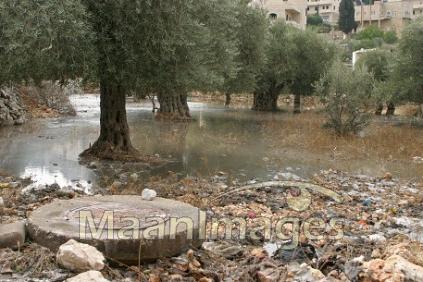
(A view of flood water in an olive grove in Beit Jala, near Bethlehem, last October. The filthy water killed about 30 olive trees. Photo from Ma’an News).
In Israel for the first time last week, Hollywood stars Liev Schrieber and Naomi Watts (and their two cute kids) planted a pistachio tree (and other trees) in the Galilee with the Jewish National Fund (JNF). Though we loved their appearances in “X-Men Origins: Wolverine” and “King Kong”, we think that tree planting certificates and soil on their hands suit Schrieber and Watts just as well.
The couple’s itinerary was planned by the JNF and included swimming in the Sea of Galilee (Lake Kinneret), visiting the biblical zoo in Jerusalem, seeing important Christian and Jewish holy sites, taking advantage of Tel Aviv’s beaches. Not to mention meeting with President Shimon Peres.
Algae biofuel is now being developed as a source of energy for the future, but really algae has been fueling society for a long time. When looking at the components of coal, oil, and natural gas that power our world today, they are all originally comprised of organic materials such as algae. As we currently aim to shift away from fossil fuels because of their non-renewable nature and significant contribution to global warming, we may be going back to using one of fossil fuels’ original organic components.
In an interview Dr. Michael Kagan, a long time environmental researcher and founder of the algae development company Algaenesis, I was introduced to the beneficial uses of algae that make it vital to human and animal life and how Algaenesis has developed a new system of growing it.
The beauty of algae is that it does not have to be grown in fresh water. In fresh, brackish, or salt water Algae grows by photosynthesizes producing a range of products including oils that can be refined into fuel, powerful antioxidants and vitamins, Omega 3 and Omega 6, and there’s even one species that grows octane fuel. Algae should be more integrated into human and animal diets because it has tremendous health properties, and if more accessible, it could feed animals and provide more food in poor areas of the world.
Dr. Kagan explained that researchers have dreamed of algae being widely used to feed the world for 40 to 50 years, but it is difficult to grow, especially inexpensively and in large quantity. Scientists have tried to grow algae in raceway shaped ponds and in vertical tanks called bioreactors, but both systems have experienced setbacks.
You heard about being a vegawarian here, which in case you forgot, means “you are ‘aware’ that eating animals contributes more towards global warming than eating plants. So, maybe, sometimes, you will choose the vegetarian option instead of the meat option.”
The New York Times’ Freakonomics blog has just published another scheme for cutting down meat without cutting it out, “vegetarianism as a sometimes thing.” Writer Ian Ayres posted a reader letter suggesting that a group of friends get together and agree to always have one vegetarian eater among them. In other words, collective vegetarians:
Carbon offsetting your flight is one way to help reduce the amount of greenhouse gases entering the air. But experts in the transportation industry know that it’s necessary to start from the ground up — by making planes, trains and automobiles more environmentally friendly as part of their engineering. Green Prophet’s Tal Ater was just at the Paris Air Show reporting on just this, and new advances in green aviation news.
Now, taking on a major partnership in the European Union’s flagship project – the $1.6 billion Clean Sky Joint Technology Initiative together with large European partners, Israel’s aviation giant Israel Aerospace Industries (IAI) is helping to make skies greener. The company is the only non-EU partner in the massive research and development project.
Although in planning for a couple of years, just six months ago the Israeli company started working on its tasks. Led by Dassault, a prominent European aerospace company, IAI is also greening the skies along with Airbus and Eurocopter.
“We are dealing with reducing the amount of hazardous manufacturing waste, recycling, reducing weight – which will reduce carbon emissions – and extending the life [of the aircraft], which reduces need for recycling,” says Arnold Nathan, the director of IAI’s R&D Engineering Division.
German industrial giant Siemens is now involved in talks to purchase the Israeli Solel Solar Energy Ltd., according to an article published in Globes, Israel’s leading business paper.
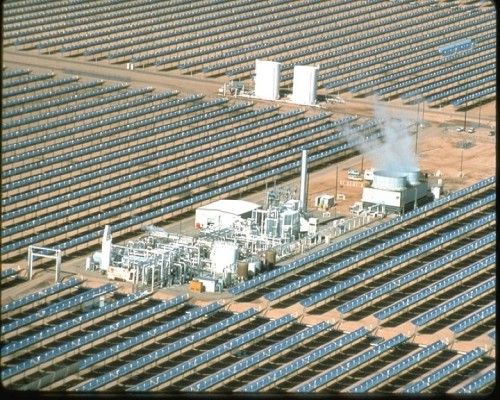
Solel, a global leader in building solar thermal fields, was partially invested in by a UK energy company, Ecofin about 18 months ago. But it now appears that Seimens has become very interested in the Israeli company, due to its technology that converts sunshine into useful thermal energy, and subsequently into electricity. It is considered one of the most promising Israeli solar energy innovators, up there with other companies on investors’ watchlists like BrightSource, ZenithSolar, Aora, and Di.S.P. (the technology of Prof. Avi Kribus).
With the aviation industry reeling from increasing fuel costs, dipping profits and those pesky upcoming environmental regulations, airlines are scrambling to become more efficient, cut costs and increase fuel efficiency.
Japan Airlines did their part to shed excess weight on their flights by shortening their blankets by a centimeter, and Northwest Airlines did it by removing all the spoons from their planes.
Airbus A380
But true change must come from innovation and new thinking by aircraft manufacturers. This week, I visited the Paris Air Show at Le Bourget, to see firsthand what direction the industry is taking. The general sentiment of the show was summarized by Airbus in 10 foot letters on the side of their new Airbus A380 – “Greener. Cleaner. Quieter. Smarter.”
The A380’s bar (image by jjay69)
The new Airbus A380 is the largest passenger aircraft in the world, and Airbus boasts that it is the first aircraft ever to achieve a fuel efficiency below 3 liters per passenger over 100 kilometers (a boast which loses some meaning if you take into consideration that all current airlines fly A380 configurations that cater to fewer passengers per flight and are rarely fully booked).
The A380 also uses a new wing design and lighter composite materials to improve its performance. Airbus also claims a 50% smaller noise footprint than the 747-400 while carrying 40% more passengers.
Impressive claims. But as I look up at the A380 flying overhead in slow graceful circles, all of those energy saving statistics melt away and all I can think of is the full-sized, fully stocked bar in the plane’s upper deck.
The Bluecopter
Not to be outdone by Airbus, Eurocopter are showing their own idea for a greener future. Their new concept helicopter, codenamed Bluecopter, has a “high-compression engine” that promises to reduce fuel consumption, CO2, NO and NO2 emissions by 30-40%… That is if they can get it off the ground.
It seems that calling it a helicopter is a bit of a stretch, as the bluecopter is currently nothing more than an off the shelf Mercedes-Benz V6 turbodiesel engine with a helicopter shaped box around it painted in blue and green. In fact, it is currently so heavy, it couldn’t get off the ground even if you gave up on the fancy extras such as passengers or a pilot.
Not that any of those facts stood in the way of Eurocopter generating a lot of green-buzz around this innovation.
Another recurring theme in the show was increased use of composite materials such as carbon fibers to make aircraft lighter. One notable example was the 4-seater Simba. With a hull built entirely from carbon fibers, Simba weighs less than 500 kg (I’ve ridden motorcycles heavier than that), but can still reach a cruising speed of 220 km/h, and pulled off impressive stunts in the sky above our heads.
500 kg of innovation
After spending a few days looking at the latest and greatest being developed by some of the biggest companies on the planet, it is clear that the current direction is focused on optimizing, refining and improving as opposed to revolutionizing.
But in an industry where it can take over a decade to bring a product to market (The A380 took 13 years to develop), is it fair to expect a revolution right now? Or will we have to wait another decade before seeing a true leap in technology? I’d like to believe that current market forces will accelerate the current progress and bring a revolution out of necessity.
But will this be enough to save the industry? 2009 marked the 100th year of the Paris Air Show, and it was quite a somber one, with fewer Champagne bottles uncorking to celebrate big deals, fewer new models and not enough innovation.
Looking at the big airlines, it is easy to draw parallels between the state of the aviation industry, and the stagnation in the American car industry. Perhaps what we need here is an outsider with a fresh point of view to shake the boat… to borrow an idea from Todd Dagres – Perhaps what the aviation industry needs is a Steve Jobs.
Like a Kid In a Toy Store
All cynicism and skepticism aside, the Paris Air Salon is the ultimate place for the kid-at-heart to check out the latest toys in action.
Where else in the world can you see a Eurofighter Typhoon pull off crazy stunts, walk a few meters under the shadow of two huge space rockets to flirt with an F-15 pilot, then turn your head back to the roar of a 50 year old Lockheed Super Constellation taxiing 5 meters from you, its giant wing over your head.
Even a grumpy treehugger like me can’t help but melt and squeal with glee as a F/A-18 Super Hornet prepares for takeoff next to me, the hot air from its jets blasts me in the face like a thousand splendid suns… Burn all the fuel you want buddy, right now I’m an 8 year old with the shiniest toy.
Plastic bags are evil. They are not biodegradable, pollute our landfills, pollute our waterways, convince fish and ducks that they’re food… it’s pretty well established that they’re just bad news. While activists encourage consumers to try using fewer bags, or sometimes try to ban the use of plastic bags entirely, the truth is that these pleas often fall on deaf ears.
Which is where – thankfully – designers step in. Because where environmental activists fail, hip design often succeeds.
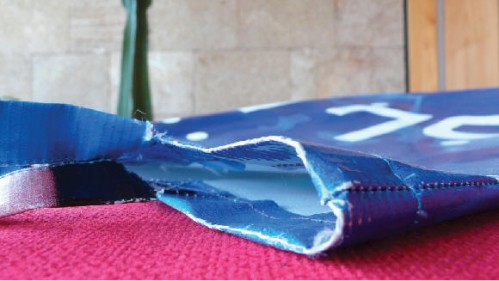
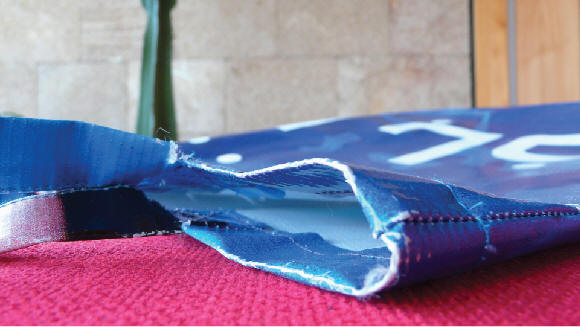
Waste Lb, the collaboration of designers Waleed Jad and Stephanie Dadour, is a response to the pervasive use of plastic shopping bags in Lebanon. Waste Lb reclaims flex, the material used to create billboards, in order to make reusable shopping bags such as the ones above and below. (Abu Yoyo, a designer based in Tel Aviv, also appropriates billboard materials in order to make bags.)
By using flex, Waste Lb encourages conservation in two ways: they encourage consumers to switch to reusable bags while simultaneously using material that would otherwise be discarded into a landfill. According to Dadour, “we know we’re not here to change the world or to educate people, but we thought we could sensitize people to reduce their use of plastic bags by promoting a product that can be reused.”
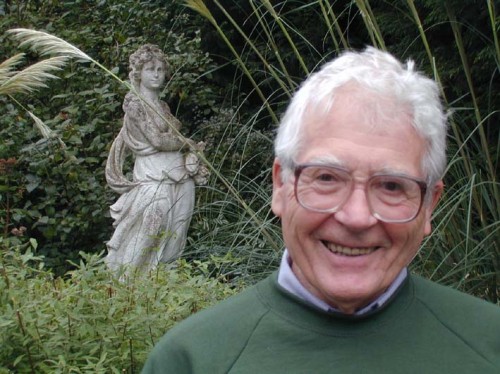
“We became the Earth’s infection a long and uncertain time ago”: James Lovelock is perhaps the world’s best-known independent scientist; he has published a new book, The Vanishing Face of Gaia: A Final Warning.
Lovelock has served humanity and the planet well by inventing a device (the ECD – Electron Capture Detector), which detected the amount of CFC’s in the atmosphere, but he is better known as the founder of the Gaia Principle. In a nutshell, this is the structure in which to see the planet and all that is on and of it, as a living whole, instead of separate parts.
In Lovelock’s own words: “To Golding, Gaia, the goddess who brought order out of chaos, was the appropriate title for a hypothesis about an Earth system that regulated its climate and chemistry so as to sustain habitability.” [Writer William Golding gave Lovelock’s theory, developed in 1965, its name]
The author of 5 books about Gaia, Lovelock, as he approaches the sage-like age of 90, has written his most direct and challenging book yet, subtitled ‘a final warning.’
As the author prepares to take up Richard Branson’s offer of a place upon a Virgin Galactic flight in space, he is at his simplest and most direct in this book; highly critical of European green politics and environmentalism, and offering what he believes are the only solutions for partial human survival through the onslaught of climate change.
For many tourists to the Israeli Negev desert, a visit to the Bedouins includes a commercialized camel ride and perhaps an afternoon spent in a tent near Mitzpeh Ramon.
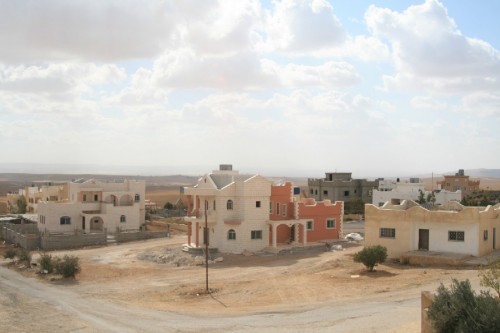
But as the Jerusalem Post writes, the Desert Sites tourist company is offering a revolutionary immersion Arabic course in the last week of July in the Bedouin township of Darajat (also spelled Dirgat), known as Israel’s first solar village.
Israel has 160,000 Bedouin Arab citizens. Between 50-60 percent of them live in recognized communities and the other are strewn about the landscape in unrecognized villages in tin-roofed shantytowns. Darajat is a recognized village with a population of approximately 800.
Most residents have solar water heaters and electric systems, the school is powered by wind and sun, and students learn hands-on about alternative energy by reading the power meters in their classrooms. The village also boasts a solar mosque, below.
Alfa, Lebanon’s chief mobile phone service company, is now operating on solar energy to power its transmission network.
The company recently installed its fifth solar powered station in the Hourata Reserve, and the station’s new solar powered generator is expected to be in full power by next month.
Alfa, a state owned communications company, managed by Orascom Telercom, began making the decision to switch to solar energy even before the 2006 war in Lebanon, which severed damaged the country’s electricity grid.
The new power station is designed to provide energy even in the worst winter weather, when normal solar power stations would not be functioning.
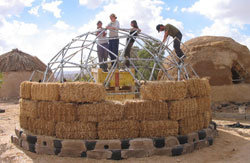
Tucked deep into the Arava desert at the southeastern border of Israel, Kibbutz Lotan‘s Center for Creative Ecology has announced two programs for the late summer and fall, including detailed information for funding on its Web site.
The first is the Peace, Justice and Environment course, which is run in conjunction with the Living Routes organization and runs August 31-December 9, 2009. Students in the course will work with Jewish and Arab environmental leaders, from the ecological straw-bale builders on Kibbutz Lotan to a permaculture site in the Bedouin town of Segev Shalom. The course includes a tour of the Separation Barrier in Jerusalem The 14-week course is accredited by the University of Massachusetts, Amherst and is worth 16 credits. The program costs $14,200.


 With so much concern over global warming and the future of our planet, the idea of eco tourism is becoming more of an “in thing” to do.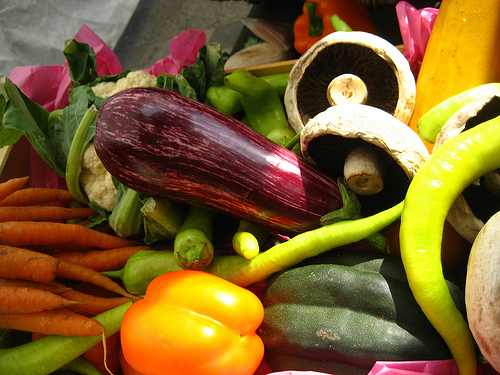









 With the aviation industry reeling from increasing fuel costs, dipping profits and those pesky upcoming environmental regulations, airlines are scrambling to become more efficient, cut costs and increase fuel efficiency.






 Alfa, Lebanon’s chief mobile