Creators who want to influence people for good should also think carefully about tone. Environmental storytelling does not need to lecture or shame audiences. It can invite curiosity instead.
The company's Next Generation Process (NGP) Pilot Plant in London, Ontario, has officially moved into initial operating campaigns, generating the kind of structured, repeatable data that separates laboratory promise from commercial viability.
In the modern nutrition universe, that level of commitment deserves an applause. But for those who don’t live in a Nordic fishing village, the nutrition company Zinzino has built its omega-3 research and formulations around these principles, combining biomarker testing, antioxidant protection and traceable sourcing across both sustainably harvested small-fish oils and a vegan marine-microalgae alternative.
Dubai Municipality has set up 12 AI-powered "Ehsan Stations" to safely and officially feed strays. The city also officially supports Trap-Neuter-Return (TNR) programs.
Creators who want to influence people for good should also think carefully about tone. Environmental storytelling does not need to lecture or shame audiences. It can invite curiosity instead.
The company's Next Generation Process (NGP) Pilot Plant in London, Ontario, has officially moved into initial operating campaigns, generating the kind of structured, repeatable data that separates laboratory promise from commercial viability.
In the modern nutrition universe, that level of commitment deserves an applause. But for those who don’t live in a Nordic fishing village, the nutrition company Zinzino has built its omega-3 research and formulations around these principles, combining biomarker testing, antioxidant protection and traceable sourcing across both sustainably harvested small-fish oils and a vegan marine-microalgae alternative.
Dubai Municipality has set up 12 AI-powered "Ehsan Stations" to safely and officially feed strays. The city also officially supports Trap-Neuter-Return (TNR) programs.
Creators who want to influence people for good should also think carefully about tone. Environmental storytelling does not need to lecture or shame audiences. It can invite curiosity instead.
The company's Next Generation Process (NGP) Pilot Plant in London, Ontario, has officially moved into initial operating campaigns, generating the kind of structured, repeatable data that separates laboratory promise from commercial viability.
In the modern nutrition universe, that level of commitment deserves an applause. But for those who don’t live in a Nordic fishing village, the nutrition company Zinzino has built its omega-3 research and formulations around these principles, combining biomarker testing, antioxidant protection and traceable sourcing across both sustainably harvested small-fish oils and a vegan marine-microalgae alternative.
Dubai Municipality has set up 12 AI-powered "Ehsan Stations" to safely and officially feed strays. The city also officially supports Trap-Neuter-Return (TNR) programs.
Creators who want to influence people for good should also think carefully about tone. Environmental storytelling does not need to lecture or shame audiences. It can invite curiosity instead.
The company's Next Generation Process (NGP) Pilot Plant in London, Ontario, has officially moved into initial operating campaigns, generating the kind of structured, repeatable data that separates laboratory promise from commercial viability.
In the modern nutrition universe, that level of commitment deserves an applause. But for those who don’t live in a Nordic fishing village, the nutrition company Zinzino has built its omega-3 research and formulations around these principles, combining biomarker testing, antioxidant protection and traceable sourcing across both sustainably harvested small-fish oils and a vegan marine-microalgae alternative.
Dubai Municipality has set up 12 AI-powered "Ehsan Stations" to safely and officially feed strays. The city also officially supports Trap-Neuter-Return (TNR) programs.
Creators who want to influence people for good should also think carefully about tone. Environmental storytelling does not need to lecture or shame audiences. It can invite curiosity instead.
The company's Next Generation Process (NGP) Pilot Plant in London, Ontario, has officially moved into initial operating campaigns, generating the kind of structured, repeatable data that separates laboratory promise from commercial viability.
In the modern nutrition universe, that level of commitment deserves an applause. But for those who don’t live in a Nordic fishing village, the nutrition company Zinzino has built its omega-3 research and formulations around these principles, combining biomarker testing, antioxidant protection and traceable sourcing across both sustainably harvested small-fish oils and a vegan marine-microalgae alternative.
Dubai Municipality has set up 12 AI-powered "Ehsan Stations" to safely and officially feed strays. The city also officially supports Trap-Neuter-Return (TNR) programs.
Creators who want to influence people for good should also think carefully about tone. Environmental storytelling does not need to lecture or shame audiences. It can invite curiosity instead.
The company's Next Generation Process (NGP) Pilot Plant in London, Ontario, has officially moved into initial operating campaigns, generating the kind of structured, repeatable data that separates laboratory promise from commercial viability.
In the modern nutrition universe, that level of commitment deserves an applause. But for those who don’t live in a Nordic fishing village, the nutrition company Zinzino has built its omega-3 research and formulations around these principles, combining biomarker testing, antioxidant protection and traceable sourcing across both sustainably harvested small-fish oils and a vegan marine-microalgae alternative.
Dubai Municipality has set up 12 AI-powered "Ehsan Stations" to safely and officially feed strays. The city also officially supports Trap-Neuter-Return (TNR) programs.
Creators who want to influence people for good should also think carefully about tone. Environmental storytelling does not need to lecture or shame audiences. It can invite curiosity instead.
The company's Next Generation Process (NGP) Pilot Plant in London, Ontario, has officially moved into initial operating campaigns, generating the kind of structured, repeatable data that separates laboratory promise from commercial viability.
In the modern nutrition universe, that level of commitment deserves an applause. But for those who don’t live in a Nordic fishing village, the nutrition company Zinzino has built its omega-3 research and formulations around these principles, combining biomarker testing, antioxidant protection and traceable sourcing across both sustainably harvested small-fish oils and a vegan marine-microalgae alternative.
Dubai Municipality has set up 12 AI-powered "Ehsan Stations" to safely and officially feed strays. The city also officially supports Trap-Neuter-Return (TNR) programs.
Creators who want to influence people for good should also think carefully about tone. Environmental storytelling does not need to lecture or shame audiences. It can invite curiosity instead.
The company's Next Generation Process (NGP) Pilot Plant in London, Ontario, has officially moved into initial operating campaigns, generating the kind of structured, repeatable data that separates laboratory promise from commercial viability.
In the modern nutrition universe, that level of commitment deserves an applause. But for those who don’t live in a Nordic fishing village, the nutrition company Zinzino has built its omega-3 research and formulations around these principles, combining biomarker testing, antioxidant protection and traceable sourcing across both sustainably harvested small-fish oils and a vegan marine-microalgae alternative.
Dubai Municipality has set up 12 AI-powered "Ehsan Stations" to safely and officially feed strays. The city also officially supports Trap-Neuter-Return (TNR) programs.
According to the military news site Defense Professionals IDF ground forces managed to reduce their water consumption by 21% in the first half of 2009 as compared to the same period in 2008.
Electricity consumption was also slightly reduced during the same period (by 3%) with more conservation awareness being transmitted to soldiers to have them be more involved in conserving already scarce water resources. The significant water savings should be even more with the installation of special water savings devices on all water faucets on IDF bases, which will be done at the beginning of 2010.
Every week, it is the custom of religious Jews to read their holy book, the Torah, and relate it to the world around them. This week our resident Eco Rabbi, Jack, talks about sticking up for our planet.
At the end of last week’s segment, Joseph still had not revealed his true identity to his brothers and he decided to incarcerate Benjamin, the favorite brother of their father. When Judah hears this, he knows that it would kill their father, and he stands up to Joseph, the second in command to Pharaoh.
I identify with Judah. He took upon himself the responsibility to watch over his younger brother, Benjamin. When everything seemed to be going wrong, and Pharaoh’s right hand man was going to detain Benjamin in jail, Judah had to stand up for him.
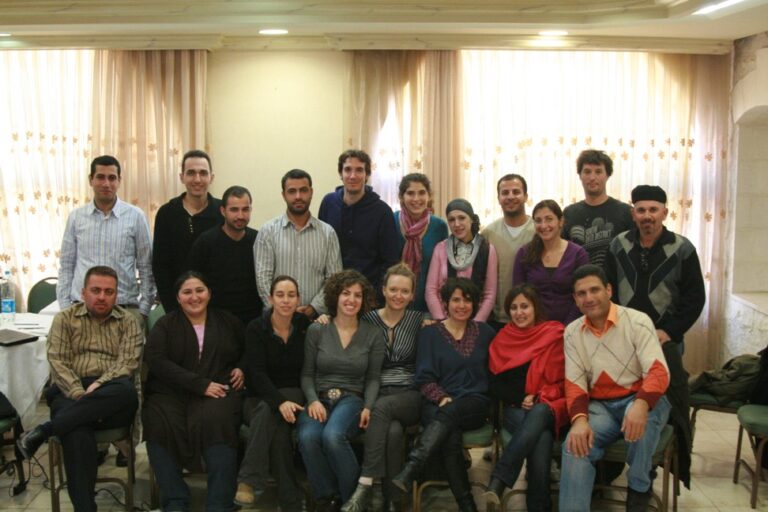
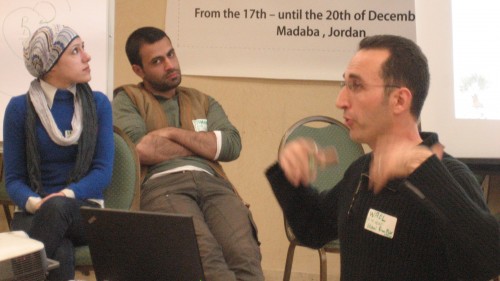
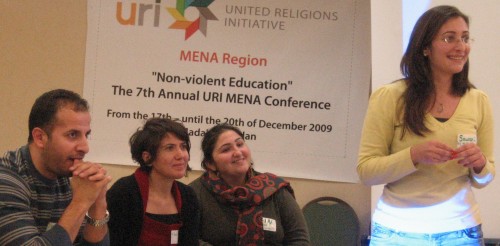
After around two months of international phone calls, this Sunday and Monday Green Prophet hosted a whirlwind two-day (20-hour) seminar on environmental blogging in Madaba, Jordan.
Thanks to the good efforts of Volunteers for Peace and the Masar Center, nearly 20 Jordanian, Palestinian and Israeli writers and activists met for the first time and learned about each others’ projects and goals at home.
This past weekend I traveled to historic Madaba, Jordan at the first Middle East Green Bloggers Conference. Among this inspiring collection of environmental writers, professionals, and activists, I’ve just met a trio of Jordanian young innovators bringing a special variety of “thin film” technology to the Middle East.
Zein Nsheiwat, Sawsan Issa, and Osama Suliman first met in 2005 when they were all students at the Arava Insitute for Environmental Studies in southern Israel. After they returned home to Jordan, they wanted to find a way to take advantage of what they had learned at the Arava, and to apply it in the context of their home country.
Today, this team is conducting a pilot project on clear thin film photovoltaic (PV) cells in the Middle East.
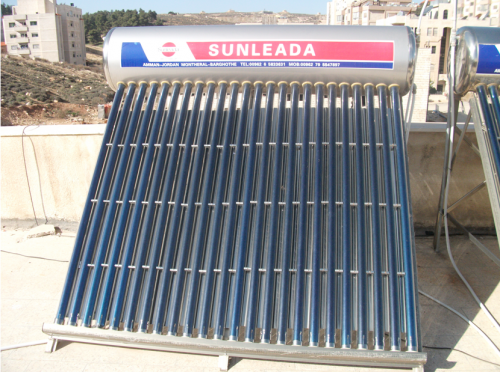
Blogger Azul looks at the use of solar thermal energy for heating Jordanians’ water. Here’s an example of a solar heater on a roof in Jordan.
If you’ve been following Green Prophet, you’ve been enjoying the posts from our Environment Blogging Workshop in Madaba, Jordan. Jordanian blogger “Azul” talks about the simple solar solutions Jordanians can use today:
About seven months ago, I was invited to a reception at the Swedish ambassador’s residence in Amman. There, a Swedish journalist- who had spent some time in Israel and the West Bank- asked me a question that left me pondering and thinking about the energy crisis we have in Jordan for quit sometime.
She said: In Israel, almost everyone has solar heating systems on their roof, with which they conserve and ration their consumption of energy; why don’t Jordanians have those installed up on their roofs, as it would quite save them a lot financially an also preserve their environment?
As we’ve been saying, Green Prophet hosted a Green Blogger’s Conference in Jordan earlier this week. We’ve recapped what we’ve learned from the Jordanian activists. Now Hiba Hamzeh from Volunteering for Peace living in the West Bank, Palestinian Authority, blogs about her desire to initiate a “green” change among people and youths in the PA:
Talking about the environmental issue in the Palestinian community is something we would rarely hear or read about. So far the activities related to environmental awareness and preservation are rare. On the other hand it is of great importance to start from somewhere to lead this human community to emphasize how essential working on this issue could be on different levels.
The Palestinian community is not of the richest communities in the world, so thinking “green” could add some financial benefits, as people will start to use their waste and leftovers for other purposes. This line of thinking will improve the environmental atmosphere in Palestine which will guide Palestinians to a better and healthier standard of life, which eventually will lead to more environmental awareness.
As an educated Palestinian woman, I feel that I have a responsibility to be a part of a campaign aimed to spread the environmental awareness in my community since I was introduced to it and know how important it is for humanity.
The way to start this in Palestine could begin from the very simplest ways so they would be observed easier, and would be easy for the people to implement in their lives. The examples to do this through environmental awareness could be unlimited, and they can be used to make the environment a part of the peoples’ lifestyles and in small daily activities that they do.
One of the few examples for a simple way that could be implemented in the Palestinian community easily is garbage compressing for organic leftovers. Another example could be introducing people to use some solid leftovers such as glass bottles for other purposes like preserving food, or for keeping other stuff in them, even sell them to glass factories so they will be re-manufactured again into other forms.
In order for us to introduce people to such practices we can start from working in the Palestinian cities and villages and guide the local community through these model activities to show them how they can do this in their homes and lives, and how this would save them much in both finance and health.
The possibilities out there in this community are huge: on one hand it is a young society where the youth form a large percentage of the population. Their energies could be hired in many activities in the streets, schools, and at home. Also many people in the villages are farmers and could use the compressed organic compost leftovers as fertilizer on their land.
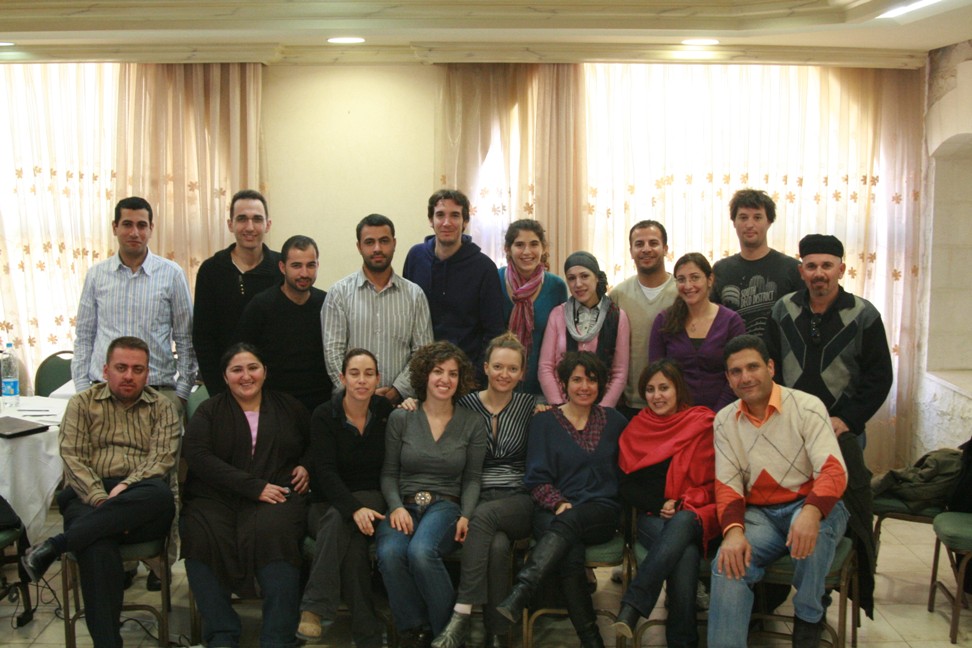
It was 20 hours we will never forget. Nineteen journalists, activists and bloggers from Jordan, the PA and Israel met at an international blogging workshop in Jordan intending to make better environment bloggers (and friends) out of all of us. Hosted by Green Prophet, Volunteers for Peace in Bethlehem and the Masar Center in Jordan, we shared, we ate, we danced and we wrote. Blog posts from the event are forthcoming.
Besides all of our mutual desires to share and to learn more about communicating our regional problems in the global blogosphere, each and every one of us all shared our local environmental issues, projects and dreams. Readers should take note: it’s very uncommon for Palestinians, Jordanians and Israelis to meet in such face-to-face encounters. We overcame our fears and stereotypes to broaden our worldviews and to make change.
Jericho in Palestine will light up with solar power thanks to Japanese initiative.
The Japanese government has agreed to assist the Palestinian Authority with two solar energy projects totaling $23 million, according to the Palestinian Maan News Agency.
Part of the funds, $16.7 million, will be used to assist in alleviating the Authority’s financial difficulties, with the remaining $6.3 million going to construct a photovoltaic solar energy plant in Jericho, just above the Dead Sea.
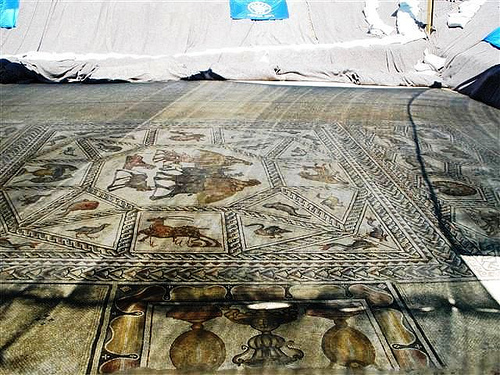
An ancient mosaic recently uncovered in the mixed city of Lod: Stigmatized as a crime infested, religiously divided city, residents of Lod have launched a grass-roots effort to change the face of the ancient city at the heart of Israel.
Mention Lod to anyone in Israel and more often than not it conjures up images of crime-infested slums, religious tensions and cultural backwardness.
Five minutes from Israel’s ultra-modern international airport is the city of Lod. Smack in the heart of the country, and rich in history, Lod has been Israel’s shameful backyard, the reference place for what Israelis didn’t want their cities to become, and a place most Israelis would never want to visit.
Today’s reality is not a rosy one. Lod has one of Israel’s poorest communities, with a sizeable high-school dropout rate and an enormous drug problem. The World Monument Fund recently included the city on its list of heritage sites, but its culture remains buried by neglect and decay. Indeed the municipality of the mixed Arab-Jewish city was found to be so corrupt and bankrupt that the government threw it out and imposed a former army general as acting mayor.
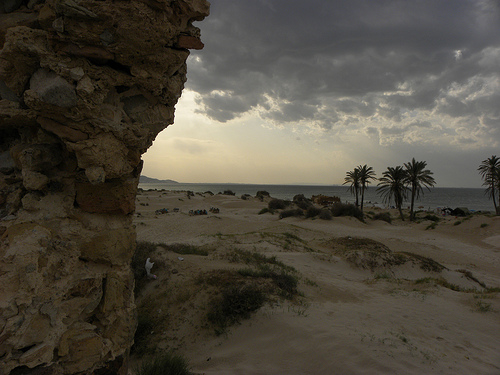
Borj Cedria beach in Tunisia. This North African country speaks up after Copenhagen.
The fallout from the failure of the Copenhagen climate change summit that ended last Friday continues to see world leaders lash out at the international community’s missteps. This time it is Tunisia’s Minister of Environment Nadir Hamada, who said the global leadership must understand the need for strengthening its resolve in the face of climate change. Hamada called on the international community to meet its commitments and to face up to the “dire consequences” of climate change no matter how wealthy a nation may be.
He argued that international efforts to address the issue of climate change, “are still far below expectations,” when it comes to addressing the impact of climate change on developing countries. He added that Tunisia is ready to step up its efforts to contribute to reducing carbon emissions and creating the means to battling climate change.
Masdar City: A model city for sustainable cities of the world?
Masdar City, that 100% carbon neutral eco-city being built in Abu Dhabi, is receiving well deserved attention not only from local environmentalists, but from many individuals and organizations located far from the unique ecological project.
The city currently under construction by an international consortium of construction and architectural firms which include the Australian architectural firm LAVA Architects, the renowned UK architectural firm Foster + Partners, America’s General Electric, and the German BASF construction company. The idea of an environmentally sustainable, and carbon neutral residential and business development has attracted great interest from companies like GE, which is also establishing an “ecomagination” research center in Masdar, like it already has in Niskayuna New York and Munich Germany.
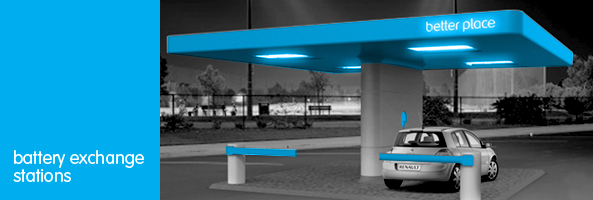
Automotive companies in Michigan are looking to Israeli battery and electric car innovators, like Better Place, to help revive their ailing car industry.
Michigan meet Israel, Israel meet Michigan: In actual fact, the state of Michigan and the State of Israel don’t need an introduction. In some ways the automotive heart of America has been working steadily with Israel for decades.
While it’s no big secret that the Big Three automotive companies in Michigan have tanked, government incentives are now looking to transform America’s battered auto industry into something new. And Israel could play a part.
Ron Perry, executive director of the Michigan Israel Business Bridge, says that Israel’s history as a supplier to the Big Three – General Motors, Chrysler and Ford – is well developed. With a new focus on electric and hybrid cars, Michigan, he surmises, could benefit from collaboration with Israeli battery researchers.
Here at Green Prophet we are concerned about the current water shortage. Today we’re sharing 12 water conservation tips for the kitchen that can impact the Middle East.
1. If you use a dishwasher, always fill it completely and choose the fastest setting.
2. When washing by hand, soak to soften the residue, then scrub with a brush or sponge. Only use running water for a final rinse, never as a cleaning tool.
3. Dilute dish detergent in advance and use a small amount so it will dissolve properly. Excess soap goes down the drain or need more water to be rinsed off.
6. When washing utensils, don’t fill items like glasses, pots and bowls. Tilt them so that the water reaches the sides and bottom.
7. Defrost foods in the refrigerator to avoid soaking.
8. When washing a jar or glass, put in a small amount of soapy water and shake with the cover on. Then transfer the water to the next utensil. Wipe and rinse.
9. Use a minimum of cooking water to retains nutrients and save on cooking time. Pasta needs much less water than the package instructs, just stir frequently.
10. Save cooking water for soups, grains, and bread dough. Don’t reuse water from washing dishes, but water from cleaning vegetables can be reused in the washing machine, toilet or garden. A microwave or pressure cooker retains more moisture than the stovetop or oven.
11. Make one-pot meals (like mejadera) to save on washing.
12. Place dirty pots in the sink to collect used water, instead of soaking them in clean water. In some countries, like in Australia, they use rainwater tanks to gather rainwater. Suppliers like http://supatank.com.au/ assists homeowners to set up a rain catchment system that connects to the bathroom, kitchen and anywhere where water is most needed during the day.
During the week of December 13, 2009, Israel’s solar energy field suffered a major setback and it was announced that IDE is set to build the biggest desalination plant in Israel. At the Copenhagen summit Israeli President Shimon Peres emphasized the importance of cooperation between all the countries in the region to work together to help save the environment. For these stories and more, check below.
Are the “Sons of the desert” doing their utmost to curtail climate change?
One out of every 4 human beings on this planet is a Muslim. As such, are members of this planet’s largest religious group doing enough to combat the growing problems of global warming and climate change?
Much of the world’s known petroleum reserves are located in or off-shore from Muslim dominated countries in South Asia, North Africa, and the Middle East. Overgrazing and other environmentally damaging agricultural practices in many of these countries are resulting in “desertification,” a term that not only refers to the abuse of once fertile pasture land, causing it to become arid or desert-like, but also the expansion of existing deserts – especially in North Africa, the Arabian Peninsula, and in many parts of Asia as well.
Soon after the beginning of the just completed COP 15 climate change conference in Copenhagen, an article appeared in a Canadian Islamic web blog, Muslim Presence.com by the author, Dr. Hind Al-Abadleh , an assistant professor of Chemistry at Wilfrid Laurier University, and who teaches courses in Environmental Chemistry, dealing with the relationship between Islamic religious teaching and the preservation of the environment – particularly in regards to climate change. Professor Al-Abadleh asked the following question: “With all the science behind climate change, is there room for religion to say anything about it?”

 DARPA in America looks to use solar power on the battlefield. In a small capacity, Israel is now too.


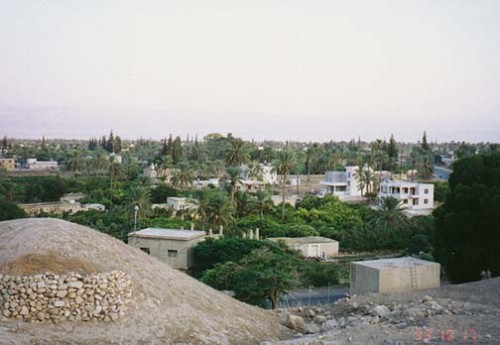
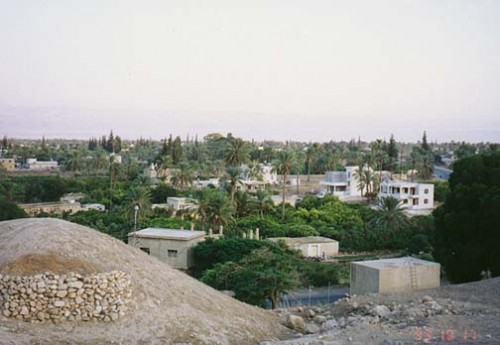 Jericho in Palestine will light up with solar power thanks to Japanese initiative.