Creators who want to influence people for good should also think carefully about tone. Environmental storytelling does not need to lecture or shame audiences. It can invite curiosity instead.
The company's Next Generation Process (NGP) Pilot Plant in London, Ontario, has officially moved into initial operating campaigns, generating the kind of structured, repeatable data that separates laboratory promise from commercial viability.
In the modern nutrition universe, that level of commitment deserves an applause. But for those who don’t live in a Nordic fishing village, the nutrition company Zinzino has built its omega-3 research and formulations around these principles, combining biomarker testing, antioxidant protection and traceable sourcing across both sustainably harvested small-fish oils and a vegan marine-microalgae alternative.
Dubai Municipality has set up 12 AI-powered "Ehsan Stations" to safely and officially feed strays. The city also officially supports Trap-Neuter-Return (TNR) programs.
Creators who want to influence people for good should also think carefully about tone. Environmental storytelling does not need to lecture or shame audiences. It can invite curiosity instead.
The company's Next Generation Process (NGP) Pilot Plant in London, Ontario, has officially moved into initial operating campaigns, generating the kind of structured, repeatable data that separates laboratory promise from commercial viability.
In the modern nutrition universe, that level of commitment deserves an applause. But for those who don’t live in a Nordic fishing village, the nutrition company Zinzino has built its omega-3 research and formulations around these principles, combining biomarker testing, antioxidant protection and traceable sourcing across both sustainably harvested small-fish oils and a vegan marine-microalgae alternative.
Dubai Municipality has set up 12 AI-powered "Ehsan Stations" to safely and officially feed strays. The city also officially supports Trap-Neuter-Return (TNR) programs.
Creators who want to influence people for good should also think carefully about tone. Environmental storytelling does not need to lecture or shame audiences. It can invite curiosity instead.
The company's Next Generation Process (NGP) Pilot Plant in London, Ontario, has officially moved into initial operating campaigns, generating the kind of structured, repeatable data that separates laboratory promise from commercial viability.
In the modern nutrition universe, that level of commitment deserves an applause. But for those who don’t live in a Nordic fishing village, the nutrition company Zinzino has built its omega-3 research and formulations around these principles, combining biomarker testing, antioxidant protection and traceable sourcing across both sustainably harvested small-fish oils and a vegan marine-microalgae alternative.
Dubai Municipality has set up 12 AI-powered "Ehsan Stations" to safely and officially feed strays. The city also officially supports Trap-Neuter-Return (TNR) programs.
Creators who want to influence people for good should also think carefully about tone. Environmental storytelling does not need to lecture or shame audiences. It can invite curiosity instead.
The company's Next Generation Process (NGP) Pilot Plant in London, Ontario, has officially moved into initial operating campaigns, generating the kind of structured, repeatable data that separates laboratory promise from commercial viability.
In the modern nutrition universe, that level of commitment deserves an applause. But for those who don’t live in a Nordic fishing village, the nutrition company Zinzino has built its omega-3 research and formulations around these principles, combining biomarker testing, antioxidant protection and traceable sourcing across both sustainably harvested small-fish oils and a vegan marine-microalgae alternative.
Dubai Municipality has set up 12 AI-powered "Ehsan Stations" to safely and officially feed strays. The city also officially supports Trap-Neuter-Return (TNR) programs.
Creators who want to influence people for good should also think carefully about tone. Environmental storytelling does not need to lecture or shame audiences. It can invite curiosity instead.
The company's Next Generation Process (NGP) Pilot Plant in London, Ontario, has officially moved into initial operating campaigns, generating the kind of structured, repeatable data that separates laboratory promise from commercial viability.
In the modern nutrition universe, that level of commitment deserves an applause. But for those who don’t live in a Nordic fishing village, the nutrition company Zinzino has built its omega-3 research and formulations around these principles, combining biomarker testing, antioxidant protection and traceable sourcing across both sustainably harvested small-fish oils and a vegan marine-microalgae alternative.
Dubai Municipality has set up 12 AI-powered "Ehsan Stations" to safely and officially feed strays. The city also officially supports Trap-Neuter-Return (TNR) programs.
Creators who want to influence people for good should also think carefully about tone. Environmental storytelling does not need to lecture or shame audiences. It can invite curiosity instead.
The company's Next Generation Process (NGP) Pilot Plant in London, Ontario, has officially moved into initial operating campaigns, generating the kind of structured, repeatable data that separates laboratory promise from commercial viability.
In the modern nutrition universe, that level of commitment deserves an applause. But for those who don’t live in a Nordic fishing village, the nutrition company Zinzino has built its omega-3 research and formulations around these principles, combining biomarker testing, antioxidant protection and traceable sourcing across both sustainably harvested small-fish oils and a vegan marine-microalgae alternative.
Dubai Municipality has set up 12 AI-powered "Ehsan Stations" to safely and officially feed strays. The city also officially supports Trap-Neuter-Return (TNR) programs.
Creators who want to influence people for good should also think carefully about tone. Environmental storytelling does not need to lecture or shame audiences. It can invite curiosity instead.
The company's Next Generation Process (NGP) Pilot Plant in London, Ontario, has officially moved into initial operating campaigns, generating the kind of structured, repeatable data that separates laboratory promise from commercial viability.
In the modern nutrition universe, that level of commitment deserves an applause. But for those who don’t live in a Nordic fishing village, the nutrition company Zinzino has built its omega-3 research and formulations around these principles, combining biomarker testing, antioxidant protection and traceable sourcing across both sustainably harvested small-fish oils and a vegan marine-microalgae alternative.
Dubai Municipality has set up 12 AI-powered "Ehsan Stations" to safely and officially feed strays. The city also officially supports Trap-Neuter-Return (TNR) programs.
Creators who want to influence people for good should also think carefully about tone. Environmental storytelling does not need to lecture or shame audiences. It can invite curiosity instead.
The company's Next Generation Process (NGP) Pilot Plant in London, Ontario, has officially moved into initial operating campaigns, generating the kind of structured, repeatable data that separates laboratory promise from commercial viability.
In the modern nutrition universe, that level of commitment deserves an applause. But for those who don’t live in a Nordic fishing village, the nutrition company Zinzino has built its omega-3 research and formulations around these principles, combining biomarker testing, antioxidant protection and traceable sourcing across both sustainably harvested small-fish oils and a vegan marine-microalgae alternative.
Dubai Municipality has set up 12 AI-powered "Ehsan Stations" to safely and officially feed strays. The city also officially supports Trap-Neuter-Return (TNR) programs.
Either the threat of increased international sanctions is finally convincing the Iranians that so much emphasis in “going nuclear” is not good for them in the long run. Or, perhaps, the mullahs there are realizing that there are feasible alternatives to using enriched uranium to provide fuel, as well as for using their petroleum reserves which someday will be depleted.
The Iranian project leader Dr. Mohammad Hossein Morowvat (not listed on the university directory) said: “Iran and many other countries are seeking new energy sources like biofuels.”
We’ve had our eyes on Greek-Israeli green architect, Elias Messinas, for a while.
President of the NGO ECOWEEK (active in Greece, Cyprus, and Israel), and an environmental consultant to the Kramim Eco Village project in Israel, he’s also been busy over the past year in organizing a “green” civil engineering lecture series for the city of Beersheva.
Apparently, he still has some time on his hands. He’s going to be one of the important lecturers in a permaculture and green building course starting January 22nd in Meshek Tapuchi in Beit Nehemia, Israel.
Meshek Tapuchi is a center for permaculture studies and is in and of itself an example of sustainable living.
The course, hosted by Yonatan Tapuchi, will host lecturers with a range of experiences including Messinas and Tami Tsoori from Tel Aviv’s City Tree among others. It will also grant participants an international permaculture planning certificate, and those who excel during the course will be integrated into relevant projects.
When we talk about water security in the Middle East, Israel could play a role in making water allocation a sustainable endeavour for this water-starved region. Partnering with the Strategic Foresight Group for its water series, Green Prophet interviews one of the most influential water company in Israel today: Mekorot.
We talk with Eli Ronen, the chairman of the board at Israel’s National Water Company – Mekorot. Founded in 1937, Mekorot has set up hundreds of water projects all over the country, and also globally – most recently it’s announced its intentions to desalinate California. Mekorot is also a pioneer in the field of new water technologies, handled by its WaTech division. Here are Ronen’s answers to the 5 questions we posed to him.
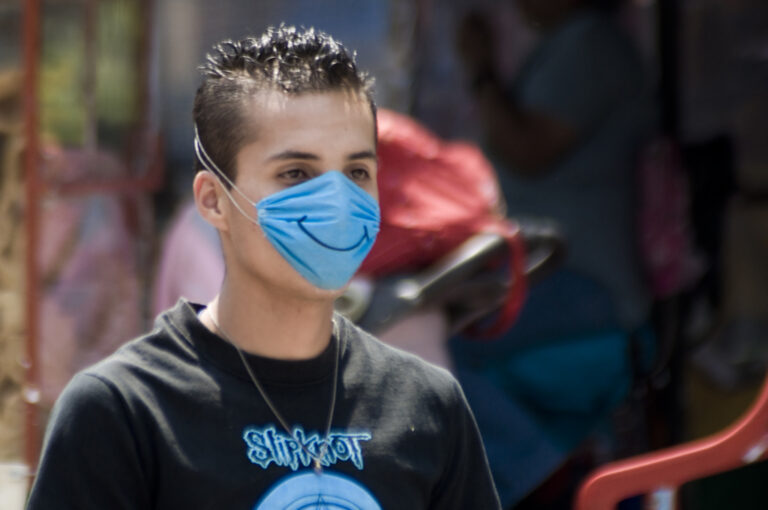
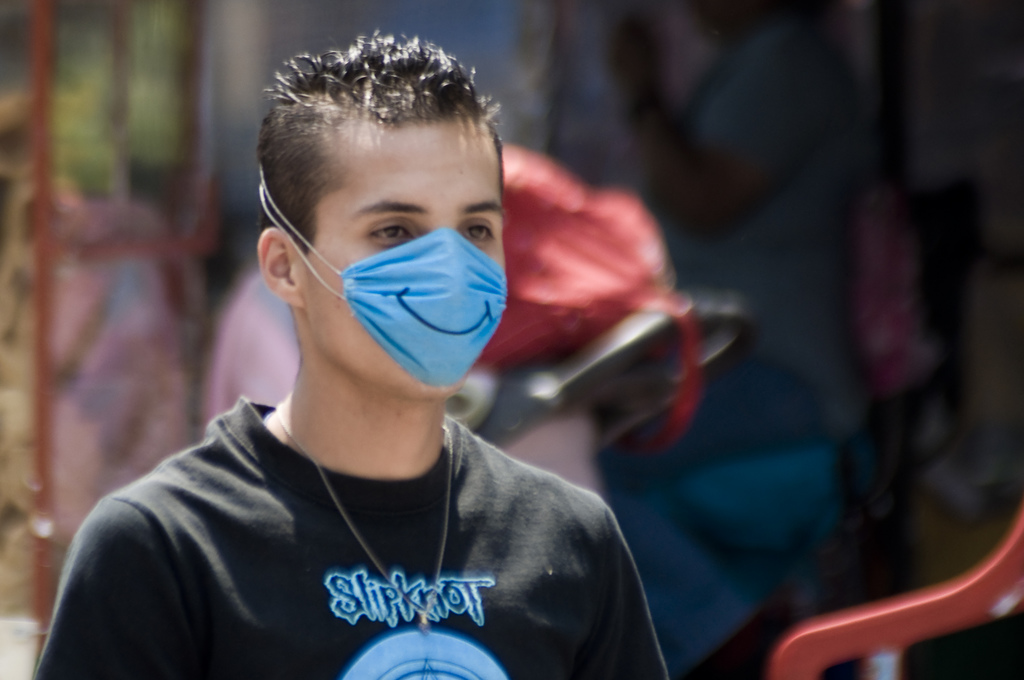
To get the needle or not, that is the question some of us are asking. A researcher looking at bacteria model, says these ancient organisms wouldn’t mass immunize.
In America, and Canada, large numbers of people are opting for the swine flu shot – to be on the safe side.
Yet, in countries like Israel, where the swine flu shot is now being offered, only a small part of the population is opting for protection, mainly healthcare workers. According to an Israeli researcher, only those people who are networked in public positions, or who contact many people in a day or in the week, should be immunized. Because there could be other risks by getting the shot, which has yet to be proven safe over the long term. Looking at the model of bacteria behaviour, here’s more on the research.
Who doesn’t want to live the longest, fullest life? We all do right? That’s why we go to the gym, fight for the right for clean air and water, and eat healthy organic food. As environmentalists with eyes wide open, some of us take vitamin supplements, like Omega 3, and other multi-vitamin packs, hoping to stave off illness and promote healthy tissues in our bodies. But buyer beware. Taking vitamins, like Vitamin E, a new Tel Aviv University study has found may do more harm than good.
The potent anti-oxidant has been used to stave off heart disease in those at risk, but indiscriminate use of the vitamin, without medical intervention, warn researchers, could shave time off your life.
China takes a shine to Israel and invests more than $10 million in new solar technology innovation.
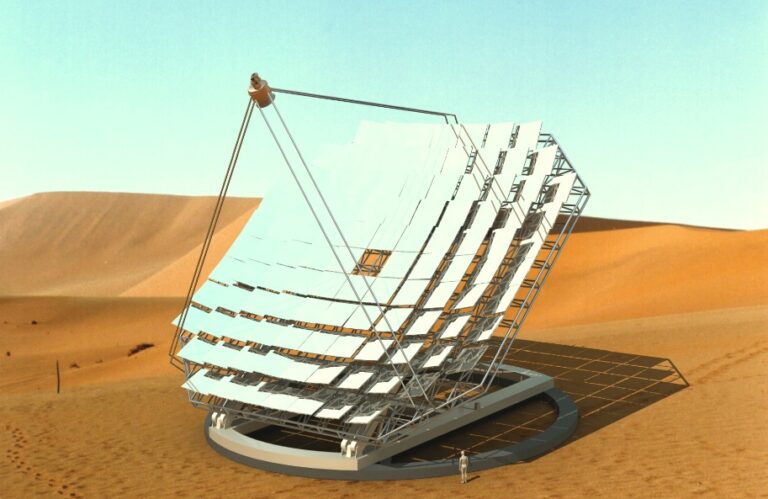
Israel’s solar tech company HelioFocus, based on research from the Weizmann Institute, will be invested in by China’s Zhejiang Sanhua 002050 in a $10.5 million agreement, reports HelioFocus in a press announcement. The solar thermal systems developed HelioFocus will be the first direct investment made by a Chinese company in an Israeli one, reports Tova Cohen from Reuters.
The Chinese company will not only be a developer but a strategic partner, and is expected to produce components and control parts to enable the technology.
It can harness 20 times more energy than any other wave technology in existence today and also produce carbon-free desalinated water. How? Seanergy ‘holds the waves.’
To wean America off polluting and politically unstable foreign oil, government members and legislators are advocating technologies such as solar, wind, geothermal and also wave energy to develop new sources of power. President Obama is pushing for green jobs and Americans want them.
Inspired by children playing with a beach ball at the seaside, Shlomo Gilboa an Israeli politician-turned-inventor has invested millions of his own dollars in Seanergy, a new company and product that share a name. Seanergy harvests the energy of ocean waves through an offshore farm of buoys. It could be the next technology adopted by American utility companies, if Gilboa has his way.
Sewage on the streets of Jeddah, Saudi Arabia, left more than 120 dead and questions about the country’s green credibility very much open to debate. Photo: Reuters.
All these efforts may be for naught if the Kingdom’s infrastructure authorities do not make a greater effort to deal with environmental disasters such as the recent flooding and sewage leak incidents in Jeddah, a city of about 2.6 million people, with almost no municipal sewerage system.
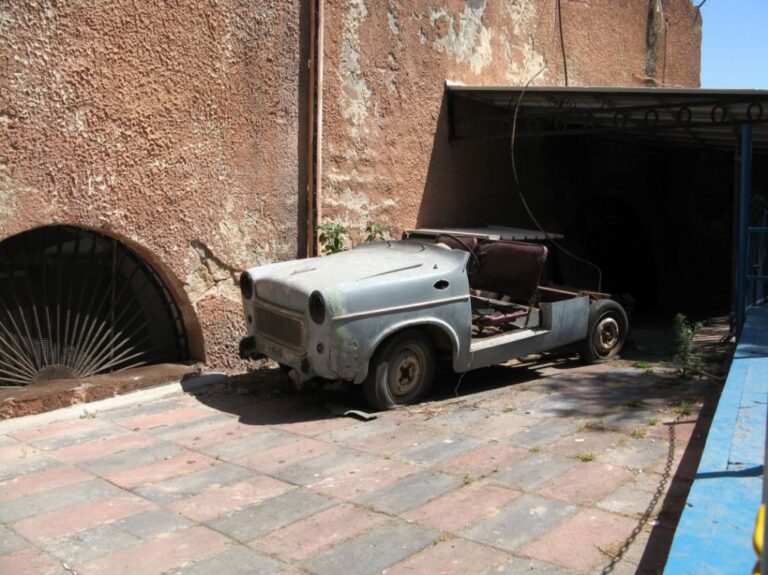
Susitas sitting in a junk pile. Getting clunkers off the streets in Israel, paves the way for hybrids and electric cars. This is the Israeli-made Susita, a lemon of a car, but snack of choice for local camels.
Copying the wildly popular Cash for Clunkers program in the United States, the Israeli government has announced its own plan to get polluting gas guzzlers off the streets and cities of Israel.
While it’s not really that common to see Texas-size Cadillacs and old gas guzzling V8 engines in Israel anyway – with gas at about $2 USD a liter, and with 100% import tax, who could afford such luxuries – the plan is to get people to trade in their more polluting hunks of steel for more fuel efficient, less polluting cars.
The troubled history of the Susita, the short-lived Israeli-made car reflects the conflict between Israel’s attraction to Western technology and the Middle-Eastern corruption that often hobbles advances in the Middle East.
The first car-composting lot opened in the city of Ashdod on Friday and new sites are expected to open across the country over the coming months. The deal is that anyone with a car more than 20 years old (you must have proof) will be given NIS 3,000 (about $800 USD) in exchange.
Some NIS 100 million (about $30 million dollars) has been allocated to support the program, being sponsored by Israel’s ministries of environmental protection and infrastructure. The Hebrew reporter writing the article did say that the Israeli version of Cash for Clunkers was copied on the model developed by US President Barack Obama.
An ad for Susita in 3 models, a car that camels liked to eat
The American program, whose name has been changed to the rather less catchy Car Allowance Rebate System, proved enormously popular. Owners received $4,500 each for their heaps of steel. More than 700,000 new vehicles were sold as part of the program, which a number of other countries have also adopted (Mexico too, for example).
Thousands of polluting cars, which are also deemed unsafe, are expected to be taken off the roads. Perhaps to pave the way for Shai Agassi’s electric car of Better Place?
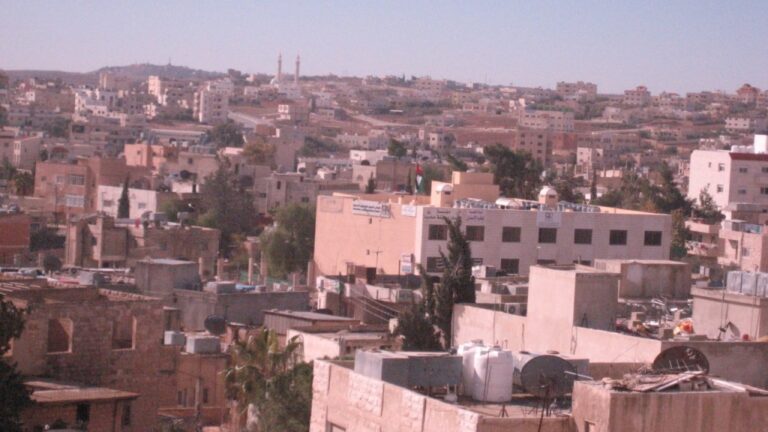
A water conference in Jordan was a call to arms in Arab world to fight water insecurity. Photo: Water tanks on the roofs of buildings in Madaba, Jordan.
There are people in over 17 Arab countries living well below the water poverty line of 500 cubic metres annually, said Arab decision makers from around the Arab world, meeting on water insecurity this past Monday, in Jordan, reports the Jordan Times. They recognized climate change in the Middle East as an issue that will further impact their poorly-available water resources, noting that 75% of the surface water in the Arab world, originates from outside its borders.
Reporters were given a sneak peak at Burj Khalifa at 828m tall, this week. The world’s tallest building, could attract international investment to the debt-afflicted emirate.
Dubai inaugurated Burj Dubai (now Burj Khalifa after Sheikh Khalifa bin Zayed, President of the UAE), the world’s tallest building, with a spectacular display of sound, light, water and fireworks on Monday. Burj Dubai, a development of Emaar properties, stands at more than 800 meters (2,625 ft) high with 160 storeys, making it the tallest man-made structure ever built.
“This is not just a building that’s a little bit bigger than other buildings. It’s much bigger,” Christian Koch, Director of International Studies at the Gulf Research Center in Dubai told The Media Line. “Everybody will know about it. This is certainly going to represent the status of Dubai and the Arab Gulf as a whole for many years.”
If you know water issues in the Middle East, then Gidon Bromberg, the Israeli director of EcoPeace, Friends of the Earth Middle East (FoEME) will need no introduction.
From this series, we hope to gather information and answers that will influence policy makers to help develop a sustainable water culture in the Middle East. And also to lead journalists in the right way when they are investigating the true nature of this regional conflict over water. Today we ask Bromberg 5 questions, the same questions we’ve asked Israel’s Water Commission office, and before that Shimon Tal, the past water commissioner of Israel.
NatureMill’s urban compost bin does the work right in the house. Now there are no excuses to not composting!
You already know through reading Green Prophet that you can make your own vegetable composter for only $10 worth of easily obtainable materials. With all the interest being circulated dealing with organic gardening at home, including the annual event known as Compost Awareness Week the idea of “manufacturing” your own organic compost in your own backyard or on your apartment balcony is not only realistic but very practical.
Especially in the Middle East (Beirut, Tel Aviv, Aleppo) where most of us live in apartments.
Composting at home (in the city) not only offers a solution to alleviate much of the organic food wastes people would normally throw into their refuse dumpster (enclosed in non-biodegradable polyethylene bags); composting saves on gas transport to the dump, and cuts down methane gases there too.
On the lighter side of life, composting, as James has found in his garden, offers an excellent opportunity to embark on your own home organic gardening project as well. And that’s why we love the idea of NatureMill, which can be shipped to almost any address in the world.
It’s easy to cultivate chickweed (a vitamin powerhouse) on your windowsill for a quick springtime salad.
One of the most prevalent edible weeds thriving now in the Mediterranean is chickweed, Stellaria media if you want to get botanical about it.
Its flavor is delicately salty and fresh, not at all like spinach. (Every edible weed’s flavor is described as spinach-like. I’d love to hear someone describe a food as fresh and chickweed-like.) Want to know how to cultivate it?
Birds love chickweed; hence its folk name. And for centuries, people have loved it too. It’s tasty, easy to digest, and good for you. In season, I cut about a cupful from my windowsill planters, rinse it, and mix it into my salads. Or layer it into sandwiches, or add it, chopped, to omelets just before serving. Cooked, the tender plant loses its flavor and becomes stringy and unappetizing.
If you care to cultivate chickweed, it’s an easy thing to do in the Middle East where it is native. Gather it when summer arrives and the plant has gotten long and leggy, with white flowers.
Bring the wild inside by growing chickweed at home
How to start your chickweed garden
There will be plenty of tiny, bright-orange seeds among the flower heads. Scatter them wherever you wish to grow chickweed, and wait till next spring. It will grow and re-seed every year, so you’ll only need to sow once. To harvest it, take a pair of scissors and just snip the leafy tops off, giving it a haircut and leaving at least an inch of stem. You will get a second crop several weeks later.
Chickweed is one of the first edible greens to pop up after winter. Old folks from freezing climates where people ate no fresh vegetables for months, recall how joyful was its appearance (and dandelion’s). It’s a powerhouse of nutrients, offering Vitamins B6, B12, D, and C, ruitin, biotin, choline, and beta carotene as well as the minerals magnesium, iron, calcium, potassium, zinc, phosphorus, and more.
And this tender little weed, which often hides under the taller nettles and mallows of this season, has a large range of medicinal properties as well.
How to make chickweed tea
Chickweed has the power to draw infected matter out of tissue. So if, for example, a splinter in your finger has become infected, soaking it in strong chickweed tea will draw the splinter and pus out. I use the fresh weed, or dry it for strong tea when it’s out of season, in cases of eye infections and boils. Crush the fresh weed and press it to the infected eye: as it draws infection out, the green poultice will get hot. Throw it out, wash your hands, and do it again.
The herb contains saponins, a chemical constituent that dissolves congestion and cleans waste matter out. The kidneys, liver, skin and lungs benefit from this gentle cleansing. You can get this by eating lots of fresh chickweed or drinking chickweed tea.
How to make a chickweed tincture
Tea or tincture of chickweed is helpful in treating acne, and its diuretic properties aid in weight reduction. It is a soothing, lubricating plant whose abundant use in salads or as tincture will ease inflammatory conditions like arthritis. I’ve found chickweed to be soothing to the spirit also, acting not like an anti-depressant but more as something that reduces sorrow and agitation to manageable levels.
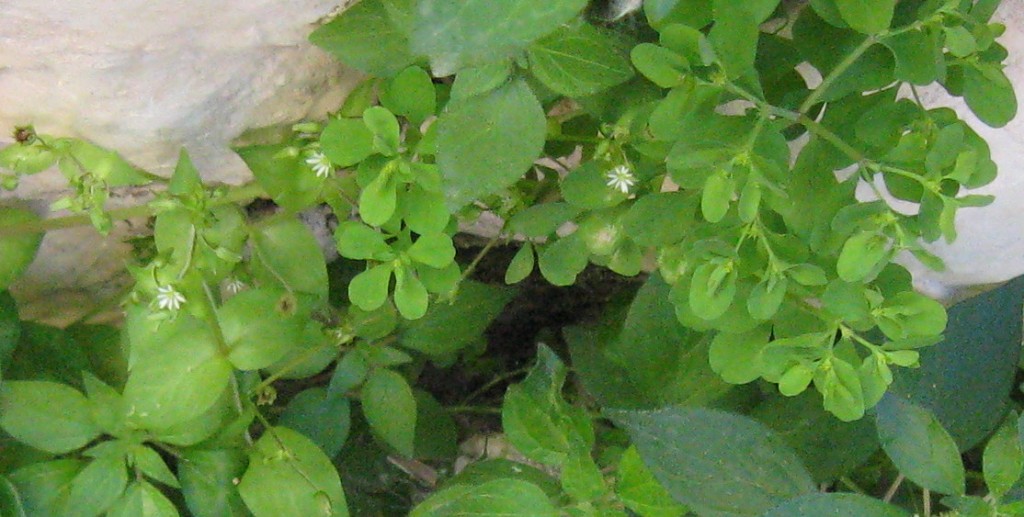
Chickweed’s a soft, low-growing plant with tiny white flowers whose five petals are so deeply cleft they look like ten. An important characteristic of chickweed, and one that helps the forager to distinguish it from a toxic look- alike, is the row of tiny hairlike fibers that climb along its stems.
The toxic look-alike is a common spurge (euphorbia). Even experienced foragers look twice – in fact experienced foragers always look twice – to make sure that what they’re gathering is chickweed, not spurge. The second photo from the top shows flowering chickweed on the left and spurge, with its narrower, clustered leaves, on the right.
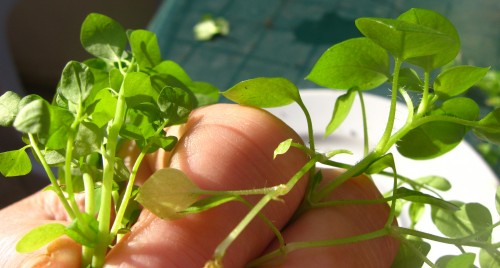
Here you can see chickweed and spurge side by side from the back. Spurge is on the left, with long, almost leafless stems and a bunch of dark leaves at the tops. Chickweed, on the right, has trailing, branching stems with the characteristic line of hairs.
Remember to harvest chickweed, as well as all other wild herbs, from clean places free from the wastes of dogs and cats.
Christina Pirello combines healthy and organic food recipes with delicious and gourmet.
Acclaimed American macrobiotic cook, food writer and TV personality Christina Pirello will be in Israel this week, teaching how to cook for health, from the 3rd to the 12th of the month.
She has authored five cookbooks and is an activist for better nutrition worldwide. She has also founded a program focused on bettering children’s nutrition in schools and at home.
Pirello was diagnosed with leukemia at age 25 and given nine months to live. On changing to a macrobiotic diet, her illness went into remission and seems to have disappeared.
Convinced of the direct relation between diet and health, she went on to study Chinese and Ayurvedic medicine and earned a master’s degree in nutrition.

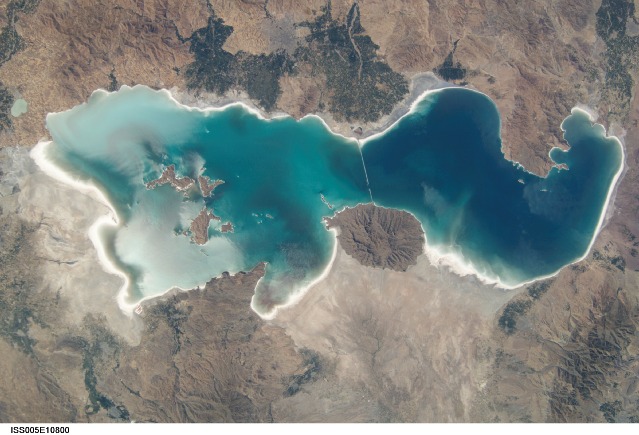 A salt lake in Iran has given rise to a new species of algae for biofuel. This is the large salt lake “Urmia”.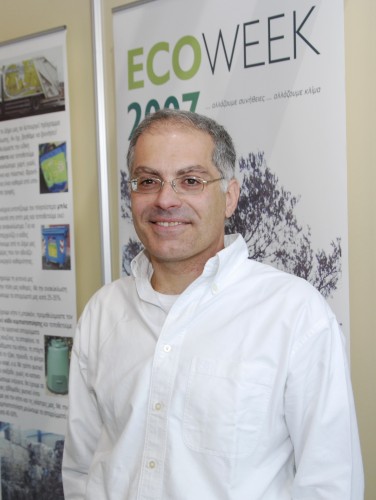















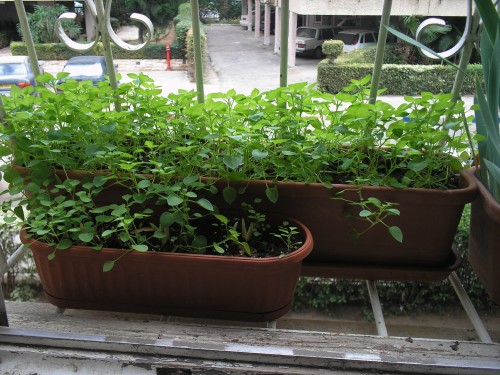
 It’s easy to cultivate chickweed (a vitamin powerhouse) on your windowsill for a quick springtime salad.