Students in Tel Aviv propose business “net” – work for peace. Left to right: David Welch, Ohad Kot, Danielle Angel, David McGeady and Osher Perry from Nets of Peace.
As one of the largest seafood producers in the Middle East, Israel’s innovative fish-farming industry is booming. Just a few miles downshore in Gaza, though, fishermen can barely eke out a living. But a new on-land aquaculture project proposed by five Tel Aviv University graduate students could change that reality and develop a thriving industrial park in the heart of Gaza. The team proposes a “Nets of Peace” project to launch the industrial park, designed both to provide a healthy protein supply for Palestinians living in Gaza and to connect the region to foreign business investment and trade.
The photovoltaic (PV) solar panels will be able to provide as much as 18 megawatts of electricity in both Israel and Italy, where they will be installed, according to an article published in Globes. Suntech is the largest solar energy component company in China and is one of the largest in the world. SBY will use the panels for solar energy plants it will be constructing in both Israel and Italy.
Some 250 people participated in the MENASOL conference in Cairo this week.Courtesy image.
The 2nd annual MENASOL solar energy conference on the development and finance of utility-scale solar projects in the Middle East and North Africa (MENA) opened Tuesday in Cairo. Approximately 250 people from around the world gathered for the two-day conference. This is about double the number of participants who attended the initial MENASOL conference, held last year in Abu Dhabi, conference director Heidi Hafes explained.
Worried about the impact of the tourism industry on the world’s resources? Want to know whether tourism sustains or destroys local communities and ecology in the developing world? Then this is the book for you.
‘The Final Call’is a thoroughly good read and I had to remember that I was actually meant to be reviewing it.
In The Final Call,Leo Hickman takes the reader on a journey to the most popular tourist destinations in the world and uncovers the facts about the impact of tourism: exploitation of citizens in developing countries; destruction of natural resources and ecological systems; imbalances of power and control.
The book is well researched and includes reference to reports, documents, policies and initiatives from all the major players in the industry, whether they are governments, environmental and campaigning organisations, tour operators, or travel guide writers.
He balances facts and figures with personal observations and behind-the-scene interviews with bartenders, prostitutes, cruise captains, local people, industry leaders and public officials. Exploring the rights and responsibilities of all concerned, he highlights the socio-economic factors at play in countries aspiring to develop and gain wealth; the increasing uptake of opportunities for tourists; and globalization.
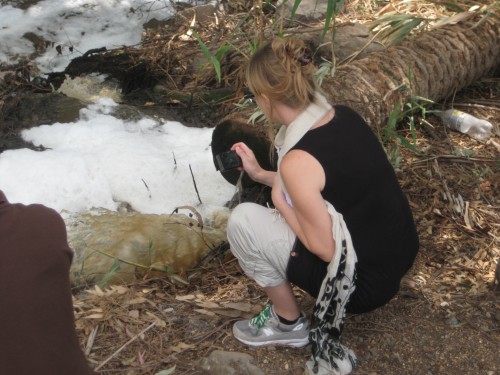
Up close and personal. Karin gets a “sniff” of sewage pipe pouring into the Jordan River. This folks, is the source of the lower Jordan River.
Green Prophet’s Karin and I received a real lesson in reality about the health of the Jordan River, at the Jordan River Media Tour sponsored by the Friends of the Earth Middle East (FoEME), a cross-border environmental NGO. The tour, which took place on Sunday this week was led by Gidon Bromberg, the organization’s Israel Director. He took us to see several locations of what is known as the lower part of the Jordan River, that runs from the southern end of Lake Kinneret (Sea of Galilee) more than 105 kilometers until reaching the Dead Sea. Estimates are that the Jordan River will stop running by 2011 if action isn’t taken today.
Eco-Activist Beit Midrash offers an alternative (and ecological) alternative to the traditional yeshiva experience. [image via: shorashimroots]
The Eco-Activist Beit Midrash (EABM) based in Jerusalem has been devoted to a Jewish approach to environmentalism for a long time. In their own words, they are trying to “bring Torah down to earth.” And now they are sharing their approach with those unable to stay in Israel for extended periods of time with their 2010 summer session that explores ecology and Judaism all over Israel.
Slow Food people and chefs like Moshe Basson know that eating slow can reduce stress. New study shows how stress affects health, diet and fat reserves. Image via macbeck
Few people would say that they lead stress-free lives. It starts with the pressure to fit in at school, then you need to wear the right clothes, pass your exams, get into a good university, pay off your student loans, meet your mortgage payments – and before you know it, you’re worrying about college funds for the kids.
Some of us already have an inkling that stress is a factor in many of the metabolic and emotional disorders we see today. Stress wears us down and hangs heavy on the shoulders of our immune system. It’s no wonder that the rates of diabetes, anxiety disorders, depression and heart disease are at an all time high. And now for the first time, an Israeli team has located a gene in the brain that appears to be triggered by high levels of stress, and causes a series of negative physiological reactions.
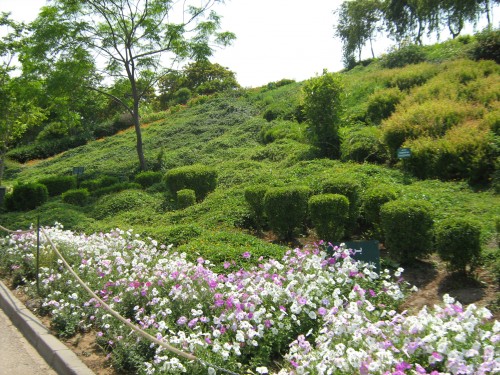
The impressions of Alexandria I shared in a recent post were largely negative, so here I’ll present a happier picture: a green oasis in Cairo built upon a former garbage dump. The photos are mine; the background information comes mainly from touregypt.net.
Jordanian teens work to learn more about Jordan River conservation efforts and practices.
Friends of the Earth Middle East (known as foy-me for its acronym FoEME) have accomplished to develop an unprecedented study of the quality of water in the Jordan River, which they hope will lead to its rehabilitation. Highly polluted from a variety of sources including sewage, and high levels of salinity, FoEME as the only Jordanian, Israel and Palestinian trilateral organization working in partnership for a common goal in the region (theirs is water), plans on taking their study to policy makers to catalyze peace and change.
Presenting their scientific study (links to study) study on what can be done to rehabilitate the lower Jordan River, after a media tour along the Jordan River yesterday with foreign journalists (which I promise to post later), I headed to Jordan to take part in their conference to present the study, which brought out about 200 Jordanian, Israel and Palestinian water experts and government officials from around the world. The atmosphere was positive, the reception very friendly. These are people willing to look forward to the future instead of back to the untold number of Middle East conflicts from the past.
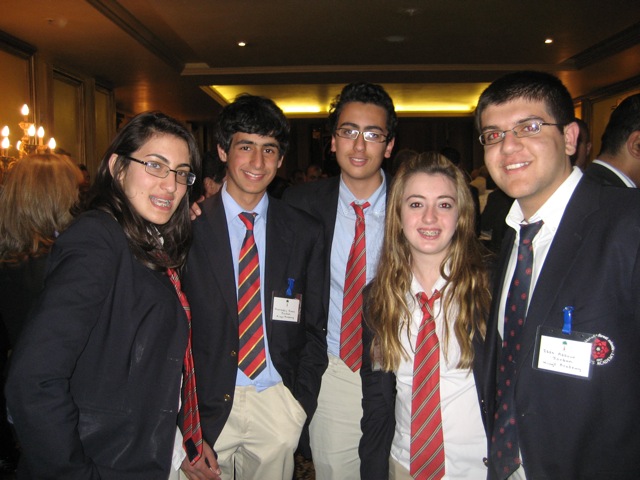
I was hoping to get to meet Princess Sumaya, the daughter of Jordan’s Prince Hassan who was to be a keynote speaker (she cancelled due to illness), but I ended up meeting two princesses and three princes instead. These five teens from the King’s Academy boarding school outside of Amman (pictured above), are working with Friends of the Earth Middle East to study and understand more about the state of the Jordan River.
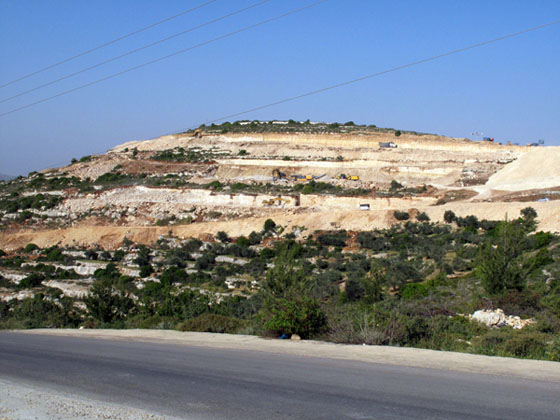
Tractors carving up the face of a hill in preparation for the new town. (Photo credit: Green Prophet)
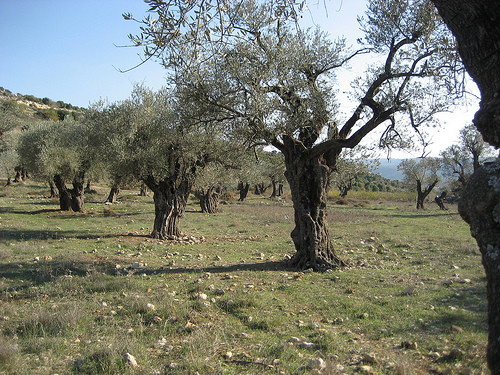
About a half hour’s drive north of Ramallah, construction has begun on the first planned Palestinian city. Surrounded by sleepy hilltop villages and terraced olive orchards, Rawabi, which means “hills” Arabic, is being marketed as a green and affordable alternative for the Palestinian middle class.
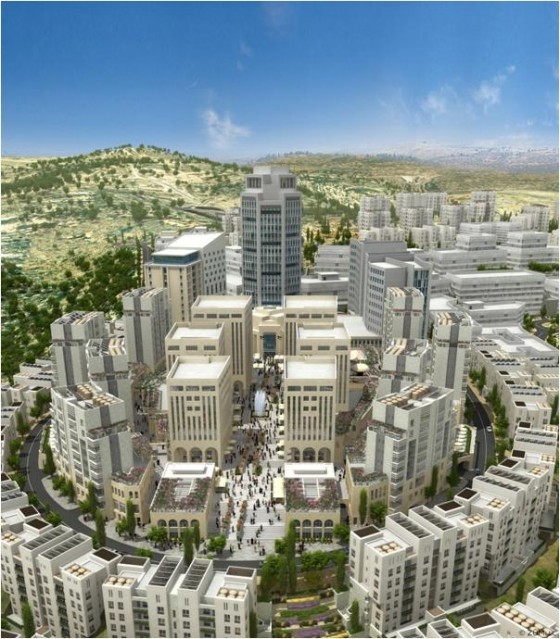
“Unlike any other in Palestine, Rawabi will be characterized as a modern, high-tech city with gleaming high-rise buildings, green parks and shopping areas,” boasts a fancy brochure published by the Bayti, the Qatari-Palestinian company developing the project. With features like underground parking garages and American-style mortgages, Rawabi would appear to have more in common with Israeli suburban towns like Modi’in than with nearby Palestinian cities like Ramallah.
The new town will have extensive green space and infrastructure (including schools, mosques, a church and office buildings), which the developers hope will also serve the inhabitants of 9 surrounding villages. Initially housing 25,000 residents, Rawabi is eventually set to grow to 40,000.
A rendering of Rawabi’s city center. (courtesy of Bayti)
Special attention has been paid to the project’s environmental aspects. The town will feature elements like wastewater reclamation, alternative energy and extensive tree planting. According to the developers, pedestrian paths and mixed-use streets will discourage the use of cars, and the town will be served by public transportation.
In a show of corporate responsibility, Bayti also conducted an assessment of the social and environmental effects of the project, both during and after construction. The company also has plans to set up a center for urban planning at nearby An Najah University in Nablus.
The red roofs of Ateret, a nearby settlement housing 70 families. (photo by the author)
Meanwhile, Israeli settler organizations have reportedly launched a campaign against the new town, claiming (with no sense of irony) that it will cause pollution, traffic jams and security issues, while benefiting only the Palestinian elite. Questions also linger about an access road that requires the approval of Israeli authorities.
However, if everything goes according to plan, Rawabi could become the prototype for a new, more sustainable Palestinian urbanism. The first residents are set to move in around 2013.
Green Prophet looks to ancient Iran for some current alternative ideas to electricity-powered air con. Catch the wind with the bagdir wind tower!
The concept of “green building” has taken off in the Middle East over the last few years. The need for ecologically efficient housing and offices is becoming more urgent as the cost of heating and cooling skyrockets and water becomes ever more scarce.
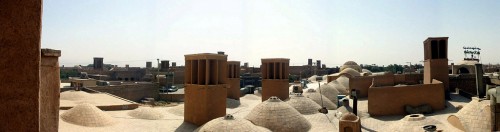
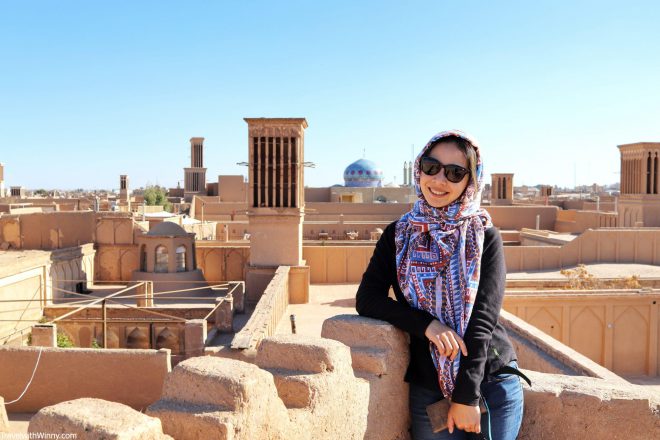
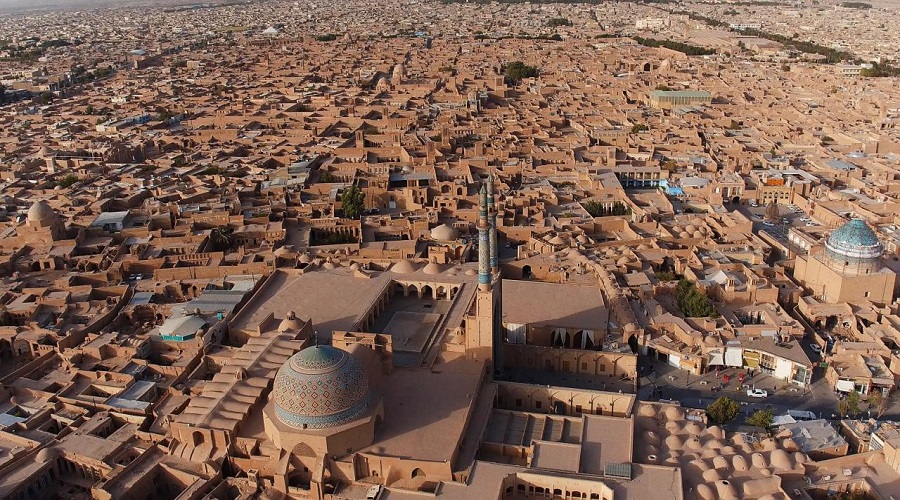
But environmentally-conscious buildings have been around much longer than the modern environmental crisis. Outdating gas-guzzling air con units by generations, bagdirs – or windcatchers – have been cooling down the people of Yazd, Iran, since before the 19th century. These towers spike the skyline of the Iranian desert city like antiquated skyscrapers.
The stone structures channel wind down into a shaft which in turn cools or heats the rooms below, allowing them to remain comfortable all year with zero carbon impact.
As well as using smart technology, the windcatchers of Yazd’s success depends on effort from the building’s inhabitants too. People can reduce their energy use by occupant behaviour strategies, for instance, moving to warmer or cooler rooms throughout the day.
This contrasts to the approach of modern Western design where “the individual chooses the climate for a room:
While nomads in Iran migrate from summer climates, for those who remain in Yazd replace the long migration by a short intra mural migration, within the walls of a single house.
In the summer, when temperatures soar to over 40 degrees C, this means using the ground floor in morning and evening, while escaping to the roof at night – a popular pastime in cities like Tel Aviv. Other strategies include watering floors, wearing lighter or warmer clothes, or – my favourite – taking an afternoon nap in the heat of the day. In Morocco, men are known to sleep on the roofs of the apartments at night to catch the breeze.
How the wind catchers work
Iran is an extreme hot/cold and arid climate. It can get very hot in the daytime sun and then cool down completely at night. Before we had electric sockets and Iran was called Persia, people engineered windcatchers.
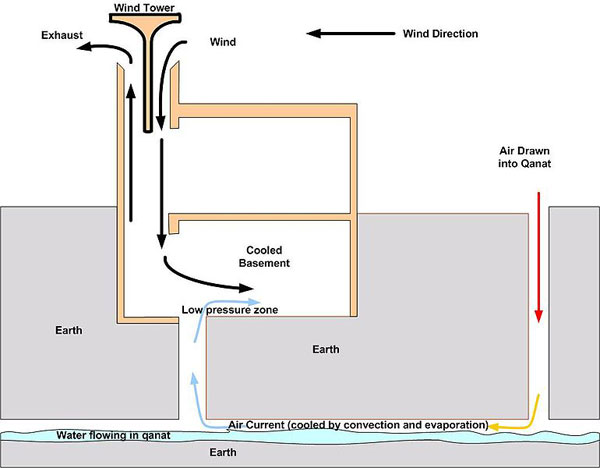
Windcatchers are very much a traditional Persian architectural design that creates natural or passive ventilation in buildings. The basic design illustrated below consists of a tower that emerges from the building below, with openings at the top.
Yazd, one of the largest cities in Iran, and which is home to hundreds of these windcatchers is also known as the City of Windcatchers. Yazd is located between the largest deserts of Iran: Dasht-e-Kavir and Dasht-e-Lut.
Today the tower of Dolat Abad is the tallest existing windcatcher in Iran.
But windcatchers weren’t built by themselves: the city of Yazd has a long network of qanats, or underground channels that bring well water to the surface. When you have a cool breeze running over water you can amplify the cooling effect. My friends in Beersheva, Israel, cool their home with a desert air conditioner which is borrowed from this idea: hot desert air that flows over water to cool the home, not refrigerate it. The modern air conditioners and the stark difference between inside and outside is sometimes unbearable.
How wind catchers work
Windcatchers work in a few ways: The first and most common is to cool the inside of a building. The tower has openings that are facing the wind and trap it inside creating a nice breeze inside the building, much like the way you feel in a wind tunnel between skyscrapers. When used with the qanat, air is pulled down, reaches the water and is drawn up the windcatcher to be dispersed in the building.
When there is no wind, the windcatchers are like a chimney, letting the hot air rise and escape. Ever spend some time in a camper fun in the heat of the summer sun? When the hot air can rise, flow is created and it escapes out of the chimney. Not so much in a camper van.
When built into adobe structures, low level spaces can remain very chill in the hottest parts of the day. And you can still find windcatchers in use in Iran, the Middle East and Persian Gulf.
One of the world’s greatest adobe cities: Yazd.
But the bagdirs of Yazd do have their dark side. Though partly funded by the silk trade, most of the windcatchers owe their existence to local merchants who made their fortunes from the British opium trade to China during the Opium Wars.
Israel’s Air Force, Shari Arison, Asia and more made headlines related to Israeli cleantech this past week. Image by Jesse Fox
During the week of April 25, 2010, ten reasons were given for Israel’s leadership in cleantech. Shari Arison was named one of the world’s greenest billionaires by Forbes and, in a somewhat similar move to the IDF, it was revealed that Israel’s Air Force is planning solar installations at all its bases. For these stories and more, check out this week’s 8 Israel-related cleantech headlines below.
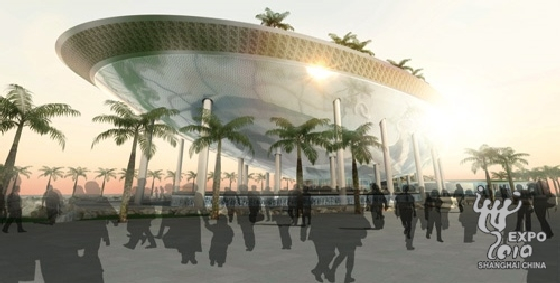
Despite its claim to promote sustainable urban development practices, the world’s largest, disposable Expo invites irony and criticism.
The first ever world fair took place in 1851 at Prince Albert’s behest. That fair was initiated to display participating nations’ industrial prowess. The tradition continues with ever-increasing largesse, culminating in this year’s World Expo that officially opened yesterday, May 1st. Countries and corporations will display elaborate pavilions that best represent their cultural and industrial brand until the expo’s closure at the end of October, 2010, which is expected to draw 70 million spectators. Israel’s half stone, half glass pavilion is one of several Middle Eastern pavilions on display, which in part highlights the region’s interest in cultural and business exchange with China.
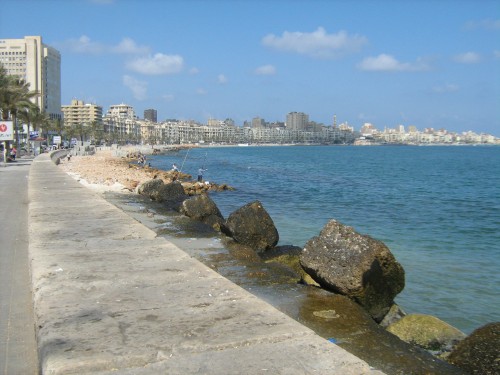
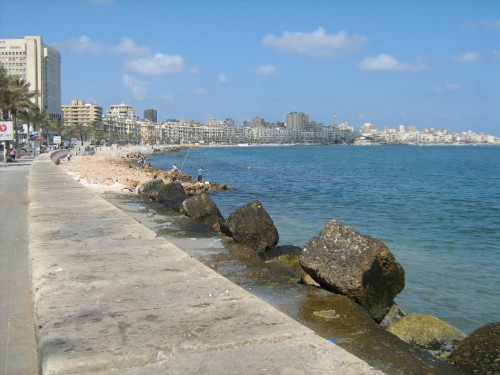
Despite its impressive shoreline, Alexandria – the self-proclaimed “Capital of Arab Tourism” – seems to be a city in decline. (Hint: watch out pedestrians).
When the Green Prophet’s editor heard I’d be stopping in Alexandria en route to the MENASOL solar energy conference in Cairo next week, she asked (implored) me to write a post from there. So, after my first day in Egypt’s second largest city, here are a few first impressions. (I’ll let some pictures do the talking too.) Any Alexandrians or others familiar with the city are invited to comment and tell me what I missed and where these first impressions are mistaken.

 Students in Tel Aviv propose business “net” – work for peace. Left to right: David Welch, Ohad Kot, Danielle Angel, David McGeady and Osher Perry from Nets of Peace.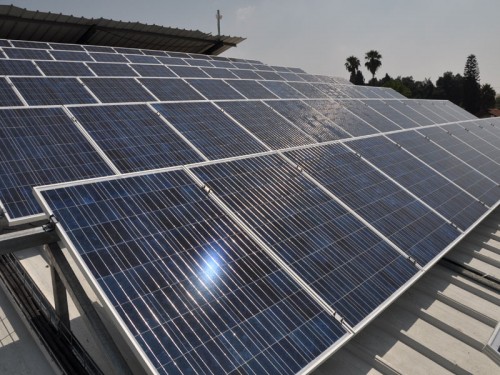
 Rooftop solar panels like these are SBY’s most popular product and will power up Israel and Italy.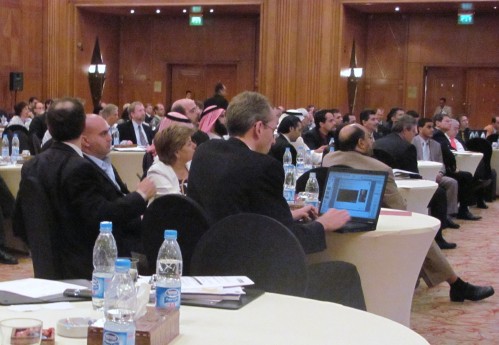
 Some 250 people participated in the MENASOL conference in Cairo this week. Courtesy image.