Sydney is best known for the Opera House and the Harbour Bridge. If you’re looking to enjoy dinner with views of these landmarks, here are some great options.
It's sea turtles which may in the end save islands in the Seychelles. They may also better help us understand climate change. Like rings on a tree, scientists have found a way to read sea turtle shells and how they are impacted by climate change tells a story.
For centuries, the Sámi shaman drum was one of the most powerful sacred objects in northern Europe, and one of the most feared by church and state. If ISIS looks bad to us today for its religious fundamentalism, Christians were just as fervent.
In a real emergency, romance takes a back seat to physics, panic, and how fast 150 people can squeeze through a narrow tube. The Federal Aviation Administration says every aircraft must be evacuated within 90 seconds. That’s the gold standard. But new research suggests that in the real world, especially as we age, that number might be more aspirational than achievable.
Sydney is best known for the Opera House and the Harbour Bridge. If you’re looking to enjoy dinner with views of these landmarks, here are some great options.
It's sea turtles which may in the end save islands in the Seychelles. They may also better help us understand climate change. Like rings on a tree, scientists have found a way to read sea turtle shells and how they are impacted by climate change tells a story.
For centuries, the Sámi shaman drum was one of the most powerful sacred objects in northern Europe, and one of the most feared by church and state. If ISIS looks bad to us today for its religious fundamentalism, Christians were just as fervent.
In a real emergency, romance takes a back seat to physics, panic, and how fast 150 people can squeeze through a narrow tube. The Federal Aviation Administration says every aircraft must be evacuated within 90 seconds. That’s the gold standard. But new research suggests that in the real world, especially as we age, that number might be more aspirational than achievable.
Sydney is best known for the Opera House and the Harbour Bridge. If you’re looking to enjoy dinner with views of these landmarks, here are some great options.
It's sea turtles which may in the end save islands in the Seychelles. They may also better help us understand climate change. Like rings on a tree, scientists have found a way to read sea turtle shells and how they are impacted by climate change tells a story.
For centuries, the Sámi shaman drum was one of the most powerful sacred objects in northern Europe, and one of the most feared by church and state. If ISIS looks bad to us today for its religious fundamentalism, Christians were just as fervent.
In a real emergency, romance takes a back seat to physics, panic, and how fast 150 people can squeeze through a narrow tube. The Federal Aviation Administration says every aircraft must be evacuated within 90 seconds. That’s the gold standard. But new research suggests that in the real world, especially as we age, that number might be more aspirational than achievable.
Sydney is best known for the Opera House and the Harbour Bridge. If you’re looking to enjoy dinner with views of these landmarks, here are some great options.
It's sea turtles which may in the end save islands in the Seychelles. They may also better help us understand climate change. Like rings on a tree, scientists have found a way to read sea turtle shells and how they are impacted by climate change tells a story.
For centuries, the Sámi shaman drum was one of the most powerful sacred objects in northern Europe, and one of the most feared by church and state. If ISIS looks bad to us today for its religious fundamentalism, Christians were just as fervent.
In a real emergency, romance takes a back seat to physics, panic, and how fast 150 people can squeeze through a narrow tube. The Federal Aviation Administration says every aircraft must be evacuated within 90 seconds. That’s the gold standard. But new research suggests that in the real world, especially as we age, that number might be more aspirational than achievable.
Sydney is best known for the Opera House and the Harbour Bridge. If you’re looking to enjoy dinner with views of these landmarks, here are some great options.
It's sea turtles which may in the end save islands in the Seychelles. They may also better help us understand climate change. Like rings on a tree, scientists have found a way to read sea turtle shells and how they are impacted by climate change tells a story.
For centuries, the Sámi shaman drum was one of the most powerful sacred objects in northern Europe, and one of the most feared by church and state. If ISIS looks bad to us today for its religious fundamentalism, Christians were just as fervent.
In a real emergency, romance takes a back seat to physics, panic, and how fast 150 people can squeeze through a narrow tube. The Federal Aviation Administration says every aircraft must be evacuated within 90 seconds. That’s the gold standard. But new research suggests that in the real world, especially as we age, that number might be more aspirational than achievable.
Sydney is best known for the Opera House and the Harbour Bridge. If you’re looking to enjoy dinner with views of these landmarks, here are some great options.
It's sea turtles which may in the end save islands in the Seychelles. They may also better help us understand climate change. Like rings on a tree, scientists have found a way to read sea turtle shells and how they are impacted by climate change tells a story.
For centuries, the Sámi shaman drum was one of the most powerful sacred objects in northern Europe, and one of the most feared by church and state. If ISIS looks bad to us today for its religious fundamentalism, Christians were just as fervent.
In a real emergency, romance takes a back seat to physics, panic, and how fast 150 people can squeeze through a narrow tube. The Federal Aviation Administration says every aircraft must be evacuated within 90 seconds. That’s the gold standard. But new research suggests that in the real world, especially as we age, that number might be more aspirational than achievable.
Sydney is best known for the Opera House and the Harbour Bridge. If you’re looking to enjoy dinner with views of these landmarks, here are some great options.
It's sea turtles which may in the end save islands in the Seychelles. They may also better help us understand climate change. Like rings on a tree, scientists have found a way to read sea turtle shells and how they are impacted by climate change tells a story.
For centuries, the Sámi shaman drum was one of the most powerful sacred objects in northern Europe, and one of the most feared by church and state. If ISIS looks bad to us today for its religious fundamentalism, Christians were just as fervent.
In a real emergency, romance takes a back seat to physics, panic, and how fast 150 people can squeeze through a narrow tube. The Federal Aviation Administration says every aircraft must be evacuated within 90 seconds. That’s the gold standard. But new research suggests that in the real world, especially as we age, that number might be more aspirational than achievable.
Sydney is best known for the Opera House and the Harbour Bridge. If you’re looking to enjoy dinner with views of these landmarks, here are some great options.
It's sea turtles which may in the end save islands in the Seychelles. They may also better help us understand climate change. Like rings on a tree, scientists have found a way to read sea turtle shells and how they are impacted by climate change tells a story.
For centuries, the Sámi shaman drum was one of the most powerful sacred objects in northern Europe, and one of the most feared by church and state. If ISIS looks bad to us today for its religious fundamentalism, Christians were just as fervent.
In a real emergency, romance takes a back seat to physics, panic, and how fast 150 people can squeeze through a narrow tube. The Federal Aviation Administration says every aircraft must be evacuated within 90 seconds. That’s the gold standard. But new research suggests that in the real world, especially as we age, that number might be more aspirational than achievable.
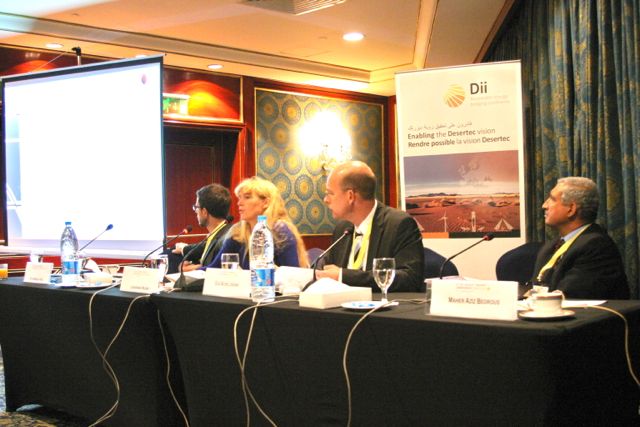
Looking deeper into the pitfalls and promise of Desertec at Dii conference in Cairo. Green Prophet’s Tafline is there and reports from the field.
Instead of scrambling to find funds and legislative support for the Desertec initiative, a handful of people gathered at the Dii conference in Cairo to explore the project’s overall environmental sustainability. The ambitious plan to develop solar and wind energy in North Africa’s deserts could replace harmful fossil fuel alternatives, but researchers are quick to dismiss the notion that renewable energy projects are completely innocent.
Dr. Anthony Patt from the International Institute for Applied Systems Analysis pointed out that scaled up Concentrated Solar Power (CSP) plants that utilize wet-cooling technology could use up to 20 percent of North Africa’s already dwindling water supply. And “that is simply not possible,” he said.
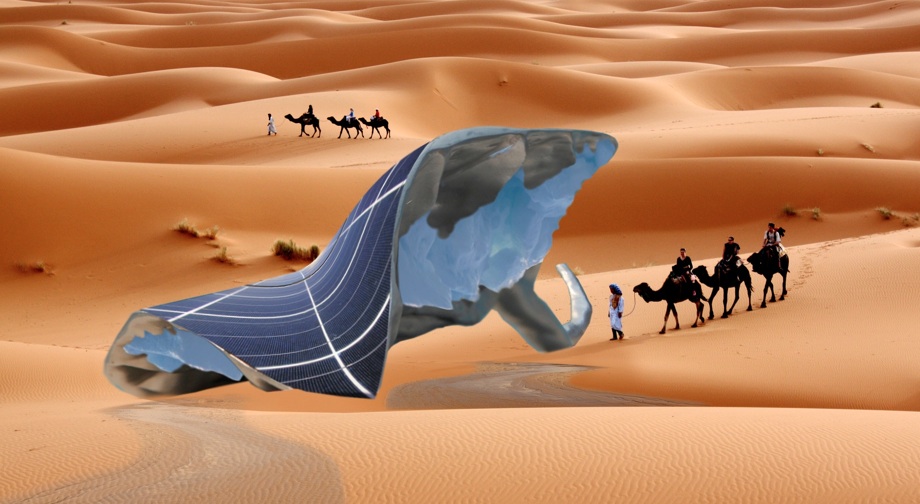
This incredible solar-powered artificial leaf that creates ice and water in Egypt’s Sahara desert is well on its way to becoming a reality!
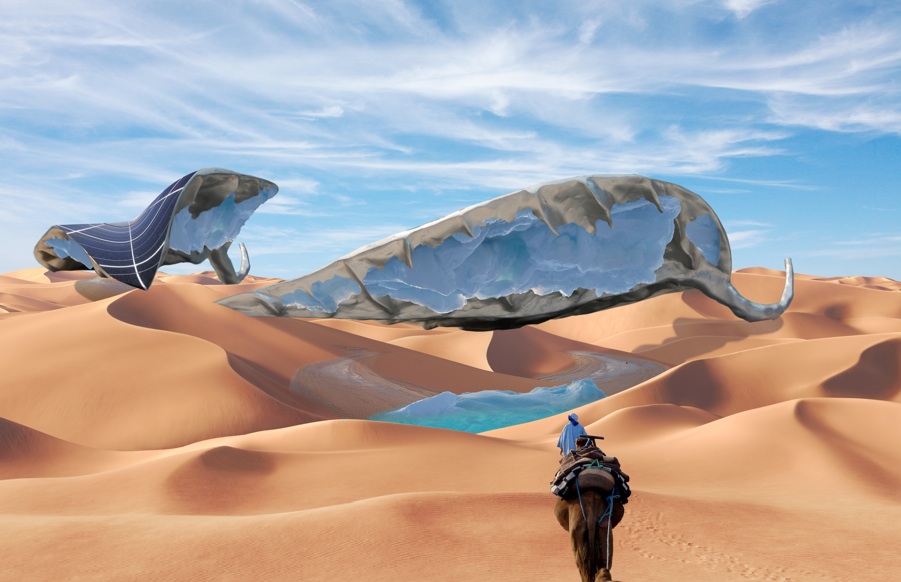
We have learned time and again what a mistake it is to see the desert as a giant wasteland, a fact that artist Ap Verheggen intends to drive home with the incredible SunGlacier project. Based in the Netherlands, Verheggen is developing a giant sun-powered artificial leaf that uses condensation to create ice out of humidity in the Saharan desert.
This may sound like fantasy, but a pilot project that tests the theory behind the SunGlacier proposal is well underway. Instead of a 200m2 elm-leaf shaped structure with an PV cell coated underbelly, which powers cooling condensers that in turn convert humidity from the desert air into ice, engineers have simulated the desert environment inside of a shipping container. And they’ve already made a 10cm slab of ice!
Believe the impossible
The Engineer reports that Ap Verheggen wants to inspire people to “believe the impossible” where climate change and appropriate action are concerned. As bold and counterintuitive as it is, albeit firmly ensconced in science, the SunGlacier leaf project is certain to do just that.
Extracting water from humid air is yesterday’s news in the Middle East. The Gulf countries in particular have very little freshwater so they have had to develop clever solutions for obtaining water wherever they can, including from the air, which is absolutely saturated with humidity.
Too dry? Nope.
But since the Sahara desert is significantly less humid than the Gulf countries, it seems like a poor candidate for this kind of technology. Not so, according to Verheggen, who told the paper that the humidity in Egypt’s portion of the Sahara desert is equivalent to that of the Netherlands and that it is sufficient to generate ice and water.
The engineers have heated the shipping container to 30 degrees Celsius and installed a humidifier that creates moisture. A fan, which simulates the fierce desert winds, is pointed at the ice. As the ice grows from the condensation, water collects at the base – an encouraging sign for water scarce countries in the Middle East.
For once, hotter is definitely better!
According to the Engineer, hotter conditions are favorable to the experiment, since theoretically, more heat means more condensation, which means more ice and water.
The group has not yet achieved the kinds of efficiencies they hope for, but the project is still in its infancy and so far their progress is quite remarkable. Combined with Markus Kayser’s Solar Sinter that produces 3D objects from the sun, it is becoming increasingly possible to envision whole new communities thriving in the desert lands once again.
Axes of power are changing in the Middle East and Israel and Cyprus as an alliance could shift energy focus away from some OPEC oil countries.
The decision for Cyprus to explore its undersea natural gas wells has Turkish government officials crying foul. Turkey occupies the northern half of Cyprus and the southern half is eager to develop its economy and ties with Israel. How this plays out in a quest for power over these cleaner fuel sources is yet to be seen. In the following article I interview a Cypriot businessman, and an Israeli consulate staff positioned in Cyprus to see how these two countries are refueling old ties.
Traditional power plant operators have been loathe to adopt renewables for infrastructure investment. But a new Israeli hybrid invention could make solar a realistic step forward.
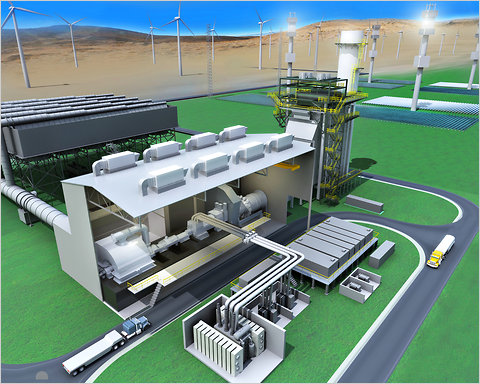
While solar energy is the environmentally-friendly alternative of choice for power plants, it’s an expensive option because of the equipment and technology needed to harvest the sun’s rays. Now a Tel Aviv University researcher says that “going hybrid” is a quicker and cheaper route to cleaner electrical power. Prof. Avi Kribus has developed a technology that combines the conventional fuel used in today’s power plants with the lower pressures and temperatures of steam produced by solar power. His new “hybrid” power plant is a potentially cost-effective and realistic way to integrate solar technology into existing power plants.
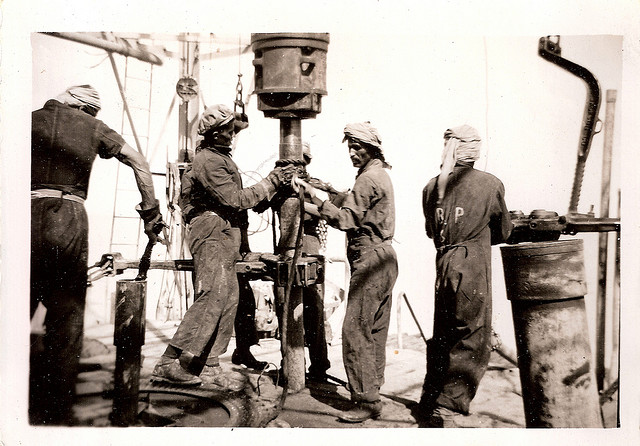
Gulf States have been drilling oil for decades now. Can we really get them to co-operate at the upcoming climate summit in Durban and re-think oil?
Climate negotiations to get world leaders to agree to a fair and binding agreement that will keep climate change in check have been ticking away in the background for a while now. Around six months ago, climate negotiations continued in Bonn and sadly, the Middle East wasn’t exactly making a positive contribution. Saudi Arabia was criticized for its attempts to delay progress and Kuwait, Oman and Qatar were awarded the ‘Fossil of the Day’ title for holding up the talks. So will this year be any different?
With this in mind, some solar energy system manufacturers, and the ones who market these systems are putting their efforts into the manufacture and installation of smaller individual solar energy systems that can even be used on private homes. Two local Israeli solar energy and smart electrical energy companies Shyrel Solar Energy Systems and Ludivine Solar have teamed up with a Swiss solar and thermal dynamics company Swiss Solar Tech Ltd, and Schneider Electric from France to give homeowners the power to create their own renewable energy.
Shyrel and Ludivine Solar are offering small businesses and private home owner a variety of energy saving systems that include small, ascetically designed solar energy systems with solar PV panels that can be literally integrated into the roof of a building, and provide the user with up to 1,000 volts and 10 amperes of solar generated electricity. The Swiss Solar Tech Ultimate Solar panels are sold in a kit form that can be literally integrated into the roof of a private home to provide a more ascetic look.
Hybrid solar energy kit.
In addition to providing solar module systems in kit form, other smart electrical systems include an Ultimate Air One wind turbine that is also built for private homes, and a unique thermodynamic heat pump that restores 3.5kW of heat for 1kW of electricity used.
Ludivine Solar also markets a hybrid solar air conditioner, the Ultimate Blu Sun that is claimed to save up to 60% of electricity costs during operation, uses a non-polluting refrigerant, and reduces emissions of carbon dioxide by as much as 20 kg per year (equivalent to planting 100 trees).
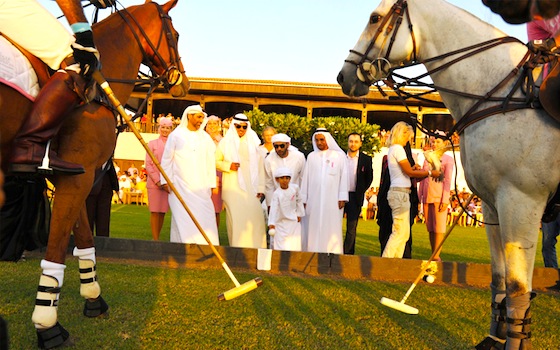
Pictured on the far left, the Green Sheikh took a break from his environmental activism to support breast cancer awareness at a polo event in the United Arab Emirates.
We must preserve raw materials like energy and water and improve the efficiency of industrialization, avoiding the production of waste in all stages of industrial and marketing operations, and we must replace toxic and dangerous substances with alternative or clean ones.
We must impose penalties on those caught producing emissions (which are expected to double in the next 30 years) after the issuing of the legislation, and we must look to other alternatives and mechanisms for the various stages of the production such as recycling, employing and recovering secondary products and waste as much as possible, in order to convert waste materials into commercial profits.
Pauline Masurel reviews a collection of literary and science fiction stories by world renowned authors that imagine the affects of climate change.
Bill McKibben was arrested in August this year while protesting against TransCanada’s proposed plans to build a pipeline that would carry oil from the Alberta tar sands to Texas. McKibben has written: “This is really really important. Jim Hansen, the world’s most important climatologist, has said that if we burn these tar sands in a big way it will be ‘essentially game over for the climate.’ That’s worth reading again. The oil companies and the Koch Bros are willing to take a few years of big profits in return for cratering the planet’s climate system.”
You might think that the facts would speak loudly enough for themselves, but McKibben has also written an introduction to this collection of short stories which aims to show that fiction can speak as persuasively as fact in making the point about the wounds we are inflicting upon our own planet. The book’s title is taken from a quote attributed to the environmentalist John Muir, ”When it comes to a war between the races, I’m with the bears.”
High birth rates coupled with domestic subsidies have resulted in soaring energy demand. Now Saudi Arabia has turned to nukes to keep it all going.
Bucking a trend globally of abandoning or reversing plans for more nuclear power in reaction to the Fukushima disaster, Saudi Arabia is now hunting for a site to build its first nuclear plant.
Faced with skyrocketing energy demand at home that is already putting a serious dent in its oil exports, and even threatening future domestic supplies, the kingdom will complete the construction of its first nuclear power plant within the next nine years, a Saudi government official revealed at a nuclear conference in Dubai.
While most experts say it is hard to know what is really going on with Saudi oil supplies, “What we do know is that, for whatever reason, Saudi Arabia produced 600,000 fewer barrels each day in 2010 than it did in 2005, and with growing Saudi consumption of their own oil, the drop in exports from Saudi Arabia has been even more dramatic.”
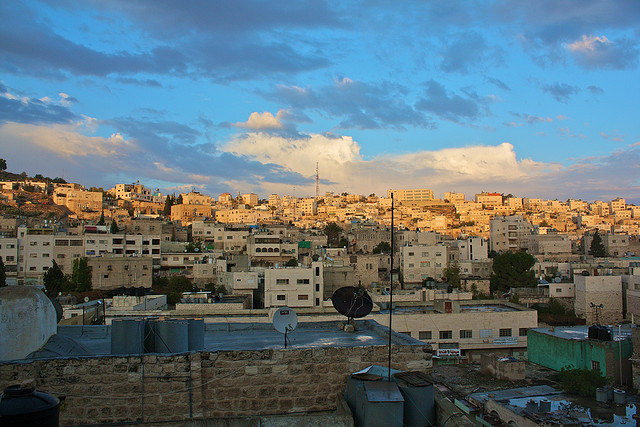
A solar plant, which is the sole source of electricity for a village in Hebron, has received demolition orders from the Israeli Civil Administration
Mneizel is a Palestinian village located in Hebron in the West Bank. In 2009, the 400 residents living there were lucky enough to be the recipients of a project funded by the Spanish government to install a solar energy plant. The solar energy project cost 300,000 Euros and is now their sole source of electricity- without it the village; its school and clinic would be plunged into darkness. On the 11th of October, the Israeli authorities issued a demolition order for the solar plant stating that it doesn’t have a permit.
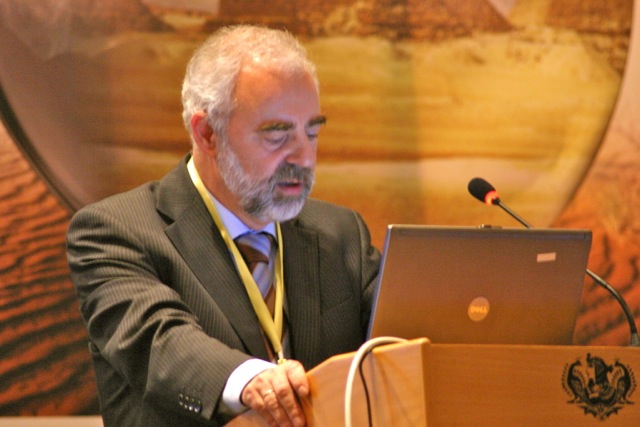
Desertec is a $500 billion solar project to catch Middle East and Africa sun. Tafline is currently at the Desertec Dii conference in Cairo, reporting from the field. Above is Dii’s CEO Paul van Son addressing the Dii conference
Just two years ago, Desertec was merely a pin prick of an idea conceived to tap into the desert’s vast energy solar and wind resources. Today it is a full fledged vision that has drawn scores of government representatives, investors, and other stakeholders from around the world to the second annual Dii conference in Cairo.
The conference venue – the Semiramis Hotel – overlooks the Nile River that is the lifeblood of so many countries. Outside the skies are heavy with pollution and the roads are as stuffed with cars as ever – a sure sign of how much this city relies on fossil fuels for its day to day function. But inside, there’s a semblance of hope that together Europe, North Africa, and the Middle East can pull off a cleaner future.
With inconsistent messages to investors and the public, Israel to create a national plan for renewable energy.
Even as Israel’s cabinet approved a national action plan for the promotion of clean technology growth, Israel’s government is also considering slashing incentives for mid-sized solar photovoltaic (PV) power plants due to fiscal constraints.
The inconsistent policies represent what has been a choppy and uncertain legislative environment for Israeli cleantech companies. With various solar incentives due to expire at the end of 2011, Israeli solar PV companies–which have been profiting since 2008 from the global drop in solar panel prices–are starting to get nervous.
Voluntary funding to support nature and ancient cities is thinned even more as Canada cuts its funding to UNESCO. If existing members don’t cough up about $70 million USD, trees like this one in Yemen could be under threat.
Palestine is neither a country nor a state, but Palestinian people living in the West Bank and Gaza are vying for their own sovereignty and recognition by the United Nations. Whether it is too early to do so, I can’t say. But attempts to go in the back door, as it were, are now threatening funding to world heritage sites, supported by the UN-organization UNESCO. Green Prophet’s Tafline put together an impressive list of UNESCO supported sites in the Middle East and budgetary cuts of now about 25 percent could hurt these sites, which include Egypt’s pyramids and Petra’s pink city in Wadi Rum, preserved for environmental and cultural reasons.

 Looking deeper into the pitfalls and promise of Desertec at Dii conference in Cairo. Green Prophet’s Tafline is there and reports from the field.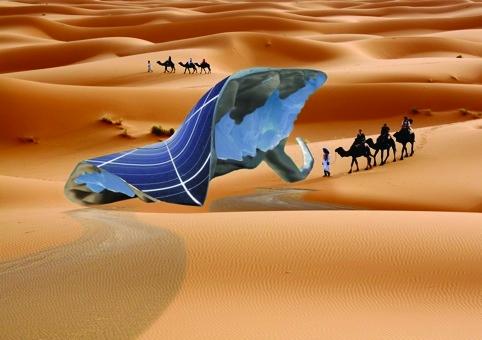










 Voluntary funding to support nature and ancient cities is thinned even more as Canada cuts its funding to UNESCO. If existing members don’t cough up about $70 million USD, trees like this one in Yemen could be under threat.