
 Dubai’s record-breaking skyline is the stuff of imagination bolstered by immense wealth, a powerful combination that mostly results in epic fail architecture. A new rotating skyscraper is in planning stage, an investment in gimmickry over game-changing sustainability, moving this city a step closer to its looming 22nd Century reality as the world’s best bad building burial ground.
New Rotating, Vertigo-Inducing Dubai Tower Back on Track
Cairo’s Coptic Solar Power Project Fades Amid Turmoil

The flame of an initiative launched in the largely Coptic neighborhood of Mokkatam in Southwest Cairo is at risk of flickering out amid ongoing political turmoil that has enflamed the city once again.
Watermelon and Feta Are an Odd Couple
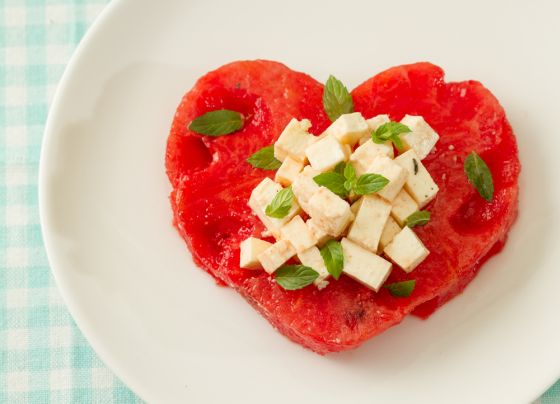
Opposites attract; just ask salted caramel, chocolate-covered pretzels, or kettle corn. These treats are all sweet-and-salty food combinations and here’s a new one to add to summer – just before the season ends.
Watermelon and feta cheese may not seem like the perfect pair, but you’ll have to trust me when I tell you that they are. I tried the combination when I traveled through Israel and became a believer in their seemingly unbecoming food relationship.
The sharp tanginess of the feta nicely complements the juicy, sugary flavor of the watermelon. The cheese needn’t be feta, but it should be salty.
For a get-together with family or friends, you can make a tray of hors d’oeuvres to pass out. Cut the watermelon and feta into bite-size pieces – a small circular cookie-cutter will make cute round shapes – and stack them, in that order, adding a fresh basil leaf on top of each bite.
Stick toothpicks or cocktail picks in the mini-masterpieces for the final step. This starter is essentially like the classic Italian tomato-mozzarella-basil antipasto, except sweeter and saltier.
In a salad, practically “anything goes,” and if you try tossing watermelon and feta with arugula, you won’t be disappointed.
Other flavors to include in such a salad or in different ways with watermelon and feta are cucumber, kalamata olives, red onion, fresh mint, and balsamic vinegar – and that’s certainly not the end of the list.
Experimentation is the only way to create something new and refreshing. After all, the simple two-ingredient creation of watermelon and feta cheese was probably an accident, one of those culinary “mistakes that worked.”
Some odd couples do end up withstanding the test of time. Marry the darling fruit of summertime with the choice cheese of the Mediterranean, and you’ll taste the love.
JewGlass: A Google Glass App for Observant Jews
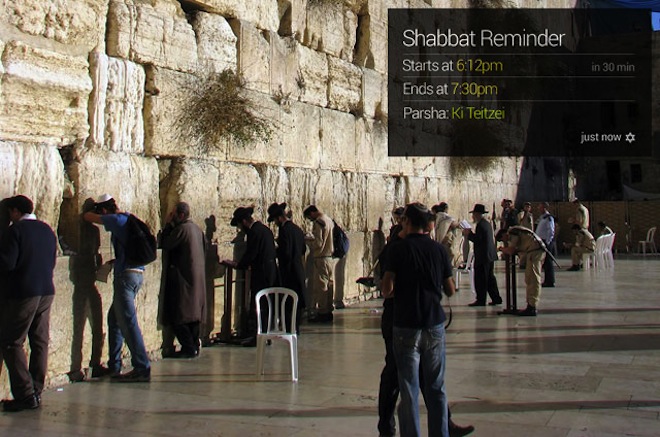
Rusty Brick is planning ahead for the day that Google Glass is released onto the market with a new app for modern observant Jews.
Deadly Middle East Coronavirus May Come from Camels

Researchers eager to trace the source of a deadly coronavirus that has spread to various countries in the Middle East and beyond have found that dromedary camels may be responsible for spreading the disease to humans, BBC News reports.
Qatar Solar Buys into Germany’s SolarWorld

Qatar Solar has purchased a stake in SolarWorld AG to give the firm a much needed fiscal boost. Called the BMW of solar panel producers, the German firm has been struggling to compete against China’s flood of cheap, generic photovoltaic panels.
Exodus from Syria Casts Dark Shadow on Muslim Holiday

The day that the month long fast called Ramadan ends is normally a joyous occasion for Muslims across the globe, but this year, with nearly two million of their Syrian brothers and sisters stranded, and strife roaring through North Africa and the Levant, a deep shadow has grabbed hold of this year’s Eid al-Fitr holidays.
Palestinian Company Harvests Naked Sea Salt for Israeli Activist

Israeli activist Ari Leon Fruchter has launched a new Kickstarter campaign, but instead of getting Israelis naked with Spencer Tunic, this time he is raising funds for Naked Sea Salt – a sustainable new brand of salt from the Dead Sea.
First Electric Bus Brightens Tel Aviv’s Streets

Don’t be surprised to find a bright orange bus rolling around Tel Aviv if you’re there; it’s new and it’s electric! The first of its kind in Israel’s busy Mediterranean city, it won’t be the last. Check out what the bus company Dan has in store.
Puri Water Bottle Makes Potable Drinking Water at Sea

During my travels throughout the Middle East and North Africa, I dreamed of having a magical bottle that could purify water without the need for any gross tasting tablets, and here it is: Puri.
Middle East Shipping Lands Prince Charles in Hot Water

 Britain’s Prince Charles lectures long on climate change and the local food movement, but a recent discovery about one of his businesses suggests the title “His Royal Highness” is just a nod to his carbon footprint.
Sugar wax: a step by step guide
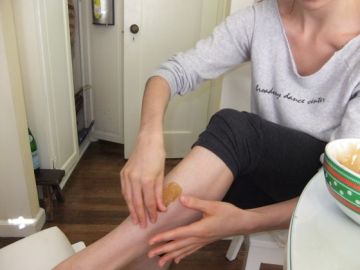

Following the wild success of our article on Persian sugar wax (and how to do it briefly), Green Prophet follows up with a step by step how-to: Now imagine that you didn’t need to call your local salon or spa to schedule a wax appointment – you could do the deed yourself. Well, the idea is actually not that far-fetched, as long as you have some basic ingredients in your kitchen.
If the ancient Persians had the ability, then so can you. They developed a simple hair removal technique based on sugar. As you might know already, Green Prophet introduced this beauty secret in a recent article, and this summer, I decided to give it a try.

1. First thing’s first: get your ingredients together. I used these measurements: 2 cups sugar, ¼ cup fresh lemon juice, and ¼ cup water. I’ve since read that honey can be substituted for the water.
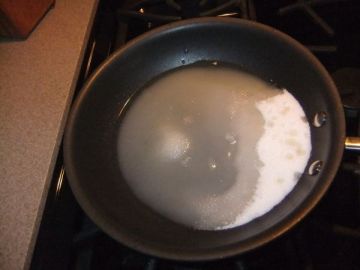
2. In a Teflon pan, I combined the goods and left the mixture on low heat, stirring occasionally. (Warning: you will be tempted to eat what you’re making. I didn’t include the pictures of me sneaking spoonfuls of lemony sugar water for fear of sending the wrong message to readers. This is a beauty regimen recipe, not one for the palate! I should have just made sugar-lemon crepes while I had all the right ingredients out!)
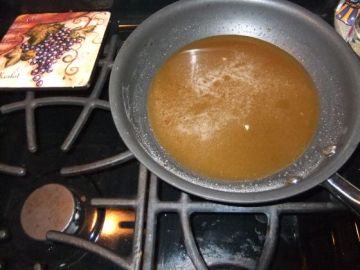

I was expecting the concoction to take on some sort of lustrous golden-brown hue almost immediately and, throwing patience out the kitchen window, I added some brown sugar to expedite the color transformation process. I should have started off with medium heat and then moved to low heat once there was a little boiling action (without letting the sugar burn). Then, there shouldn’t have been that aesthetic issue; the color would have turned more easily.
3. When the sugar was no longer grainy and the mixture seemed even, I turned the stove off and emptied the contents of the pan into a bowl. Luckily, my spontaneous addition of the brown sugar didn’t leave the mixture too thick; there was no need to add more liquid for balance.
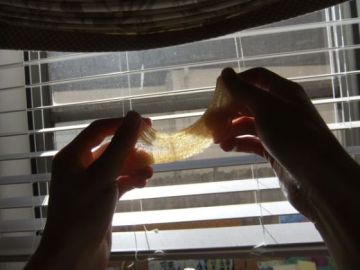
4. Gone are the days of Play-Doh and Silly Putty for me, but the wax looked so fun to play with. I extracted a wad and examined it against the light. If you have children, I would suggest preventing them from getting their hands on the wax. My smart adult self knew to rinse the sticky stuff off with warm water, but little ones might not be so keen, or willing.

5. I covered the bowl with plastic wrap and put it in the fridge. I returned when it had cooled off a bit but was not yet cold or rock-solid. Simply leaving it out on the counter is also an option; it just takes longer. If the wax does need to soften, you can pop it in the microwave for a bit. My wax was smooth and malleable but still held its shape when I rolled a small portion into a ball.
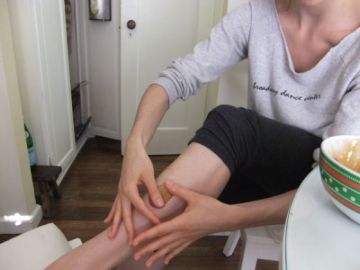
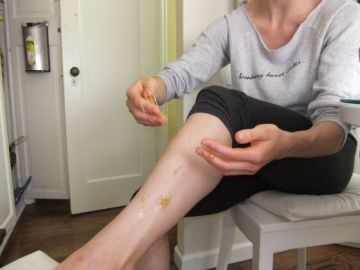
6. Don’t do this!
I should have started waxing right right then – but instead, took a misstep by adding water to the bowl. This is the big no-no of homemade Persian sugar waxing.
The addition of the water, which I thought would make the substance just a little more pliable, threw the chemistry and proportions out of whack. When I pressed the wax down onto my leg and grasped the bottom to pull up (and away from the hair growth, as is the routine), it ripped, and I could feel the excess water on my fingers and leg.
If I were to try this again and encounter the need for more moisture, I know to wet my fingers a little bit, if anything – not the whole mixture.
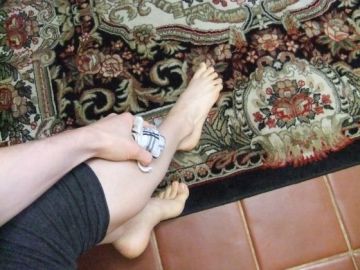
Some leg hair was removed, but not in great quantities. I started to lose interest after the water mistake. Still, I soothed the newly waxed areas with ice on a cloth.
For me, Persian waxing is about trial and error. I think it’s definitely worth attempting again. It’s a smart choice for those who are determined to wax.
There’s no doubt that it saves money. It saves the environment, too; no harsh chemicals are found in this hair-removal “product.” And you can compost the hairy results.
One could argue either way for saving time, as the preparation is a pretty time-consuming process of cooking and waiting, and then the actual waxing could be tedious. Nevertheless, a successful attempt could be well worth the effort. It also teaches you something about home-made candy making. Never a bad thing. Good luck!
Sugar wax, sugaring or Persian waxing, whatever you want to call it there is an old, tried and true way to wax, naturally.
Iraq’s Newly Protected Marshes a Huge Conservation Turnaround

We first learned about Nature Iraq’s conservation in a combat zone in 2010. Back then Iraq’s only conservation NGO seemed to receive little ministerial support; three years later and the Council of Ministries has approved the group’s push to protect the Mesopotamian Marshlands as the country’s first national park.
$325,000 Fake Beef Burgers Grown in a Lab & Coming to a BBQ Near You!

 Green Prophet’s told you about fish reared on pork products and Jordanian cows banned because of lumpy skin, but this story about beef burgers cooked up in a petrie dish really takes the cake! The world’s first laboratory-grown hamburger was just served up in London.
Eating tabouleh with Druze in the Galilee
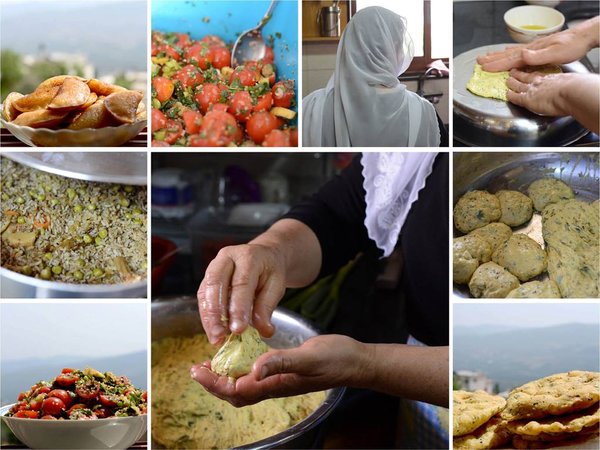
Fourteen picturesque Druze communities huddle in the shelter of Israel’s Galilee mountains. Although they flow freely in and out of Israeli society, the Druze stay close to home, marrying only other Druze and adhering to an Islam-based religion that they don’t discuss with outsiders. I have often wanted to know more about the Druze, to talk to their women and taste their food. But It never seemed possible to establish a contact with them.
Then I discovered a tour that brings outsiders like me to their homes, and indeed into their very kitchens. Paul Nirens, originally Australian and a long-time resident of the Galilee, organizes charming culinary workshops with Arab and Druze families, through his Galileat project. The families welcome paying visitors into their homes – or in my case, into their small restaurant – for classes where they teach, hands-on, how to cook a variety of traditional dishes.
Together with another group, I finally got to enjoy the authentic Druze cuisine. Under the watchful eyes of our hosts, we cooked most of a traditional meal, and then sat down to eat it. It wasn’t surprising, given the rural lifestyle, that Druze cuisine is based on vegetables grown in their own gardens, like baba ganoush, and home-pickled olives, and tahini. (Here are 8 delicious ways to enjoy tahini).
Our hostess wore the traditional long black dress and covered her hair with a light scarf. Her husband was on hand to answer questions about Druze life and society. I learned that traditional Druze women are not allowed to drive, and that both sexes observe strict modesty laws. Druze don’t eat pork, seafood or insects, nor do their laws allow alcohol.
However, I also learned that there there are those who live by a more liberal point of view. Some Druze women drive, work outside the community, and even own businesses. For the women who teach cooking, the workshops are a step towards financial independence or easing of a strained family budget. A surprise benefit is a new self-esteem.
“I do this as a business, clearly,” says Nirens. “But I get a sort of “added value” out of seeing how the women have suddenly developed a sense of empowerment through their ability to earn money. It never occurred to them that they have something to offer to people outside their village; that they have important skills. The fact that people come and find them interesting, that they can teach things that otherwise these people couldn’t learn, is very important. That, and the respect they gain.”
 Nirens adds, “I could make the workshops cheaper by paying the families less. They would accept that because they need the income. But then I wouldn’t sleep at night. I’ve been told I over-pay, but I believe I’m only paying what’s fair. And visitors get a fantastic, totally authentic cultural experience lasting three hours, with a great meal at the end.”
I can testify to that. In fact, I can personally testify to the deliciousness of the typical dishes because the Galileat workshop I attended was, surprisingly, kosher and under the supervision of the regional rabbinical council. It is the only workshop that is kosher in the Galileat project. As a kosher-keeper, I wouldn’t have been able to enjoy the experience half so much if I hadn’t been able to partake of the hearty, aromatic cooking. Although I confess that I cooked less and photographed more.
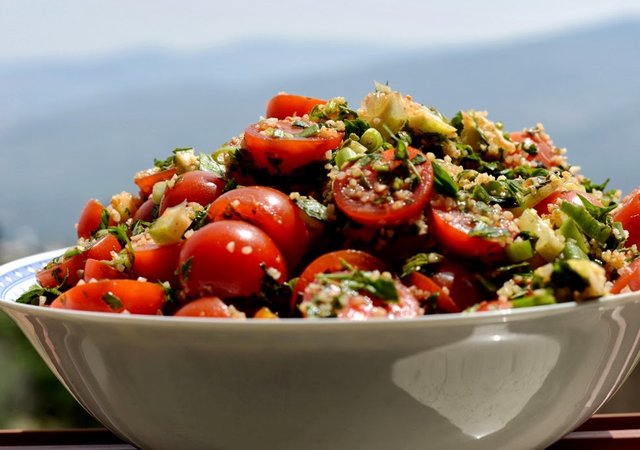
The recipe below reflects the home gardens and use of available products that come so naturally to the Druze. It’s a herby twist on tabuleh that features brilliant red cherry tomatoes. Enjoy!
Cherry Tomato Tabuleh Recipe
Ingredients:
1/2 kg cherry tomatoes
6 spring onions
I lemon
1/2 bunch fresh parsley (about 1 cup, chopped)
1/2 cup fresh mint, chopped
3 tablespoons fine burghul
1/2 teaspoon sweet paprika
Optional: 1/4 teaspoon hot paprika
1/2 cup freshly squeezed lemon juice
1/4 cup good olive oil
Slice cherry tomatoes in half. Finely chop spring onions and mix with tomatoes. Chop parsley and mint as finely as possible. Add to tomatoes. Dice lemon into small pieces, with rind and add to tomatoes.
Soak burghul for at least 15 minutes in lightly salted water. When burghul is soft, add to salad. Mix well.
Sprinkle paprika into salad mixture. Add lemon juice and olive oil. Correct flavors with salt and black pepper. Mix well.
The salad should be prepared at least 30 minutes before serving.
Serve at room temperature.
Our hint: Freeze and thaw the lemon ahead of time: it will soften and be easier to cut.
You’ll enjoy these additional Middle Eastern recipes from Green Prophet:
All photos courtesy of Paul Nirens.