Home Blog Page 263

Dubai’s Camelicious sees potential European, US market for camel milk

4

camelicious-camel-milk-dubai-7

DUBAI — Mention Dubai, and people immediately think of soaring skyscrapers, enormous shopping malls and insanely expensive sports cars. But 30 kilometers south of this world-class city-state — along the E66 highway towards Al Ain, and just past a Chuck-e-Cheese outlet — the glitz gives way to desert.

Here at Umm Nahad, there are no architectural wonders to behold, other than a lonely strip of asphalt stretching into the distant horizon. The quiet is punctuated only by the occasional screech of jets taking off and landing at a nearby military air base.
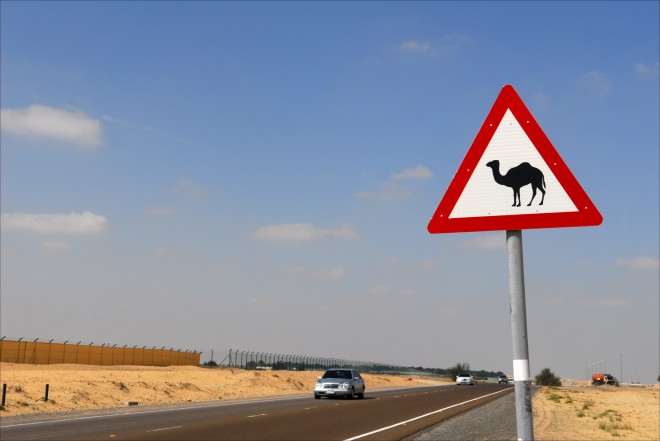
camel crossing road sign

What a perfect place for a camel farm.

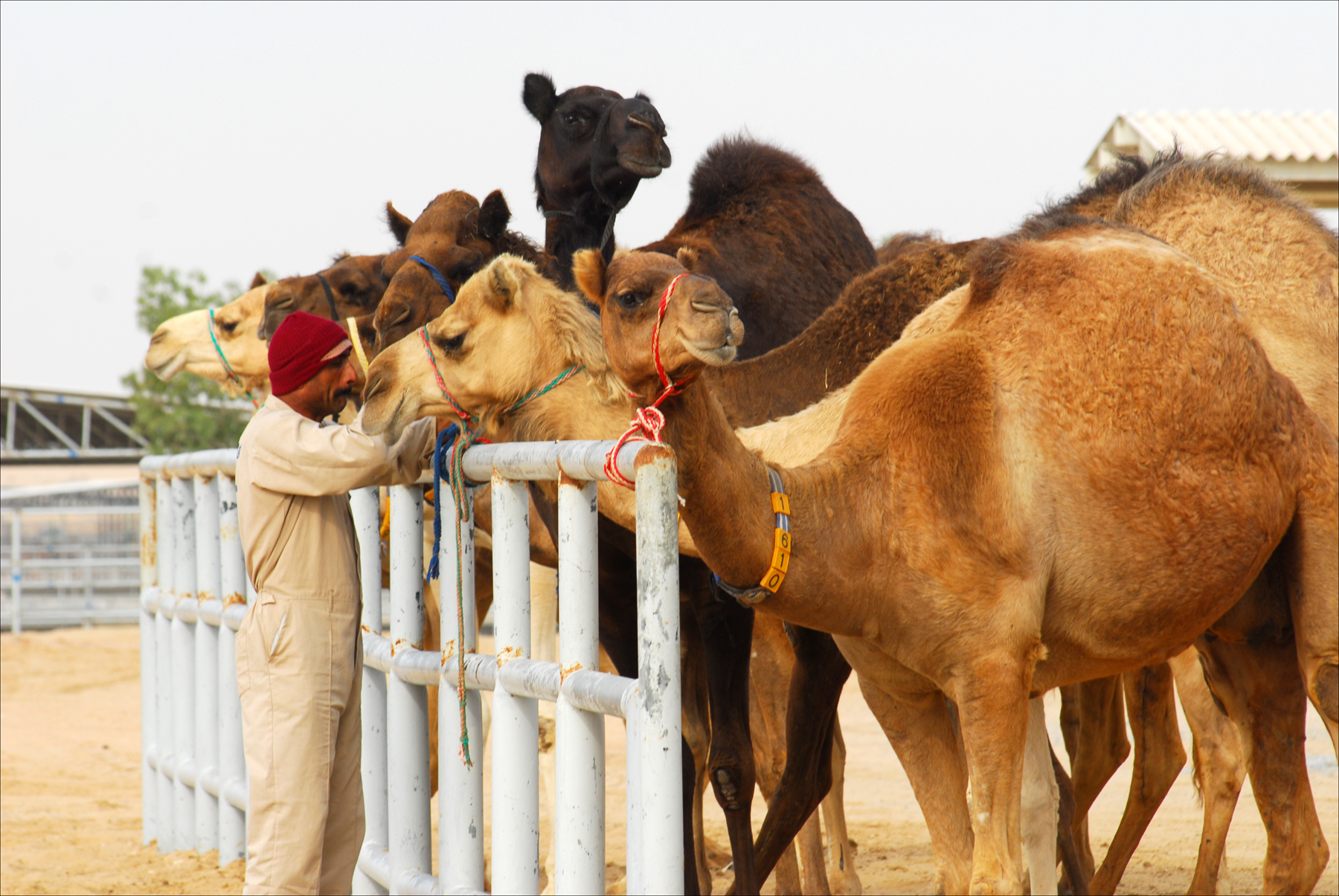
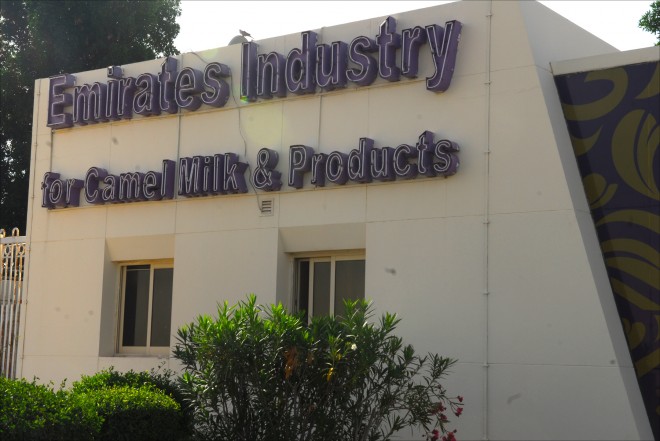
Known by its playful brand name, Camelicious — the farm represents one of Dubai’s very few attempts at actually producing something: healthy, natural camel milk.
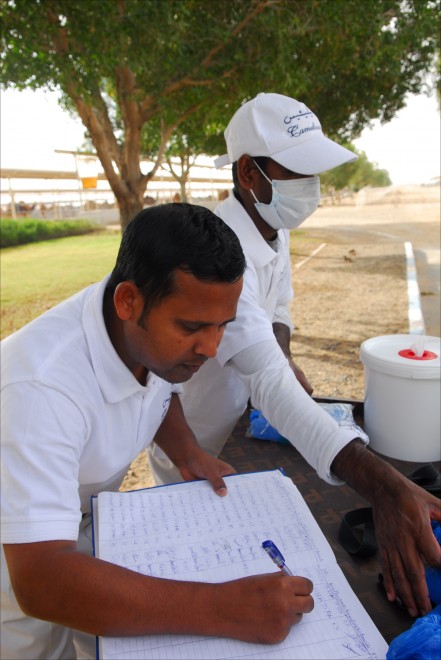
camelicious-camel-milk-dubai-2

About 250 people work at Camelicious, on a huge tract of land covering 25 to 30 square kilometers.

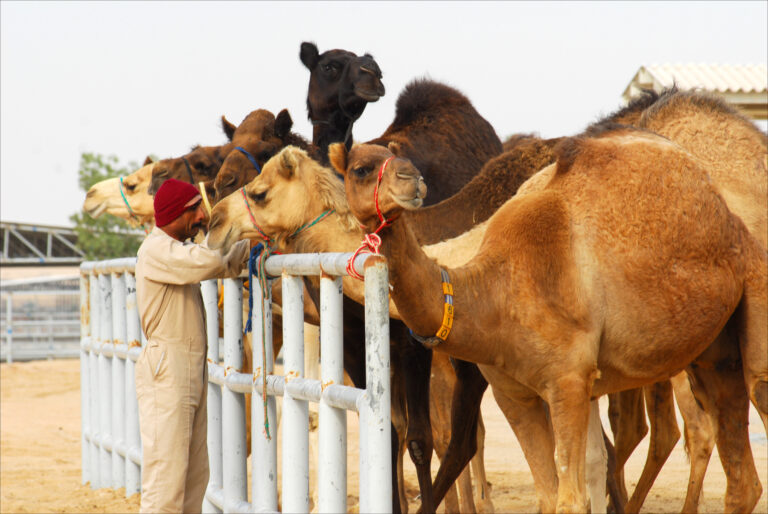
“Dates and camel milk are part of the staple diet of Bedouins. This is what people here used to live from,” said company communications director Kirsten Lange, speaking to GreenProphet.com during our recent visit to Camelicious. “Quite a few locals have camels. They drink the raw milk from their own camels, even though they might live in the city.”

At the moment, about 3,600 camels make up this operation, said Lange, though the idea is to have 10,000 animals within the next two or three years.

So how do the workers keep track of all these dromedaries?
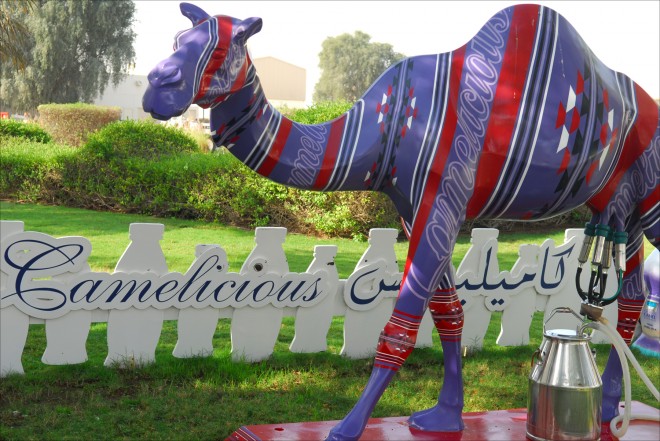
Camel milk sculpture

“The camels have numbers, but of course our vets know the old ones,” Lange said as she guided us around the farm. “Once in awhile, we give them names. Once we had a camel with lots of hair; we called her Tina Turner. They have GPS trackers on their collars, and we have a very extensive database. On every camel we have a huge database, and they get regular blood and urine tests.”
camelicious-camel-milk-dubai-9

The point, of course, is to get these camels to produce as much milk as possible. The average camel gives seven liters a day, though not all camels are producing at all times. Daily production averages 5,000 to 6,000 liters, she said.

Camel milk production line.

Last February, the company got permission from UK authorities to export its camel milk to the British market. The Camelicious brand is now available in selected ethnic stories in London, Brighton, Manchester and Bradford. Milk powder has also been shipped to potential partners in the cosmetics and pharmaceutical industries.

Milk “Camel” Chocolate

Camel milk chocolate Camel milk chocolate Camel milk chocolate

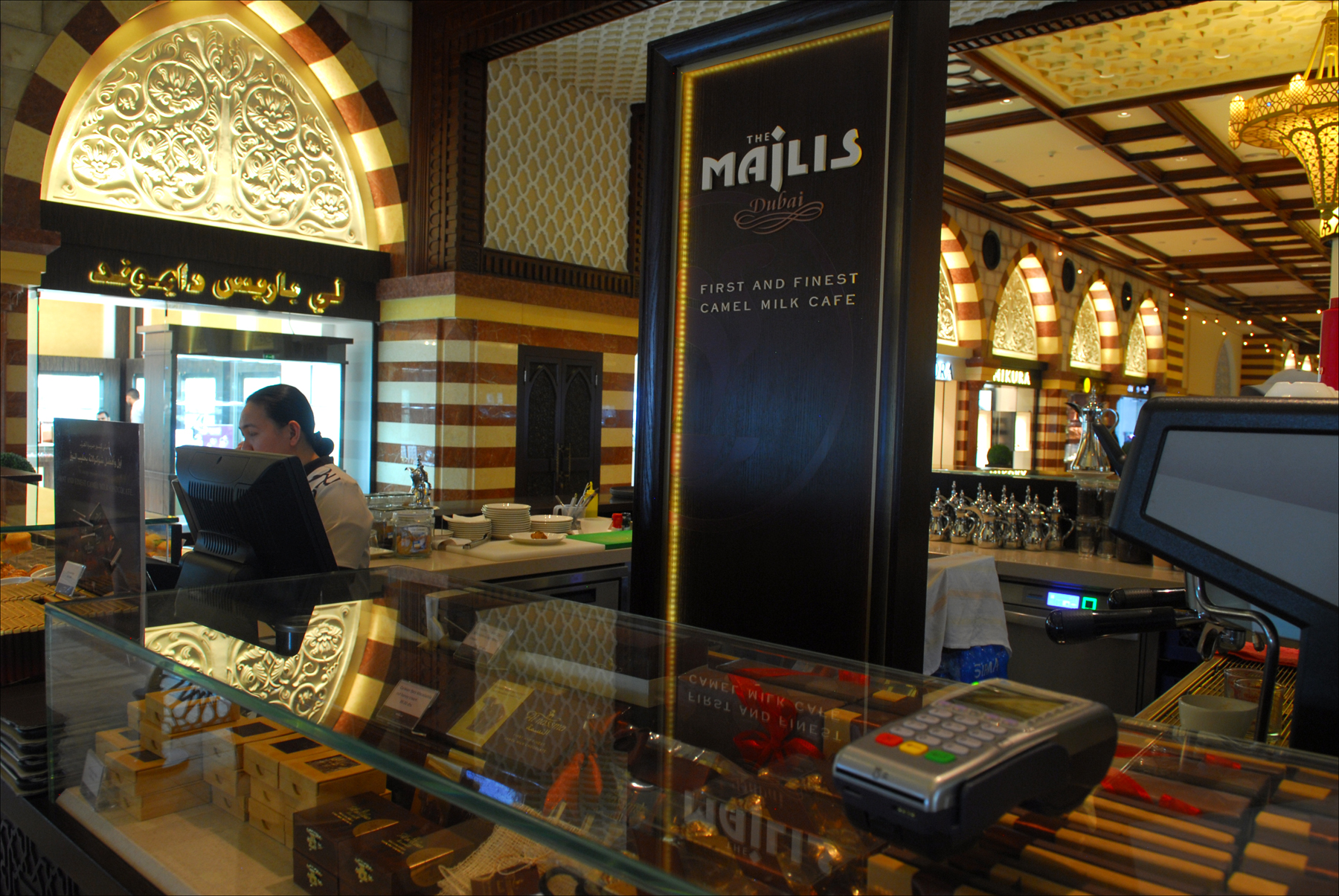
In addition, there are two sister companies: The Majlis and Al Nassma. In July, Al Nassma — which distributes fine chocolate products made from camel milk — reported a 100% growth in sales over the previous 12 months. The Majlis, meanwhile, runs a retail outlet at Dubai Mall, selling a range of bread loaves, muffins, Danish pastries and ice cream.

“Camel milk has always been known in the Middle East, but the accessibility for the wider public has been limited. We at EICMP have been reaching out to the broader community in the UAE to encourage a healthy lifestyle since 2006,” said Mutasher Al Badry, the company’s manager of business development. “Our goal is to promote the benefits of camel milk as a natural and pure resource of the region, and as a healthy alternative to cow’s milk.”

While not everyone likes the taste of camel milk — Camelicious tends to have a pleasing, slightly salty taste — the experts seem to agree that it’s far healthier than the kind that comes from cows.

Besides having three times more Vitamin C and 10 times more iron than cow’s milk, it’s antibacterial, low in lactose and shows promise in treating everything from diabetes to Crohn’s disease. A 2005 study showed that just 500 milliliters of raw fresh camel milk daily improves the quality of life for diabetics, thanks to a protein found in this particular milk that has characteristics similar to insulin but doesn’t coagulate.

“About 25 years ago, Dubai’s Central Veterinary Research Lab set up a research facility to explore what a camel could really be used for. Before that, no one thought of commercially exploiting camel milk,” she explained. “After awhile, when it became clear that this might be profitable, the company was set up on the same premises under the leadership of CVRL. It was founded in 2003 and became operational three years later.”

Camels for milk, Dubai

Lange, a German development and PR consultant who speaks Arabic fluently, previously worked in Afghanistan, Kuwait and Yemen before resettling in Dubai.
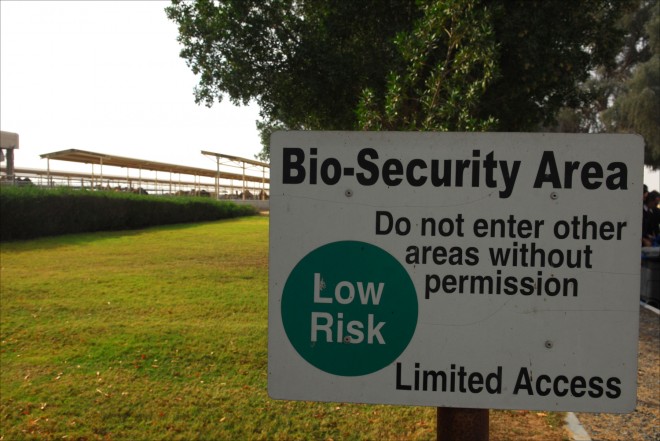
Do not enter camel milk factory sign

Lange said the Camelicious operation is heavily subsidized by the government, to the tune of “tens of millions of dollars,” though she wouldn’t be more specific.

“It is a private company, of course, owned by several shareholders. It’s not at the break-even point yet, but right now, with exports to Europe and the prospect of getting FDA approval — as well as getting into new industries like pharmaceuticals — inshallah it will be profitable soon. We see a lot of market potential.”

Camelicious comes in a variety of tempting flavors — so far, it’s available in plain, chocolate, saffron, date and strawberry. With the brand’s humorous logo of a cartoon camel with sunglasses, one might think this would be the perfect off-the-beaten-path destination for tourists and their kids.

But this isn’t Dubai Waterpark. As Lange said, “we are not a tourist attraction. We are running a business operation here with ISO and EU standards.”

Most of this operation is even off-limits to members of the media, who are not allowed anywhere near the milking facility. And visitors may enter the production and bottling line only after donning disposable blue outer garments to reduce any possible contamination from outside.

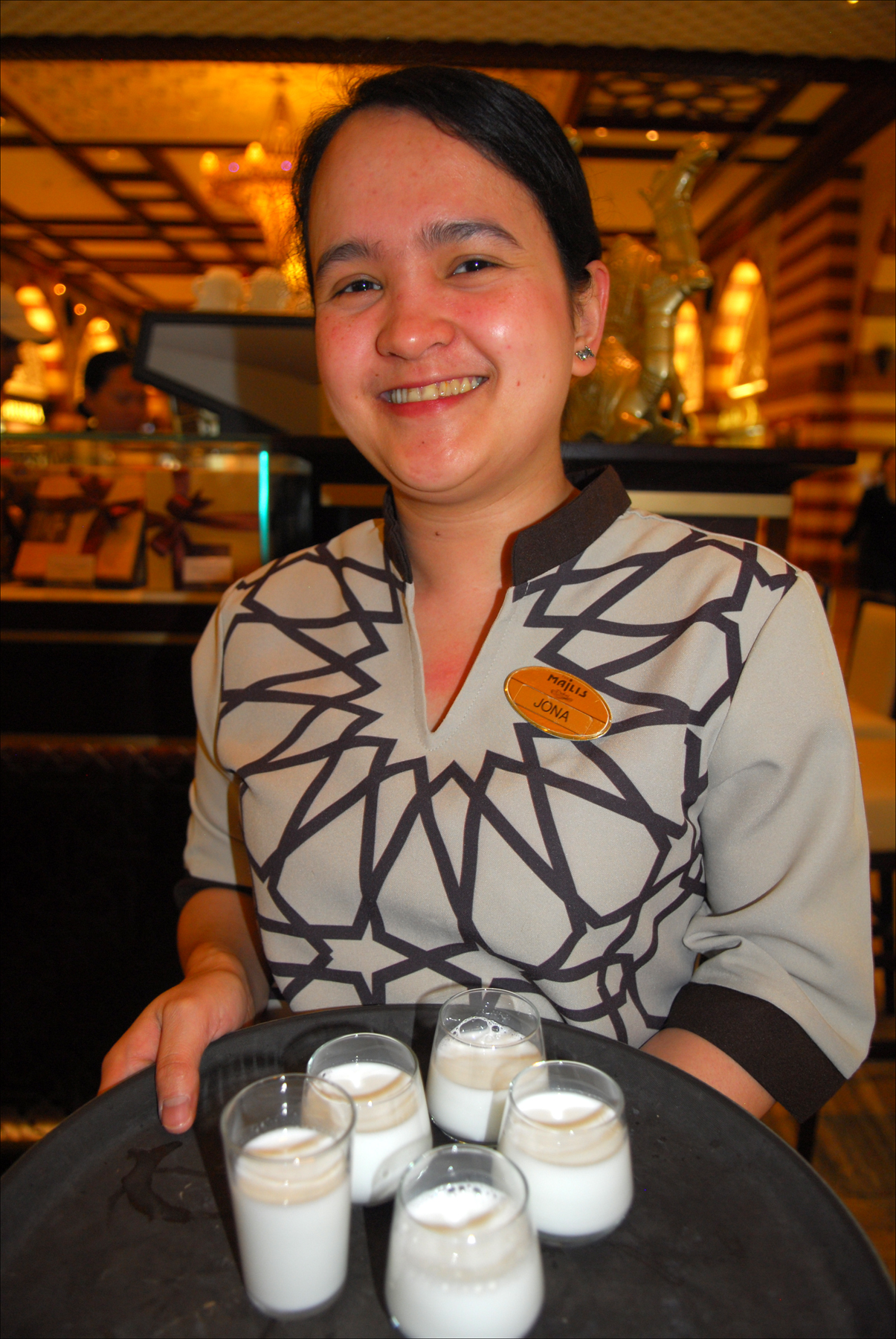
Camel milk factory
Serving camel milk

Many of the workers, it appears, come from India, Bangladesh and Nepal — along with several Arabic-speaking employees — though none of them would talk to this reporter. Asked how they all communicated, Lange said, “the ones who don’t speak English take classes. We have people who started here eight years ago not knowing English, and now their English is excellent. We take pride in caring for our workers.”
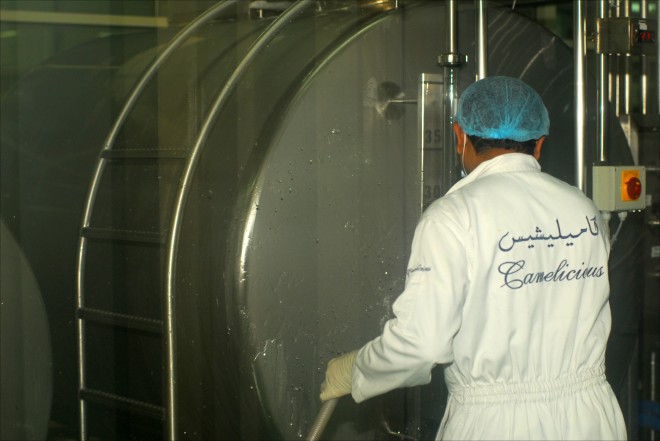
Making camel milk

On the other hand, she said, “running a camel farm is not only about having camels. Here, we have 10 years of company experience and 25 years of research, but we are not done. No one is ever done,” she said. “Everyone who sets up a camel farm will eventually face problems.”

One such problem surfaced last June, when a team of Dutch and Qatari medical researchers found that the virus which causes Middle East respiratory syndrome (MERS) is found in camel milk. That prompted the Qatari government to issue guidelines warning against drinking raw camel milk, and that milk be boiled before consumption.

In Dubai, Camelicious is available through the Waitrose supermarket chain for 10 dirhams per liter; its price is fixed by local municipal authorities.

But in the States, camel milk costs more than some premium liquors, when it’s available at all. Walid Abdul-Wahab, founder and CEO of Desert Farms, told the trade industry publication DairyReporter.com there are 18,000 cows for every camel in the United States. That’s why pasteurized whole camel milk goes for $16 per pint (473 ml).

“Camel milk retails for double the price of cow’s milk, but when it comes to European prices and maybe later on the U.S. once we get FDA approval, it’s up to the retailers,” said Lange. “It’s all about creating standards for camel milk. How do you judge whether the quality is good or bad? For other milk, there are already standards. The FDA basically has to do the same.”

emirates-camel-milk-products

Larry Luxner is a freelance journalist and photographer who writes frequently about Latin America and the Middle East. Photo credit: Larry Luxner, 2014, for Green Prophet
NASA sees Mideast holiday lights from space

0

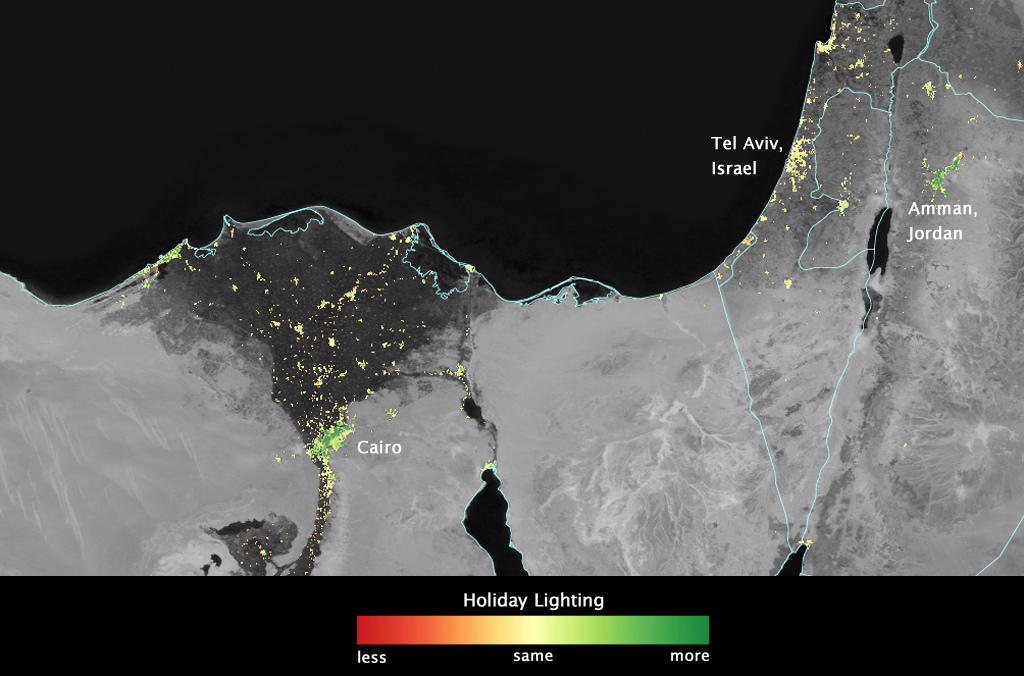
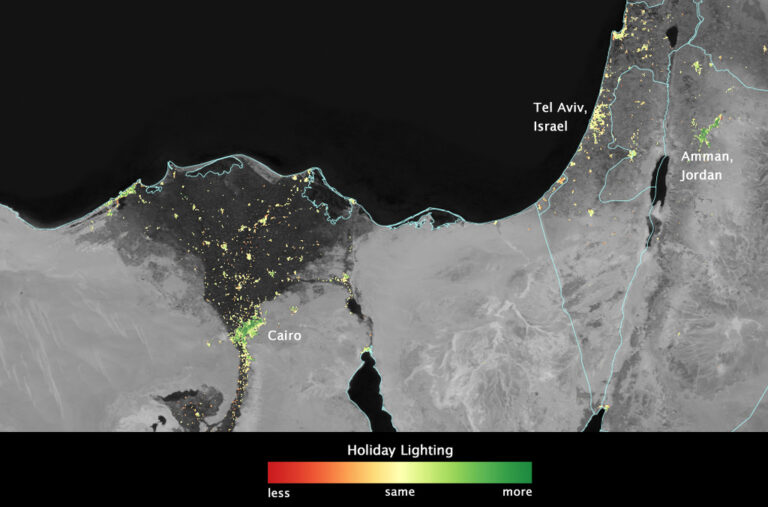
mideast_holiday_lightsNASA scientists are using the Suomi NPP satellite to photograph the earth at night. They are studying natural phenomenon as well as light pollution. They found that manmade lights shine noticeably brighter during the holidays of Ramadan, Christmas and New Year.

Some Middle Eastern cities shone more than 50% brighter during Ramadan. Find out how ancient religious celebrations led to traditions of holiday glare.

NASA scientists and associates used a sophisticated computer algorithm to compare man-made lights during holidays to man-made lights at other times of the year.

RELATED: NASA watches freshwater sea vanish

They compensated for clouds, dust and other weather phenomena which might have impacted the results. They also ignored increases in brightness from areas with snow cover because snow  reflects and increases the amount of manmade illumination which escapes into space.

The scientists were surprised that holiday lights are visible from space.

Hanukkah Holiday Light

The Jewish celebration of Hanukkah is sometimes called the festival of lights. It commemorates a Maccabee victory and a miracle of efficient lighting that took place in 165 BCE. A nine-branched Hanukkah menorah lamp is part of this traditional celebration. The menorah’s candles are lit in order to represent the miraculous extra days of light.

RELATED: NASA sees Cairo’s black cloud on camera

Electric menorahs are sometimes used for display purposes and to let others know about the Jewish faith, but under most circumstances, this mitzvah requires a true menorah which burns wax or oil as the original temple menorah would have.

So, with the exception of the green laser menorah projected onto a landfill in Ariel Sharon park near Tel Aviv, typical Hanukkah celebrations aren’t bright enough to be seen from space.

Christmas Holiday Light

Christmas celebrates the birth of Jesus of Nazareth in Bethlehem. To Christians, Jesus Christ is the messiah and the light of the world. But there is only a tenuous connection between core Christian beliefs and the traditional illuminated Christmas tree.

The ancient pagan practice of decorating an evergreen tree was adopted by devout Christians in Germany. Marriage and other family connections brought this tradition to Great Britain around the year 1800 and spread further when Queen Victoria married her German cousin. At the time, these Christmas trees were decorated with ornaments and occasionally with lit candles.saudi_arabia_holiday_lights_from_space

In December 1882, Edward H. Johnson demonstrated the first electric Christmas tree lights. This was only three years after his associate Thomas Edison demonstrated the first practical incandescent light bulb. These lights were seen as a publicity stunt of the fledgling Edison electric company and not immediately welcomed as a less flammable alternative to candles. Businesses began using them around the year 1900 but they were too expensive for average households until about 1930.

Electric Christmas lights went through several technology and style changes over the next few decades. This included compact fluorescent Christmas lights introduced in the 1940s, high voltage Christmas lights, low voltage “fairy light” incandescents and the recent introduction of red, yellow, green, blue, ultraviolet and finally white LEDs.

Ramadan Holiday Light

These decorative lights eventually spread beyond the western world and beyond the Christian holiday. Some neighborhoods hold competitions for the brightest, blinkiest, most eye-watering holiday light display. So it should surprise no one that lights such as these are seen from space:

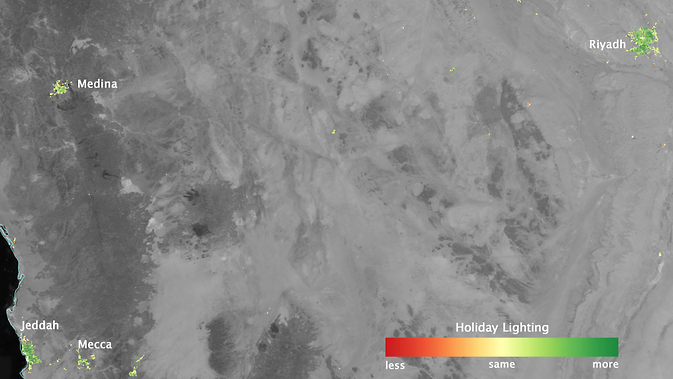
The lights of the Muslim holiday of Ramadan can also be seen from space. In Saudi Arabia, outdoor lights were twice as bright during Ramadan than they are at other times of year.  Some of this may be caused by decorative lights, and the fact that more people are outside after sunset when each daytime fast ends.

Photographs by NASA some rights reserved

Depleted Turkish coal mine transforms into prize-winning olive groves

0
coal mine turned olive grove in Turkey
Photo: Omer Aydiner (2014)

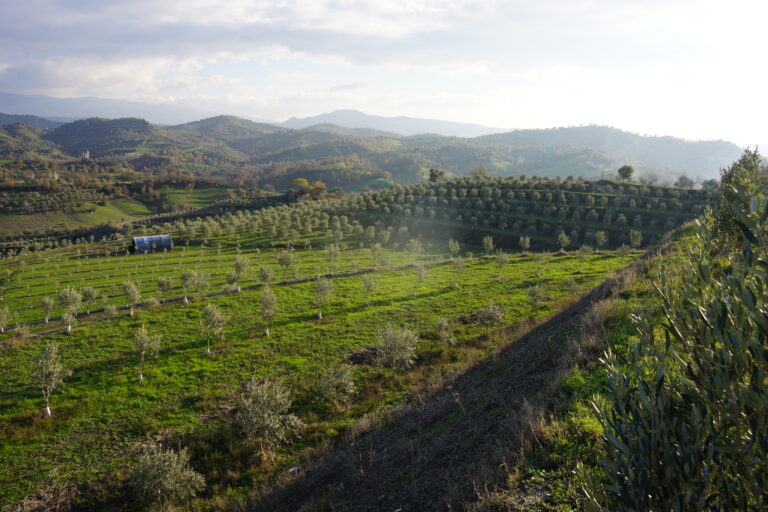
As olive groves across Turkey are falling victim to energy projects, one construction company decided to buck the trend, turning a coal mine into an award-winning olive plantation.

Protests erupted in the disaster-struck coal capital Soma last month after a construction company felled 6,000 olive trees to make way for a power plant.

coal mine turned olive grove in Turkey
Photo: Omer Aydiner (2014)

The case generated nationwide interest, underlining Turkey’s struggle to balance the government’s aim of reducing the country’s dependence on energy imports with protecting the environment.

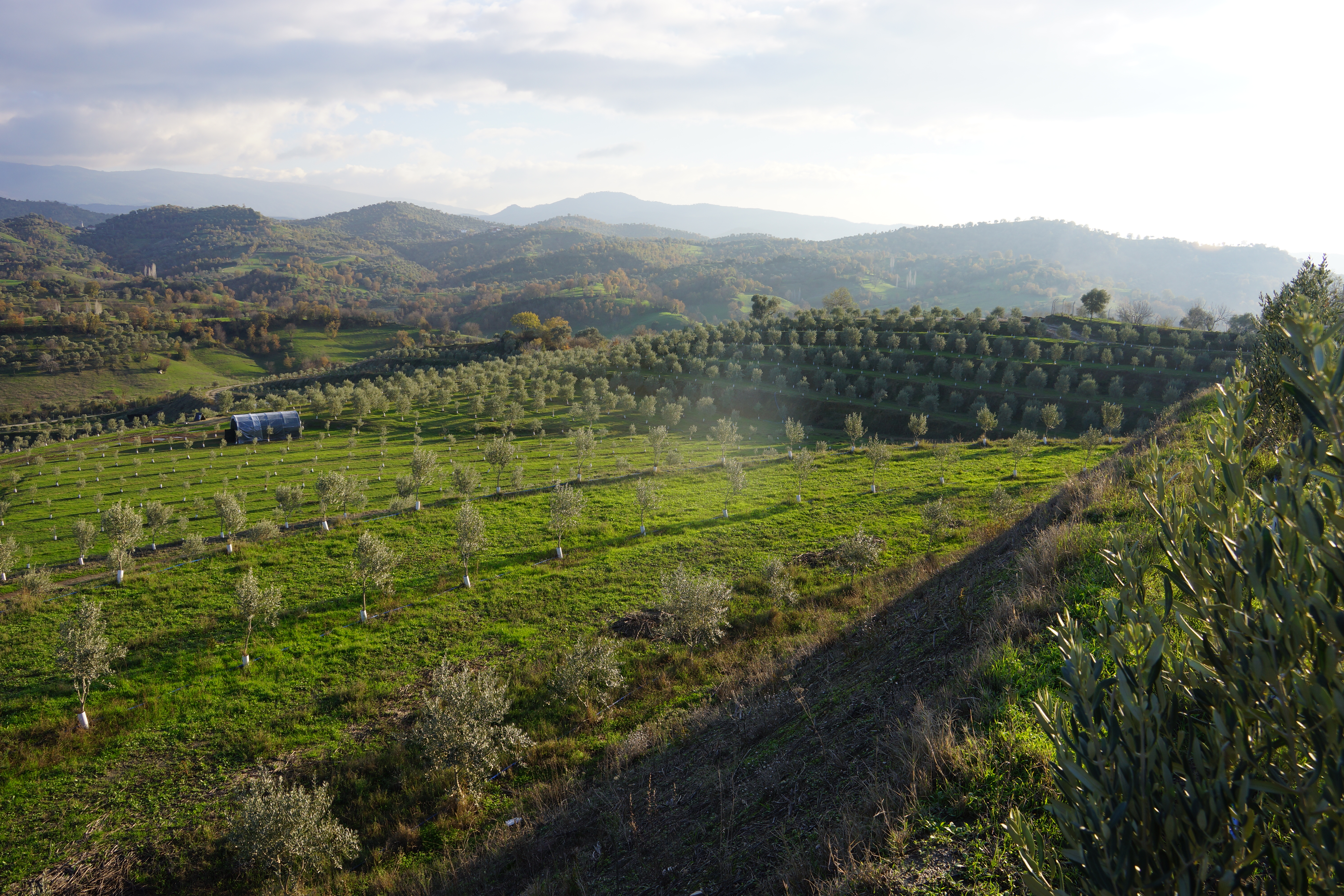
But in Aydin on the Aegean coast, a few hours’ drive from Soma, the Zetay olive grove serves as a rare example of sustainable development in Turkey.

Originally an open-excavation coal mine, it was operated by the Ankara-based Aydiner Company in the 1990s until the coal ran out.

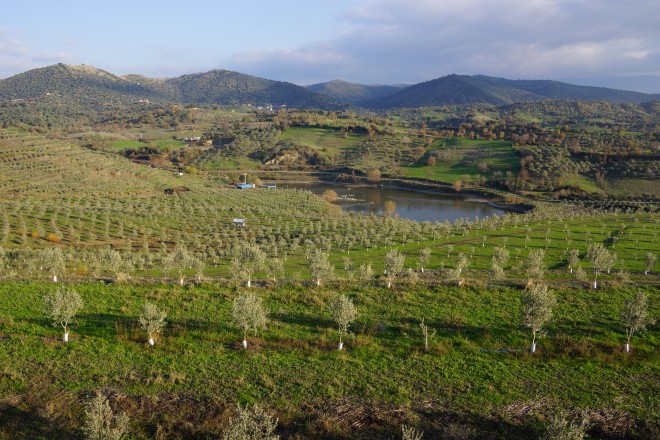
Yet instead of letting the land lie barren, the company bought the 300,000 sqm area in 2007 and transformed it into an orchard. Last year, it began producing its own olive oil.

Ömer Aydiner, the company’s owner, said he had been thinking about converting the area for several years. After deciding to turn it into an olive grove, the company sought the advice of agriculture experts at Ankara University and the local community in Aydin.

“We started looking into the best variety we could use with one of the professors in Ankara and by using the experience of the muhtar [village headman] and his father,” Mr Aydiner told Green Prophet.

“They’d been living in the village ever since that village was established, so they knew what could be grown over there. We decided to stick to the olives that all the farmers and all the people in the area were growing.”

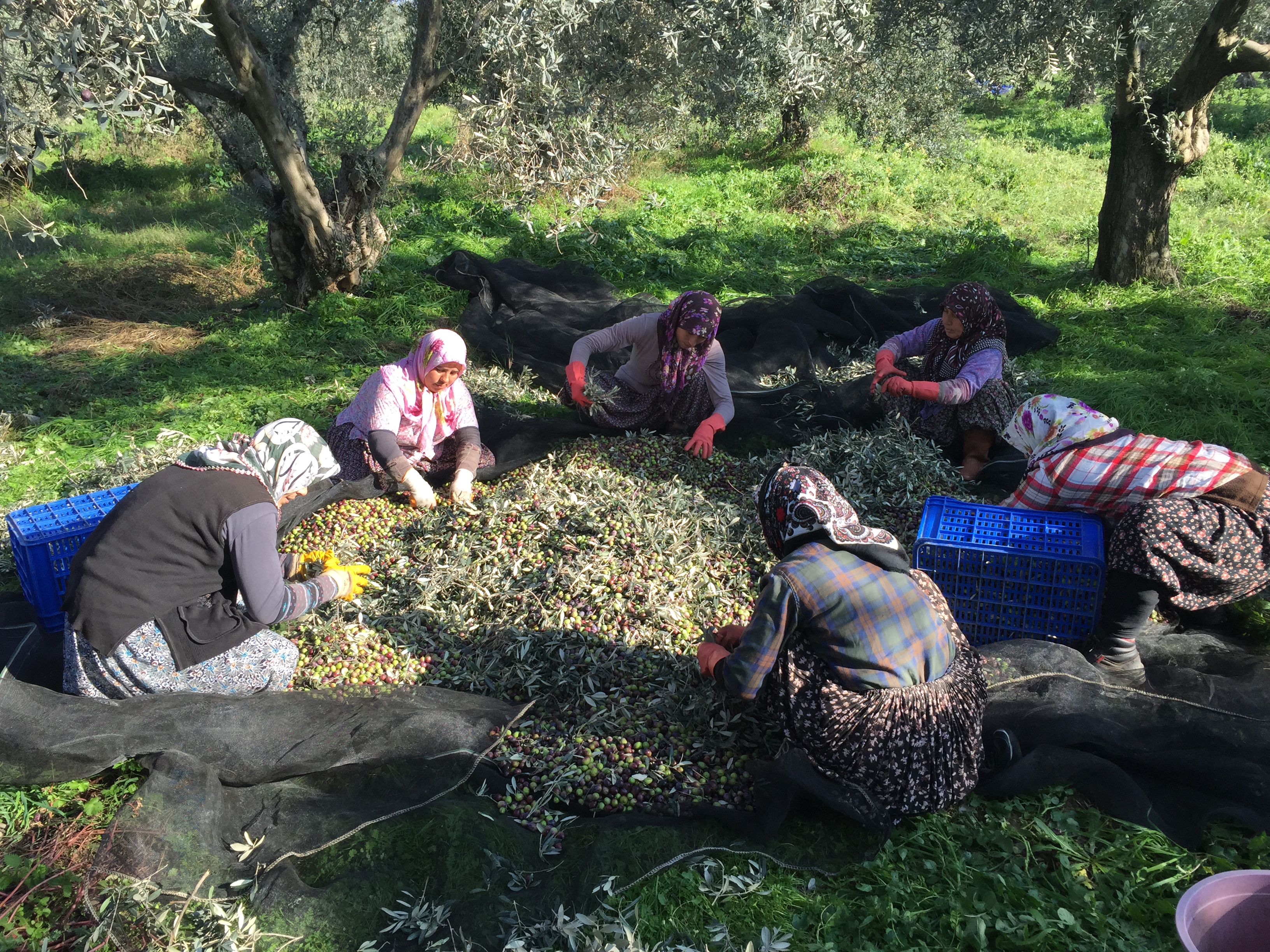
The company works closely with the villagers. As Zetay’s young trees do not yet yield enough to sustain the oil production, Aydiner buys olives from farmers in the region. During harvest, the plantation also relies on local labour.

“We are from a village ourselves. We’re from northern Turkey, from the Black Sea coast, so we know how to be a village person,” Mr Aydiner said about his company.

“The best knowledge is always on the ground, it comes from the people who live there. I cannot bring someone from the Black Sea to advise me on growing olives in the Aegean area, that would be ridiculous.”

External help came from Professor Mucahit Özkaya from Ankara University’s horticulture department, who specialises in olive farming.

coal mine turned olive grove in Turkey
Photo: Omer Aydiner (2014)

Under his supervision, the company began work on the barren mine. The area’s soil was severely damaged after years of coal exploitation, so Prof Özkaya instructed the company to dig holes – one each for the roughly 13,000 trees – and fill them with fertile earth.

He also added caper and pomegranate trees to the orchard to prevent landslides and further erosion.

“Some other companies plant forests or orchards on old coal mines, but this company contacted me to establish it in the right way. Most companies don’t care for the science behind it,” said Prof Özkaya, who still works as a consultant at Zetay.

As Aydiner wanted to produce organic oil, the plantation uses no fertiliser or pesticide and little machinery. To combat pests, the workers rely on tried-and-tested methods used by local farmers.

“We had some problems with mice and insects, so we put some animals, like turkeys, chickens, hens and geese, in the plantation and they’re eating the insects,” Prof Özkaya told Green Prophet.

Award-winning olive oil

Nearly 10 years in the planning, the effort has paid off: Zetay’s olive oil won eight awards from across the world this year. Encouraged by the plantation’s success, Mr Aydiner said his company was looking into starting a similar project in the Black Sea region.

coal mine turned olive grove in Turkey
Photo: Omer Aydiner (2014)

Such projects are rare. Elsewhere in Turkey, olive groves are under threat after the government drafted a bill to facilitate the expropriation of small olive plantations to build power plants.

An estimated 90 per cent of the country’s olive groves are smaller than 2.5 hectares and could therefore be expropriated at the government’s will if the bill passes.

RELATED: Balyolu makes Turkey’s first honey tour

Even without the new law, Turkey’s hunger for energy has led the government to lend support to destructive construction projects.

Deforestation has become widespread: Istanbul’s northern forests, where the world’s largest airport is being built, are disappearing and on the Mediterranean coast, hundreds of thousands of trees stand in the way of Turkey’s recently-greenlit first nuclear power plant.

Plans for a thermal power plant in Soma, where 301 miners were killed in an explosion in May, saw 6,000 olive trees felled last month. The images of sobbing villagers sparked outrage nationwide, forcing the Council of State to suspend the project.

Deputy prime minister Numan Kurtulmus tried to strike a conciliatory note: “We need to find the middle ground. Yes, we need electrical energy. We need power plants. But it is also wrong to damage the environment in a thoughtless, reckless way just because we have some economic needs.”

Yet a few weeks later, his words seemed to have been forgotten when several dozen olive trees were cut down to make way for a power plant in Aydin province, less than an hour’s drive from the Zetay orchard.

Un-Islamic critics want to veil “shameless” private parts of buildings in Iran

2

Elkan Towers Iran

Islamic versus non-Islamic or simply Western style architecture is an issue in many parts of the Middle East where locals, kingdoms and sheikdoms refuse or steadfastly hold onto their identity.

Look at the Arab Gulf States like Dubai where giant, glass fronted skyscrapers dominate the skyline.

These futuristic structures are being called cheap and anonymous by prominent architects like Frank Gehry. In Saudi Arabia the king there is attempting to wipe historic holy sites off the map by developing over them. ISIS too is wiping history off the map with their own agenda.

But Iran is very different than the rest of the Arab world right now. And legistlators there are trying to buck the trend of modernism.

The Iranian back end story

Architecture in the Islamic Republic of Iran, which for centuries followed a more traditional style of environmentally green designs gave way to more modern styling during the 53 year period of the Pahlavi monarchies; especially during the reign of Shah Mohammad Reza Pahlavi, who reigned from September 1941 until February 1979.

During his 38 year “off and on” reign, Shah Reza Pahlavi made great efforts to introduce Western culture into the country, which also included dramatic changes in Iran’s architectural styling.

See traditional fishbowl architecture from Iran.

Although modern architectural styling continues to change the face of Iranian cities like Tehran, efforts are now being made by Iran’s Supreme Ruler, Ayatollah Ali Khamenei is slow down the pace of contemporary architecture by issuing criticisms against modern high rise structures as being “un Islamic” and not in accordance to religious fatwas or edicts.  Sustainability issues are not on the table.

According to an essay article written by Mojtaba Nafisi,  during Iran’s rich architectural history “the spatial layout of house design in Iran reflected the patriarchal structure of the society through the rigid segregation between private and public space, known in Persian architecture as the andaruni and biruni.”

Putting a veil on shameless and erotic buildings

This architectural concept has now been compromised, he writes, by more contemporary architectural designs which “are also considered erotic because, unlike the spatially introverted pre-modern architecture of Iran, faces outward with windows that shamelessly offer strangers a peek at the buildings’ private parts.”

Related: Khamenei won’t like these rotating rooms in Tehran!

rotating rooms in Tehran

Religious edicts or fatwas against modern building styles were published by Center for the Study of Science and Technology of the Islamic Iranian Architecture and Urban Planning, which is said to have close ties with the Supreme Ruler, who appears to prefer more traditional or Patriarcial building codes.

This doesn’t mean that Khameni is against all forms of modern innovations; as Nafisi says Khamenei “appears to like other Western innovations, from smoking pipes to ballistic missiles.”

Major efforts have been made to change architectural styling that was introduced during the reign of Iran’s last Shah, the late Reza Pahlavi. These include a number of buildings that were designed and constructed by large Israeli construction companies prior  to the 1979 Islamic Revolution.

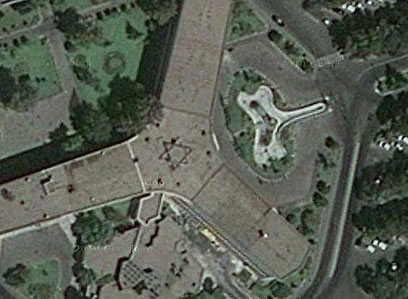
Tehran airport building by Google EarthOne of these buildings, at Tehran’s international airport (see photo), was still reported to have Israel’s national emblem, the Star of David, still noticeable on the building’s roof.  This symbol, which has been described by Iranian media as a “symbol of evil”, lays evidence to cooperation between Israel and the Pahlavi regime, when airlines of Israel’s national carrier  El Al, made regular flights to and from Tehran and Tel Aviv.
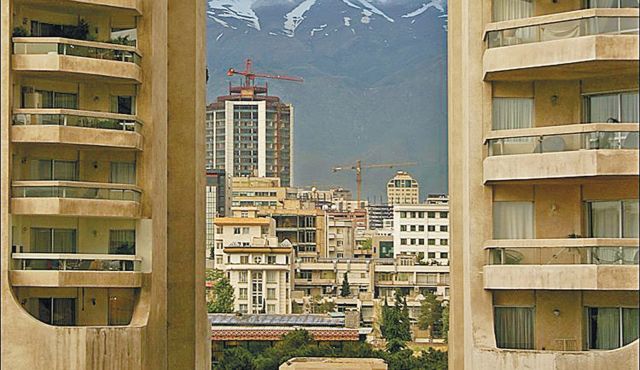
Other Israeli structures include the former Tehran Hilton hotel, now called the Parsian Esteghlal International Hotel, and the Elkan Towers residential project (photo top).

Judging from the current political atmosphere, regarding the state of relations between these two countries, these remaining symbols of past Israeli – Iranian cooporation have undoubtedly  been a part of Khamenei’s “un-Islamic” building design thoughts as well.

More articles on Middle Eastern and Islamic architecture:
Extraordinary Fish Bowl Architecture Photos by Iran’s Mohammad Domiri
Dubai’s Skyscrappers are Cheap and Anonymous Says Architect Franky Gehry
Islam’s Environmentally Friendly Architecture – Where Did it Go?

Photo of Tehran Airport building -Google Earth:
Photo of Elkan Towers, by Sam Ibanaru/Haaretz

A million mummies unearthed in Egypt – can you dig it?

3

ancient Egyptian cemetery holds millions of mummiesMaybe you’ve heard of the Million Man March? Or the Million Mom March?  Or last year’s Million Muslim March? Brace yourself for a macabre riff on that theme. A team of archaeologists from Utah’s Brigham Young University (BYU) discovered an ancient Egyptian cemetery that has more than 1 million mummies. Presumably, they don’t march.

3D-printed paws allow lame dog to run!

1

 3D printed dog legsThis is the amazing tale of Derby the dog. The life of this little pup born with withered front legs took a radical turn when he met an animal lover named Tara Anderson. See the power of tech to change lives – all species welcome.

Project Pressure captures Iran’s melting glaciers (PHOTOS)

0

Iran glacial melting
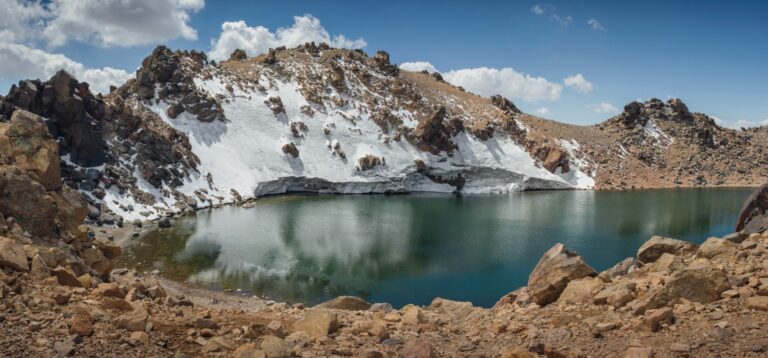
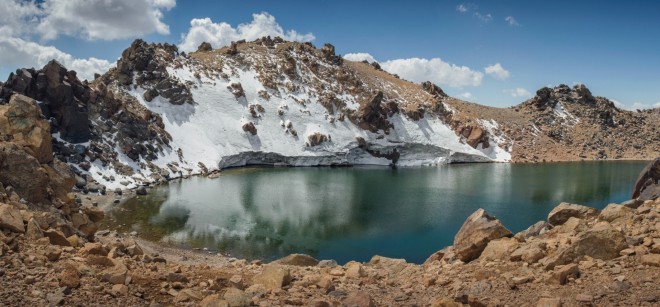
Project Pressure has created the first open source glacier archive, recording the environmental impact of climate change by documenting the world’s changing glaciers. Danish photographer Klaus Thymann launched this not-for-profit in 2008, garnering impressive street-cred with official links to the World Glacier Monitoring Service (WGMS) and the National Aeronautics and Space Administration (NASA).  What’s this got to do with the Middle East?  Some of the most endangered glaciers on the planet are in Iran. 

Egloo heats your room for a dime a day!

10

 Egloo Candle Heater
An Italian design student dreamed up a gizmo that he claims can heat a room for 10 cents a day. I just paid $700 to half-fill an oil tank that, if I’m Scrooge-like with that “on” switch, will heat my 3-bedroom Amman flat for maybe 6 weeks. Could Marco Zagaria’s Egloo heater really work?  As I read the data on his fundraising site, the radio started playing an old Doors tune, Come on baby, light my fire!, and I choked on my tea.
Jordan regal residence fully powered by sun!

2

Jordan Royal Palace energized by the sun
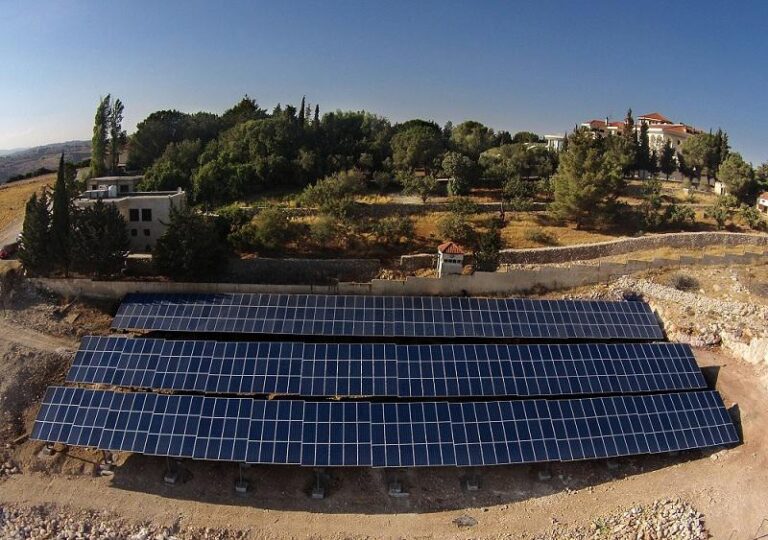
The most powerful family in Jordan is tapping into the most powerful energy source in the Universe to electrify their private residence.  Prince Muhammad bin Talal, brother of Jordan’s King Hussein I, has installed what is the largest, self-use photovoltaic (PV) array in the Middle East.

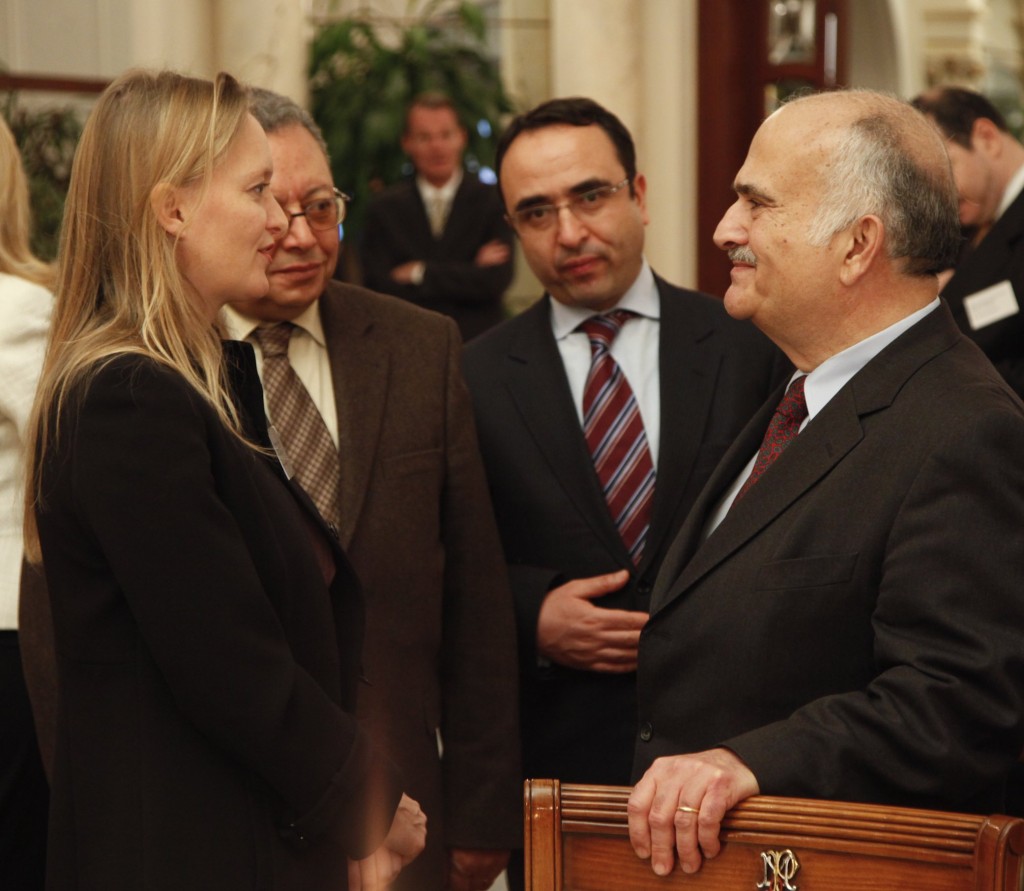
Prince bin Talal is an active pursuer of environmental solutions. Below see him with Green Prophet’s Karin at a Swiss event for water cooperation in the Middle East.

Karin Kloosterman prince bin talal

Covering a sun-facing hillside on his vast Amman estate, this royal installation represents a powerful endorsement of renewable energy.

Powered for a prince!

Jordan’s Al Manal Palace is now powered by over 160 kW solar power!

Global Renewable Energy Systems LLC, a leading PV installation company from Germany, designed a solar system that would give long-term, reliable energy output in Jordan’s desert climate.

A total of 540 poly crystalline modules manufactured by Chinese manufacturer Realforce Power and three German-produced KACO Powador 60.0 TL3 inverters provide 162 kW of installed generating capacity. KACO new energy is one of the world’s largest manufacturers of solar inverters and the first to achieve fully carbon-neutral production.

Zouhair Kefi, Managing Director of KACO new energy Dubai, praised the good example of the Royal Family in a press release, “Precisely in a region where oil wealth did not bring good fortune, the PV array on the Al Manal Palace is serving as an example to show that a prosperous future can be attained just as well with renewable energy.”

bin Talal is a longtime proponent of solar power.  Solar is environmentally suited to Jordan’s location.  It is endlessly renewable, politically stable, and secure in that it lessens dependence on imports. According to World Bank data, Jordan currently imports 98% of its oil and gas, yet renewables contribute less than 1% of Jordan’s energy despite the Kingdom boasting one of the highest annual daily averages of solar irradiance in the world.

In April 1012, Jordan’s Parliament adopted the Renewable Energy and Energy Efficiency Law (REEL) aimed at inciting private-sector investment in the kingdom’s commercial renewable energy sector. Earlier this year, development was approved for the 52.2 MW Shams solar energy plant,  slated to be the largest  solar PV installation in the Middle East.

REEL targets homeowners and small businesses too, but domestic installations have not been strong – in part due to relatively high first investment, and the current dip in heating fuel costs is also a deterrent.

The royal solar system went live in August and it’s a puzzle why no one has called Guinness World Records. Loudly broadcasting the Middle East’s largest personal-use PV array – and its royal champion – with follow-on stories on system performance, cost benefits and rate of return, will surely help spike domestic conversions across Amman.

Graphene nanotechnology makes desalination 100 times more efficient

13

graphene_molecule_sheetEngineers at Lockheed-Martin recently developed and patented a molecular filtration membrane called Perforene which can desalinate seawater using only 1/100th the energy of the best existing desalination systems.

Perforene is made from graphene, the exciting new nanomaterial which comes in the form of one-atom thick sheets of carbon atoms. Like an overzealous nanotechnology, graphene seems to photobomb itself in as the solution to numerous environmental problems such as, storing electricity, removing air pollution, advanced photovoltaics, high strength materials and now desalinating water.

Under a microscope, this material looks like a mesh net with holes as small as one hundred nanometer. These holes are small enough to block the chlorine and sodium ions in salt water but large enough to allow pure water molecules to pass through.

The material was invented by Lockheed engineer. In an interview with Reuters, Stetson said that this new material is 1000 times stronger than steel and 500 times thinner than the best existing reverse osmosis desalination filter.

He said, “The energy that’s required and the pressure that’s required to filter salt is approximately 100 times less.”

Why desalinating water is not energy efficient

Desalination typically uses at least 3 kilowatt-hours per cubic meter. To put this into familiar terms, filling a 2 liter bottle with desalinated water consumes the same amount of energy as running a 15-watt compact fluorescent light for 24 minutes.

The energy required to purify two liters of freshwater would only run the same light for less than two minutes.

This may not seem like a lot of energy, but it adds up.

According to information published by the International Renewable Energy Agency (IRENA), the world’s desalination plants consume approximately 360 million kilowatt-hours each day. Because of their gluttonous energy consumption, desalination plants are nearly always collocated with electrical power generating stations.

Nuclear power is often used. But in a bit of political doublespeak, the desalination plants are said to generate electricity. Electricity “generated” by existing desalination plants is only the excess energy produced by the collocated power plant that hasn’t been consumed.

If unconsumed energy is the same things as producing energy, Lockheed-Martin’s desalination technology might become one of the most important sources of energy and water in the Middle East.  The company is seeking commercialization partners and hopes begin manufacturing this amazing new material in 2015.

Image of graphene molecular sheet via shutterstock

SONY’s underwater Dubai shop: is the concept all wet?

0

Dubai's underwater store
The Middle East and Africa subsidiary of Tokyo-based Sony Corporation officially launched an outrageous shopping experience for its Xperia products this month, with a pop-up store located just offshore from the environmentally dubious World Islands in Dubai – and 4 meters under the sea.  It’s the world’s first underwater store.

2015 will be the year of hummus

2

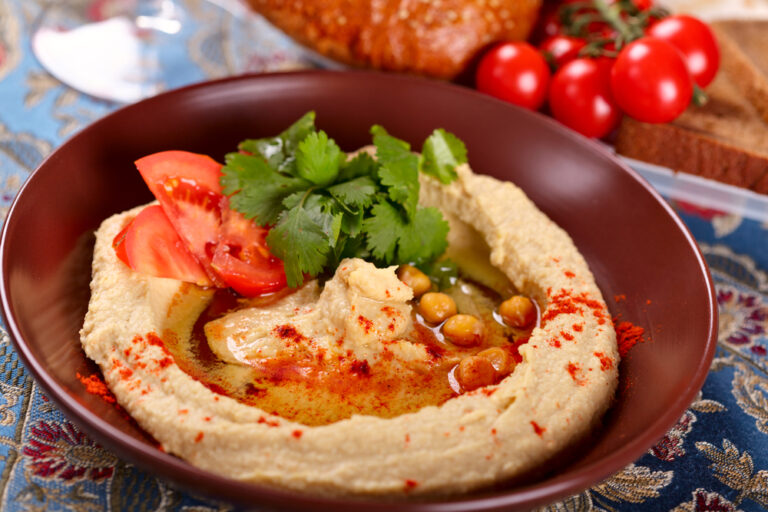
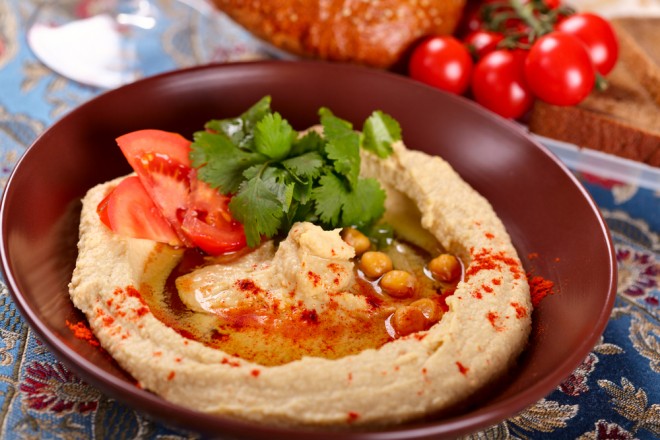
chick pea paste

Hummus, the centuries-old Middle Eastern bean paste, is ready for its close-up. According to a report released by food industry trend-trackers Baum and Whiteman, hummus will emerge as America’s “it” food in 2015.  “Once a niche product here, eaten primarily by Arab and Israeli immigrants,” says the report, hummus is matching the meteoric trajectory of Greek yogurt as the nation’s next food fetish.

Bamboo Warka Water towers pull drinking water out of thin air

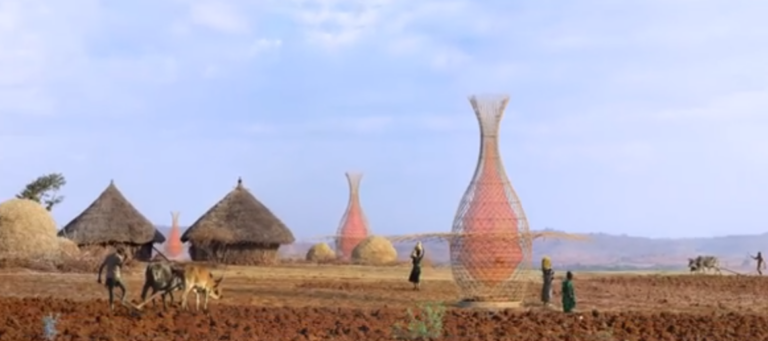
warka-water-thin-air-desert

Italian architect Arturo Vittori and his colleague Andreas Vogler designed a low-tech machine, based on passive design, that can produce between 50 and 100 liters of clean drinking water daily, without electrical equipment and independent of land-based water sources.

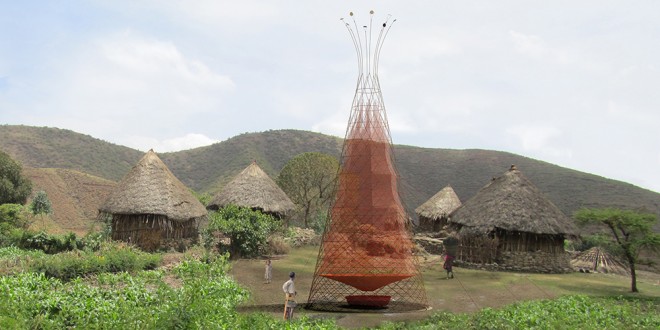
warka water tower

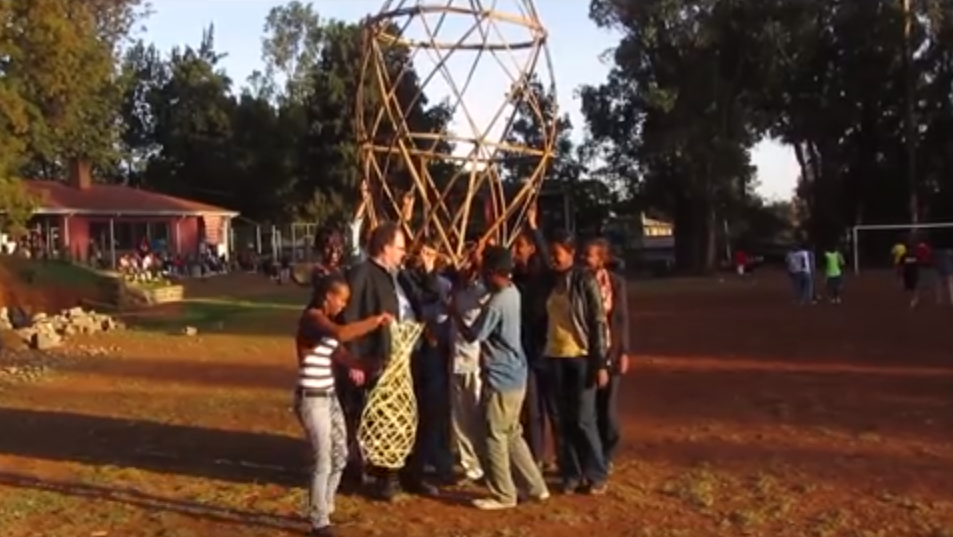
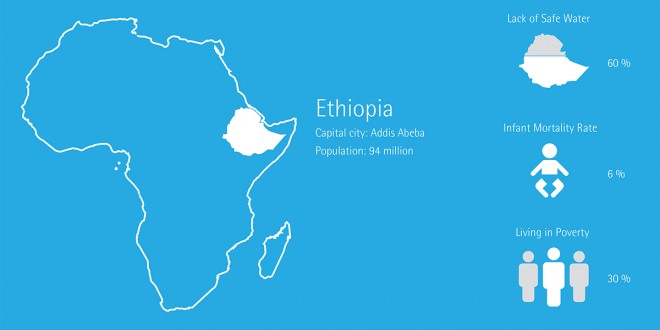
This inexpensive, easily assembled tower was designed specifically for rural communities in Ethiopia that lack access to safe drinking water. Turns out these 30-foot-tall, sculptural towers that pull potable water from the air can be deployed most anywhere, including the deserts of the Middle East.

https://www.youtube.com/watch?time_continue=3&v=rDXWK5GRaiQ

Warka water towers collect rainwater and extract clean water from fog and dew. They are made from biodegradable materials that can be sustainably sourced and locally fabricated as ready-to-assemble kits that cost about $1,000 USD to produce. With minimal training, a team of four to six unskilled villagers can construct one in a day. Assembly is straightforward, using basic tools. Warka-water-How-It-Works

The biomimetric design, based on passive design, is informed by the natural water-collecting properties of Namib beetles, termite hives, and cacti. It incorporates cultural references such as Ethiopian basket weaving, traditional fish trap design, and the Warka tree, an indigenous fig tree whose shade provides a traditional place of village gathering.

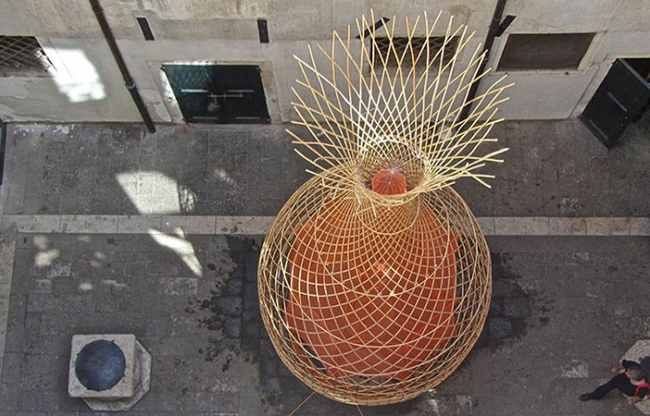
Fog-harvesting devices are not new, but Vittori’s version yields more water at a lower cost than earlier concepts.  One of his first Warka prototypes is pictured above.

warka-water-prototype-africa

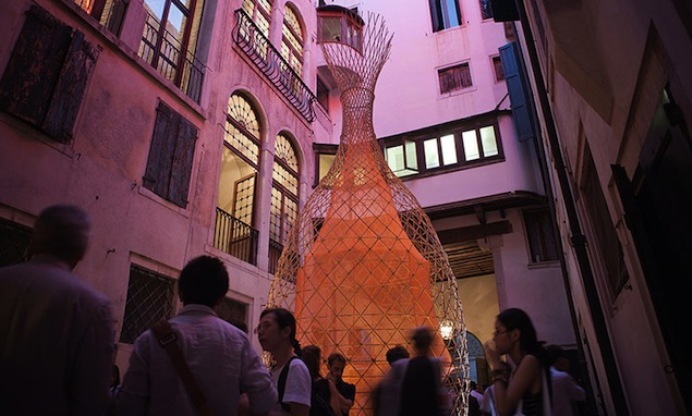
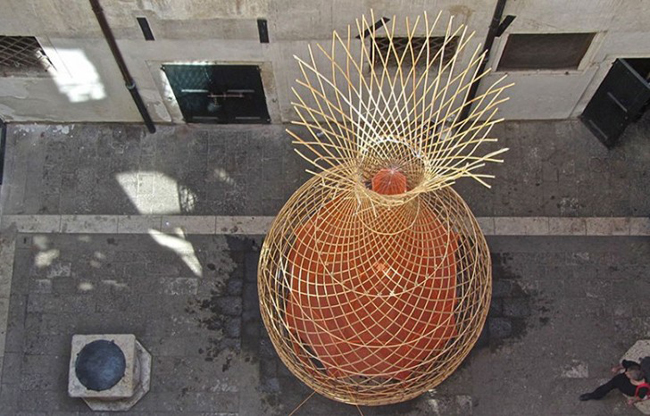
The tower consists of lightweight and flexible bamboo stalks, woven to allow unobstructed airflow and stability in the face of strong wind. It’s “crown” is designed to deter bird perching. A nylon mesh net hangs inside and collects dew drops that form along its surface. As air temperatures drop, the droplets gravitate down into a container at the tower bottom where it passes through a tube to people on the ground.

System maintenance is also simple, requiring regular monitoring and periodic replacement of filters, occasional mesh fabric repairs and periodic tightening of support cables. The development team at Vittori’s architectural firm, Architecture and Vision, estimate that a tower’s shelf-life in this African setting will reach 10 years.

According to Australian water conservancy organization the Water Group, Ethiopians spend 40 billion hours a year trying to find and collect water. Once found, the water is often unsafe, as ponds and lakes are often teeming with infectious bacteria or contaminated with animal waste. But don’t be seduced into thinking this is just an African problem.

Warka Water tower

Water scarcity is one of today’s most urgent world problems. In the past hundred years, our water use has grown at more than twice the rate of population increase.  Earth holds enough freshwater for seven billion people but distribution is uneven and much is wasted, polluted and unsustainably managed.

A United Nations Water Human Development Report published in 2006 stated water scarcity affects every continent.  Consider that around 1.2 billion people (one fifth of the world population) live in areas of water scarcity. Another 1.6 billion people live in countries that lack the necessary infrastructure to take water from rivers and aquifers.

Build new wells, you say? Vittori told Smithsonian, “[In Ethiopia], public infrastructures do not exist and building a well is not easy. To find water, you need to drill in the ground very deep, often as much as 1,600 feet. So it’s technically difficult and expensive. Moreover, pumps need electricity to run as well as access to spare parts for when the pump breaks down.”

Toilets for People founder, Jason Kasshe, wrote in a New York Times editorial, “If the many failed development projects of the past 60 years have taught us anything, it’s that complicated, imported solutions do not work.”

pulling water from the air

Green Prophet has broadcast innovative water-production kit such as Eole’s double-duty turbines that wick water from wind, and South American billboards that siphon water from the atmosphere. Other low-tech water purification inventions like the Life Straw need a traditional water source.

The Warka water towers may lessen the devastating impacts of water scarcity in specific locations, but we need to act now – everyone, everywhere – to smarten up about conservation and peaceful cooperation about this most essential planetary resource. This goes beyond peeing your shower, or dropping a brick in your toilet.

Water is more than a building block of life, it can a be a powerful tool for peace between nations. Mumbai-based think tank Strategic Foresight Group (SFG), asserts that trans-boundary water cooperation directly correlates with regional stability and peace. The inverse also holds true: failure to collaborate when managing shared water resources raises the risk of war.  Efforts like these water-producing towers are a small step in the right direction.

Nine towers have been built so far; a prototype installed in Bomarzo, Italy allows for testing and design changes. The team is working on version 3.1 (see lead image) while searching for investment partners to allow project scale-up.

The first Ethiopian pilot is scheduled for early 2015.

Update May 1, 2019:

The Warka Tower, Ethiopia, has been selected as one of the 20 shortlisted projects for the 2019 Aga Khan Award for Architecture.

Kazan, Russian Federation, 25 April 2019 – The 20 shortlisted projects for the 2019 Aga Khan Award for Architecture were announced in Kazan at an exhibition on the Aga Khan Award for Architecture that was inaugurated by His Excellency Rustam Minnikhanov, President of the Republic of Tatarstan.

Imagine a new kind of sustainable city in the desert?

0

luca-curci-sustainable-desert-city-eco-home

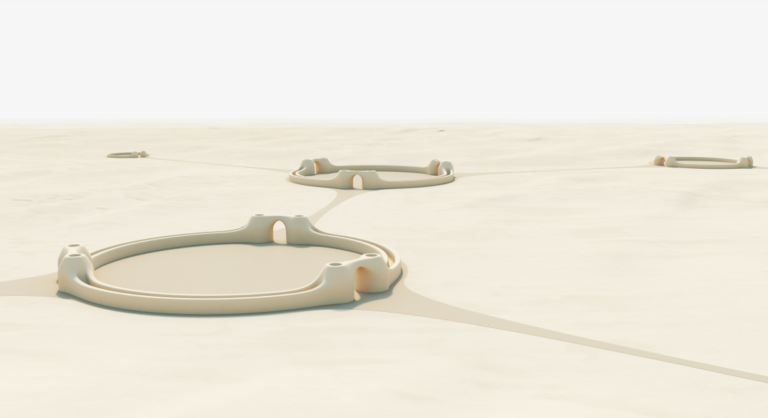
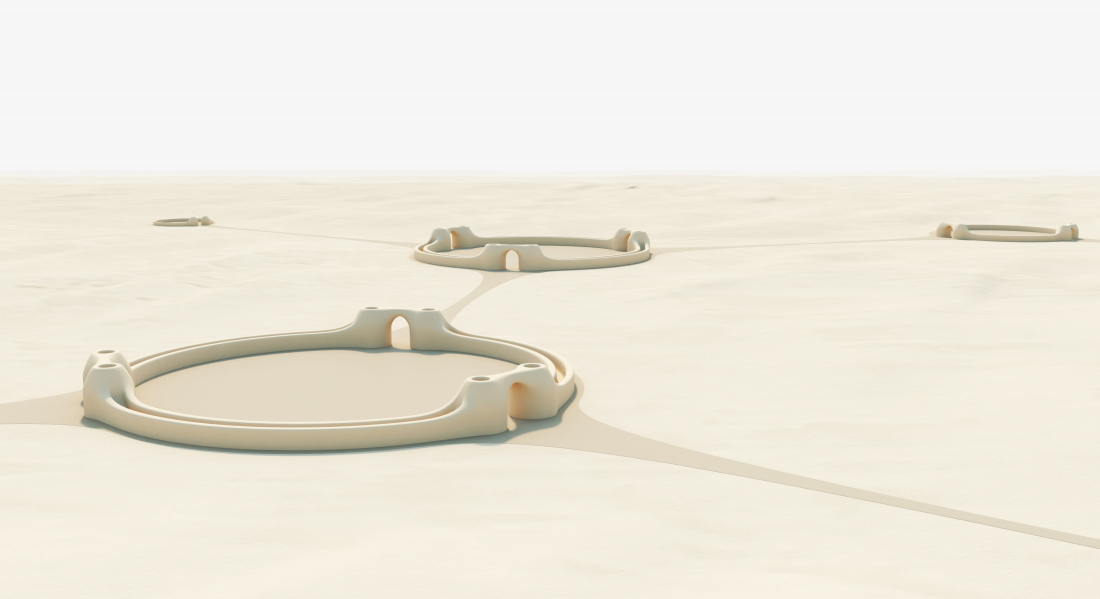
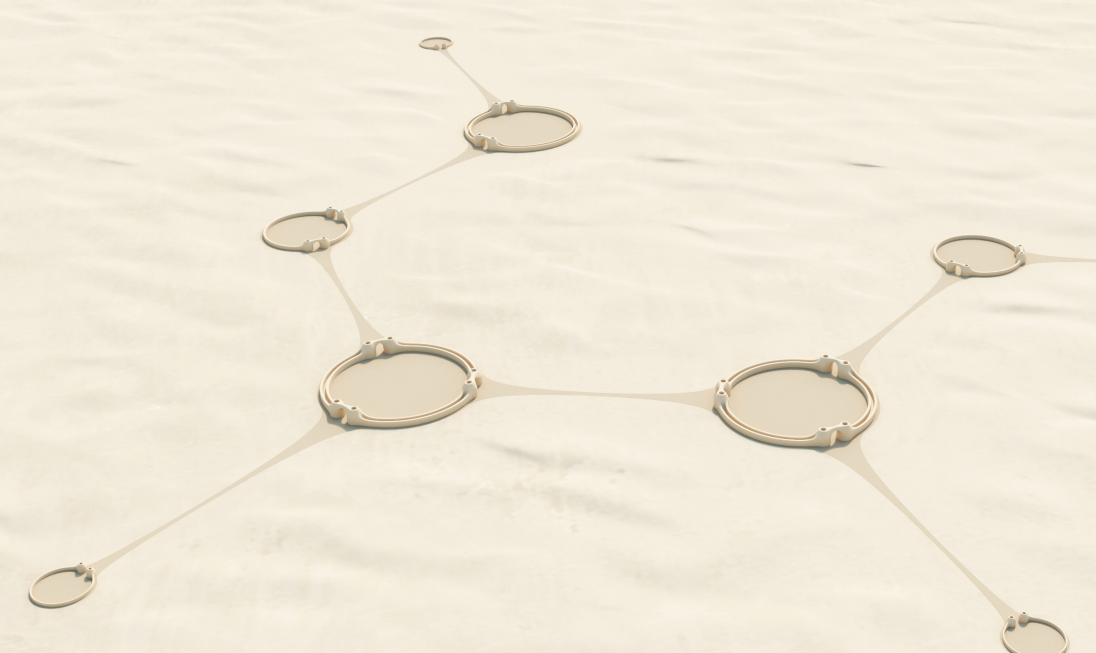
Luca Curci architects studio presents Desert City, a project proposal for a sustainable way to live in the desert. It surely beats the maze of crazy unsustainable cities we see in regions in the United Arab Emirates, save for Masdar the zero energy city outside Abu Dhabi.

eco desert homes

The architects say that their theoretical project was born from the interpretation of borders, conceived not only as a line which divides two places but, at the same time, as a meeting point between private and public space.

luca-curci-sustainable-desert-city

In these artistic sketches the architects from Italy envision a new kind of community, one based on new characteristics and social identities, a socioeconomic model aimed to cooperation and people participation.

In our world changing it’s important to imagine new paradigms when we build communities from scratch in deserts. Luca Curci Architects give us something to chew on and dream about. Pessimists might argue that we will have no choice.

Aora’s solar tulips start shining in Ethiopia, without water!

8

aora-solar-power-spain-560x360

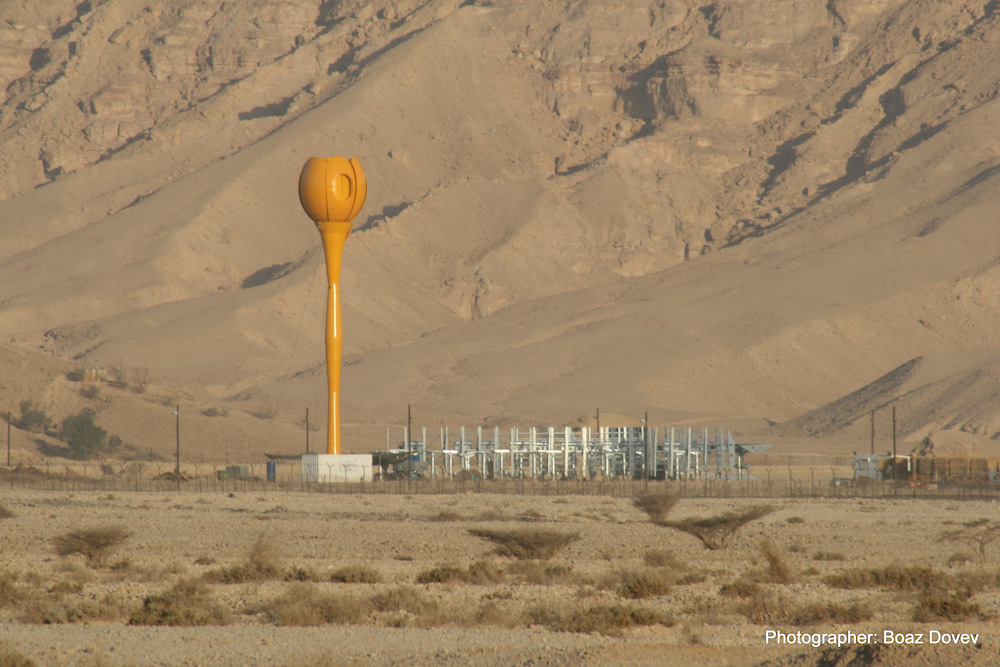
Investments in solar energy innovations are not dead! Remember those weird and wonderful solar energy harvesting tulips planted in Israel and Spain? Seen miles away the sky-high tulips have found a new commercial home – in Ethiopia, the company announced last week in a press statement.

aora-solar-tulips

We’ve covered Aora over the years and thought possibly that this CSP, or concentrated solar thermal power innovation didn’t grow. We were wrong.

The Ethiopian Government, looking for resilient off-grid systems, is now piloting Aora’s system for sustainable development.

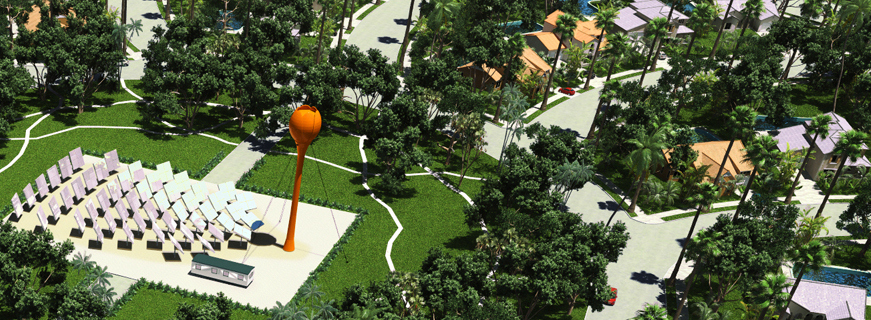
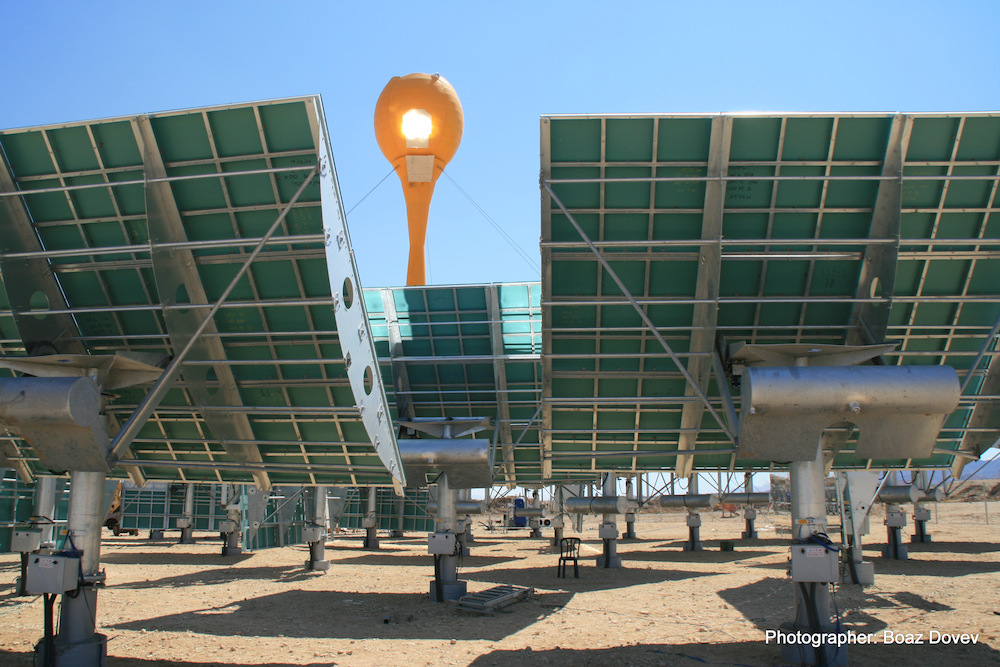
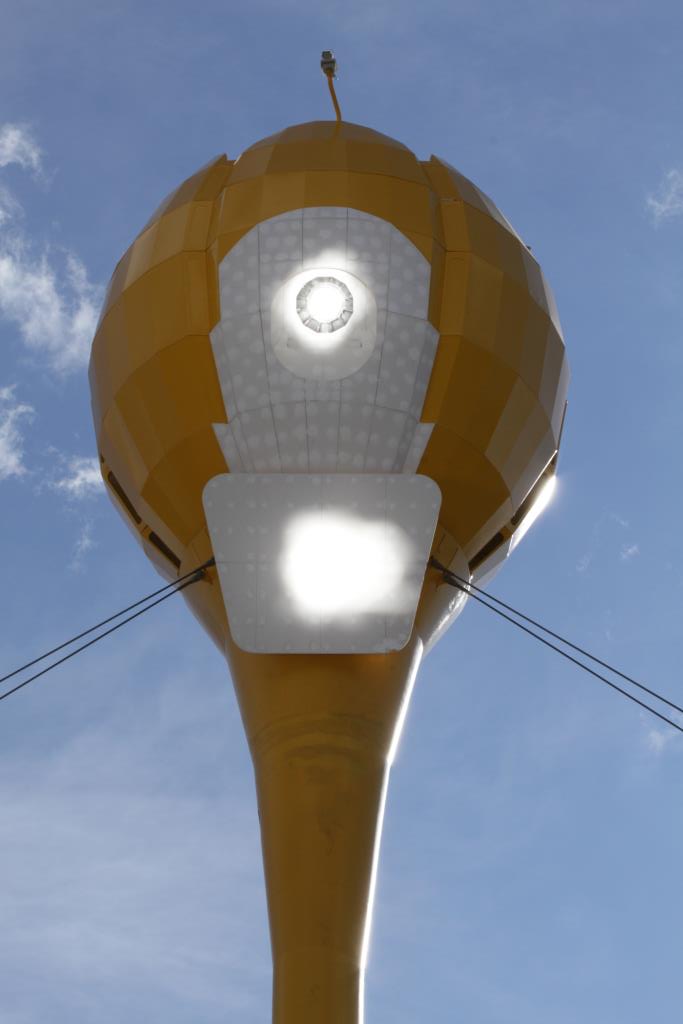
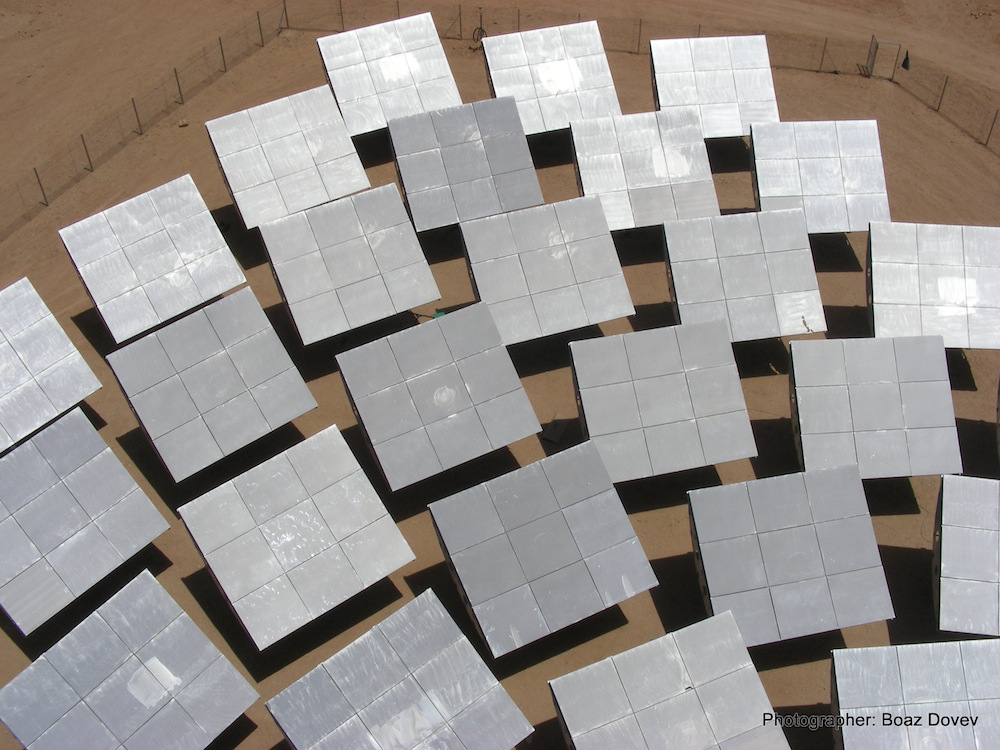
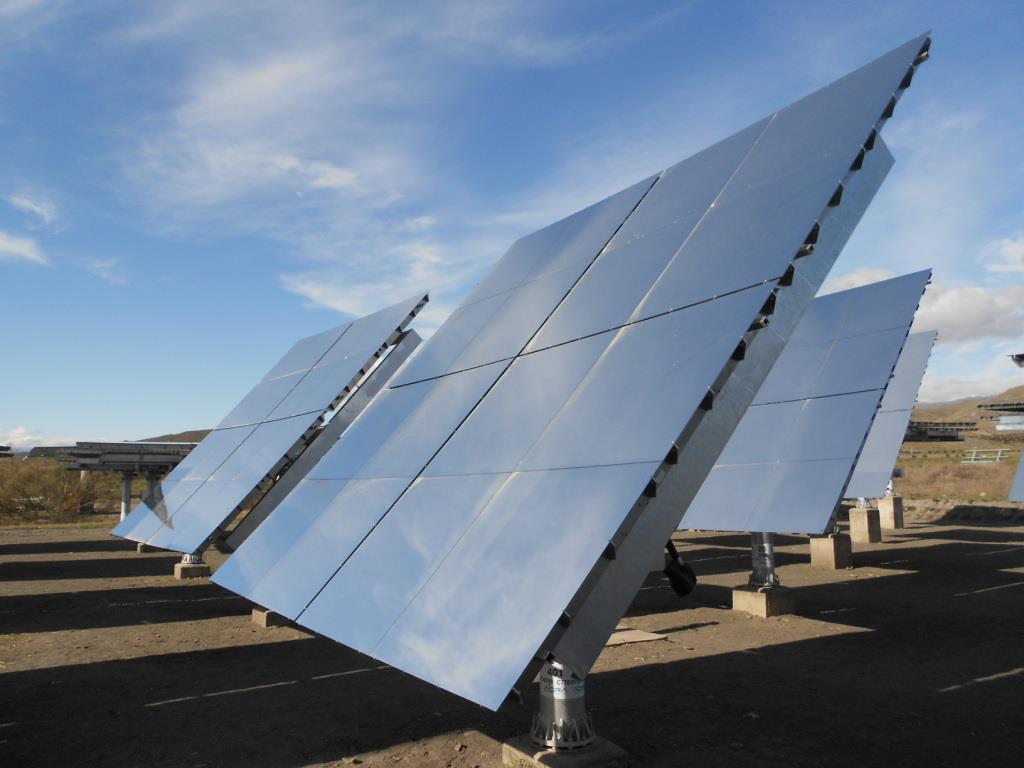
Aora’s tulips collect solar energy from 50 small mirrors and then focus the energy to heat oil and air, creating pressure to drive turbines in the tulips. The turbines create electricity. The solution runs without steam and water, important for off grid locations where there is no water.

We all may know that Ethiopia has grand ambitions to grow its economy fast and is creating the Renaissance Dam to hold back water from Egypt’s Nile to create hydro power. But even when this goes online, getting the power to the people through the grid can take 20 years or more.

This is where Aora’s solution may help:

Rural communities and villages in Ethiopia, and all over Africa for that matter, have not been able to develop themselves due to inefficient access to electricity. This affects the daily lives of people, from needing power to run schools, hospitals, and industry, to providing refrigeration for food processing and post-harvest storage.

Aora’s solar tulips collecting solar power in Samar, Israel

aora-heliostats-israel-solar-energy samar-israel-aora-solar-energy aora-heliostats-israel

We see solar power solutions for Africa out there already like Nova Lumos which has a novel business model to provide solar power for phones and limited residential use (individual units). Where people are poor and not able to invest in the one time fee, Nova Lumos lets people pay in increments – for the energy and system through the phone. Read here about how Nova Lumos from Israel puts power pimps out of business in Africa.

Aora however operates on the community or village level, giving electricity even during cloud cover or rainy days where the unit switches seamlessly to biofuels.

Unlike huge CSP systems (think Brightsource – also from Israel) Aora needs less than acre, or  3,500 square meters per module. Each module can provide 100kWh of solar electricity as well as 170kW of thermal power. The system’s heliostats follow the sun.

Built to be off grid the Aora system doesn’t require intensive investment to hook it up to the energy grid, nor does it require expensive energy storage operations since it can be hybrid and run on alternative power when the sun doesn’t shine.

The Aora systems are modular and farms of Aora tulips can be connected to generate larger amounts of power, together.

How Aora solar energy works in residential areas. So pretty!

[youtube]https://www.youtube.com/watch?v=e9qO33wGgVM[/youtube]

Their press associate told Green Prophet that the site in “Almeria, Spain, as well as the site in Israel and the site being built at Arizona State University are sites built for testing and research.
aora-solar-tulip
“The news announced [last week] about AORA‘s newest site in Ethiopia is different,” she tells us. “This is the first commercial pilot of AORA‘s system from a paying customer. It is the first phase of what should be a much bigger deal.

“Upon a successful pilot of this site, the Ethiopian government plans to expand deployment of AORA’s system to other off-grid communities in rural areas of the country. Each module produces 100kW of solar electricity and 170 wW of thermal power that can be harnessed for many applications including heating and cooling/refrigeration.

Construction of the first pilot plant is expected to begin by mid-2015.
Hoping to learn from mistakes made by the west, the Aora solar energy project is tied to Ethiopia’s Climate-Resilient Green Economy Strategy, in which the country aims to enhance access to affordable and environmentally friendly renewable energy.
The goal is to provide adequate uninterruptible and grid independent power to support the achievement of middle-income status by 2025 while developing a green economy.
“We are transforming our Green Economy Strategy into action and are pleased to partner with AORA to help achieve our vision,” said H.E. Mr. Alemayehu Tegenu, Minister of Water, Irrigation and Energy for Ethiopia. “AORA’s unique solar-hybrid technology is impressive and well-suited to provide both energy and heat to support local economic development in off-grid rural locations in Ethiopia.”

Aora collecting solar power in Almeria, Spain

almeria-aora-spain-solar-energy aora-almeria-spain-solar