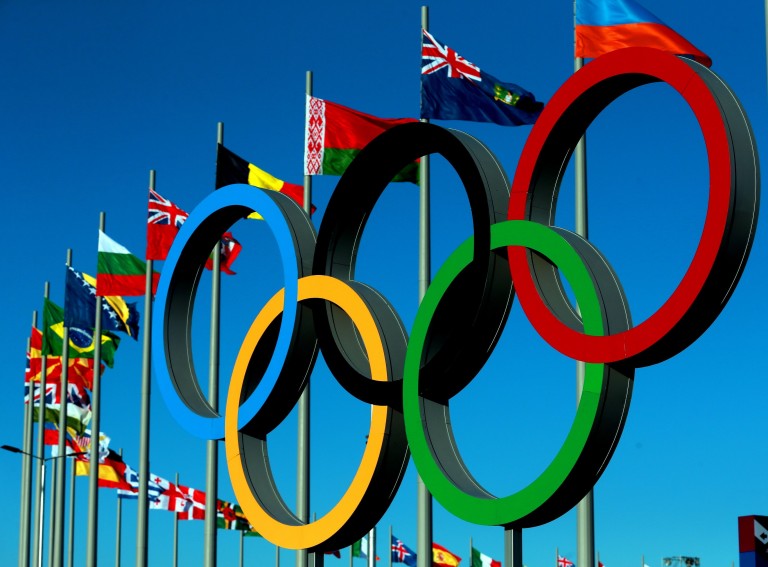
The International Olympic Committee (IOC) announced yesterday the formation of a new, nation-less team of athletes cleared to compete in the 2016 Olympic Games in Rio de Janiero, Brazil this summer. According to a statement released on the IOC website, the all-refugee team will be treated the same as the other teams representing the 206 National Olympic Committees (NOCs). They will be called Team Refugee Olympic Athletes.
“By welcoming the team of Refugee Olympic Athletes to the Olympic Games Rio 2016, we want to send a message of hope for all refugees in our world,” said IOC President Thomas Bach. “Having no national team to belong to, having no flag to march behind, having no national anthem to be played, these refugee athletes will be welcomed to the Olympic Games with the Olympic flag and with the Olympic Anthem. They will have a home together with all the other 11,000 athletes from 206 National Olympic Committees in the Olympic Village.”
The IOC has long provided aid to elite athletes affected by the worldwide refugee crisis, this year asking participating NOCs to identify refugee athletes with potential to qualify for the 2016 Rio Olympic Games. Forty-three candidates were identified. The call for additional athletes has closed, and the IOC Executive Board (EB) said that only under exceptional circumstances and with IOC President approval will new candidates be considered.
The EB also approved all operational aspects surrounding “Team ROA” which includes provision of housing in the athlete’s village alongside all other teams, with a dedicated entourage of Chef de Mission, coaches and technical officials (as per official quotas) to tend team needs.
All expenses will be picked up by Olympic Solidarity, the IOC branch that manages the Olympic Games broadcast rights, redistributing earnings through program offered to all recognized NOCs.
The athletes will be provided with specially designed team uniforms, training and equipment, and all necessary insurances. They will participate in their own Olympic Village welcome ceremony at the Olympic Village, like all other teams; but for each official representation such as medal ceremonies, the Olympic flag will be raised and the Olympic Anthem will be played. The refugee athletes will receive continued support after the event concludes, although details of what that encompasses have not been released.
The ROA team for Rio 2016 is expected to number up to 10 athletes who will be named, along with the sport thy represent, by the IOC EB in June. At the Opening Ceremony, this special team will march behind the Olympic flag before host team Brazil. Let the games begin.
Photo credit: David Davies/PA Wire




 Morocco has activated the Noor I concentrated solar power (CSP) plant, the first part of a three-phase
  The World Bank predicts that the plant will bring down the industry-wide CSP costs, but the future of the technology is uncertain given rapid price decline in solar photovoltaics (PV). The plant’s cost is around US$6 per watt, whereas utility-scale solar PV projects are coming in below US$2 per watt. The recent bankruptcy of the largest global CSP developer, Spain’s Abengoa, has further undermined interest in future CSP investments. That said, the technology is well-suited for harnessing the desert’s solar energy.
 Unlike PV systems, CSP output doesn’t dip when skies are momentarily overcast, and they do not need battery back-up to store energy for nighttime use. The technology works like this: concentrated sunlight hits the mirrors, which heat fluids in a system-wide pipeline, which create steam that, in turn, drives turbines which produce electricity. The Ouarzazate system uses 39-foot-tall parabolic mirrors to focus energy on that pipeline causing fluids to reach temperatures of 739 degrees Fahrenheit. Surplus heat can be stored in a tank of molten salts for use during nighttime or on overcast days; Noor 1 is designed to keep three hours worth of such storage, which presently is a lower cost alternative to battery storage.
 Sit four people around the dinner table, and at see that least three are tethered to their