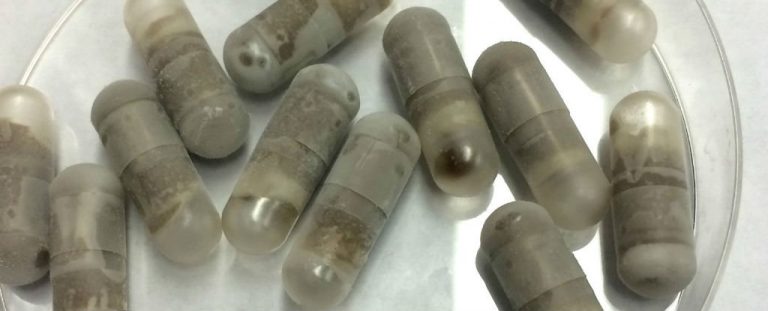

The presence of poop and poop products in our daily lives has been receiving increasing attention for some time. News stories include the discoveries of meat products fed with faeces and pumped with toxic contaminates. From a product standpoint, creating recycled paper products from poop have also been covered. But swallowing a pill full of poop to maintain good gut health? Has this idea gone too far?
The use of microbiome therapy, literally transferring healthy human gut microbes from one person to another, is very beneficial to maintain a healthy balance of bacteria in human intestines.
This therapy, now being capitalized on by a company named Seres Therapeutics, literally involves taking human faeces from recognized “stool banks” and then cleaning and processing it into capsules of “poop pills” to be used to maintain the correct bacterial balance in human intestines. Human intestinal “bug balance” often decreases with age, or following over usage of antibiotics. (Update May, 2023: the Seres poop product gets FDA approval).

People having a severe bacteria imbalance in their intestines can be afflicted with severe intestinal ailments such as Clostridium difficile, a severe gut infection that can strike people after extensive use of antibiotics, which wipes out their existing gut bacterial levels.
Although medications such as probiotics are often recommended in these cases, the poop pills being developed by Seres seem to be more directly connected to the source of the problems.
Scientifically, the process of transferring faecal bacteria from one person to another is known as a faecal microbiota transplant. The ability to do this by simply swallowing a pill or capsule is awesome. Seres’s main competitor is an actual stool bank called OpenBiome.org that provides stool samples of “pure poop” to medical practitioners for microbiota transplants. This idea does not sound good to most people, however.
This is why a pill from a company like Seres may be a better alternative for people suffering from gut-related conditions like Clostridium difficile.
There has been supportive accounts of research in this area:
An Alberta-led clinical trial has shown Fecal Microbiota Transplant (FMT) is effective in treating clostridium difficile (C. difficile) infections whether delivered by colonoscopy or by swallowing capsules.
The finding, published in the Journal of the American Medical Association, could revolutionize and broaden the use of FMT, which restores the healthy balance of bacteria living in the intestine by transferring a healthy donor’s stool to the gut of a person with C. difficile.
Dr. Thomas Louie, clinical professor at the Cumming School of Medicine and the Calgary FMT study co-lead and senior author, pioneered the development of the FMT pill in 2013. “Recurrent C. difficile infection is such a miserable experience and patients are so distraught that many ask for fecal transplantation because they’ve heard of its success,” says Louie. “Many people might find the idea of fecal transplantation off-putting, but those with recurrent infection are thankful to have a treatment that works.”
The study results are a landmark in this field.
Capsules can replace risky colonoscopies
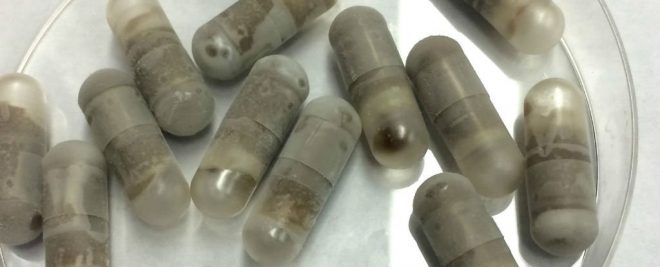
“This will transform the way people think about how we deliver Fecal Microbiota Transplant,” says Dr. Dina Kao, an associate professor with the University of Alberta’s Faculty of Medicine and Dentistry and lead author of the study. “Capsules have numerous advantages over colonoscopy. They are non-invasive, they’re less expensive, they don’t have any of the risks associated with sedation and they can be administered in a doctor’s office.”
Capsules containing frozen donor bacteria taken orally were shown to be 96-per-cent effective in treating C. difficile, the same success rate as those receiving transplant by colonoscopy.
The pills have no scent or taste. They are made by processing feces until it contains only bacteria, then encapsulating the bacteria concentrate inside three layers of gelatin capsule. “The pills are a one-shot deal, not a continuing treatment,” says Louie. “They are easier for patients and are well tolerated.”n
Humans are host to hundreds of different species of gut bacteria, which together help the digestive and immune systems to function properly. However, when a harmful infection requires treatment with antibiotics, those same antibiotics can disrupt the healthy balance of the gut bacteria, allowing opportunistic microorganisms such as C. difficile to cause illness.
People with C. difficile infections suffer from diarrhea, cramping and other gastrointestinal difficulties. In advanced cases, it may be necessary to remove the large intestine. Although rare, C. difficile can be extremely debilitating and resistant to treatment by antibiotics. In some cases, it can be fatal. In Alberta, there are about 200 C. difficile cases every year, of which between 20 and 40 are fatal.
A personal testimonial ingesting 40 poop capsules in one hour
Karen Shandro of Ardrossan, near Edmonton, came down with what was thought to be a routine sinus infection early in 2015. After a course of antibiotics, a tenacious C. difficile infection set in and knocked her off her feet. Further courses of antibiotics did little to help.
“I felt awful. My health deteriorated. I had unbearable diarrhea, no appetite, chills and fever, and I couldn’t keep any food in me,” says Shandro, whose condition became so grave her husband phoned an ambulance and she was taken to the emergency department at the Fort Saskatchewan Community Hospital.
Shortly after, Shandro learned about the study on FMT and agreed to be enrolled in the trial. She was selected at random to receive the transplant via capsules.
Shandro says although there was no unpleasant taste or aftertaste to the pills, the sheer number she had to take was a bit of a challenge. Each participant had to take 40 capsules within an hour. “Afterwards I went home and slept for four hours, then woke up starving, which was something new to me at that point,” she recalls. Her health continued to improve and within two days, she felt upbeat and like her normal self.
Today, she considers her C. difficile infection conquered.
Read more about poop-related issues:
Israeli meat fed with faeces and pumped with toxic contaminates
What recycled paper products from poo look like
Iron rich whale poop essential in Middle East habitats

 The 2016 Rio Olympics are history, but a hindsight review shows a surprising sideshow of contemporary human issues running through the international athletic games. We’re not talking about substandard construction in the Olympic Village, contaminated water, or violent crime.
 Female body image – USA’s Michelle Carter won gold in women’s shot put with her final throw, but was
  Climate Change – Kiribati weight lifter
  Refugees – Ten refugee athletes, seen above, stood as a symbol of hope for displaced people worldwide when they participated in the summer Games as the
  Organ donation – German Olympic canoe slalom coach Stefan Henze died as a result of a taxi accident during the Games, but because he was an organ donor, his choice saved the lives of four people. The 35-year-old former world champion had been travelling from the canoe slalom venue when the accident happened, and he later died in hospital due to serious head injuries. His family, who travelled to Rio after the accident, had given their consent to the
  Gender fluidity – A new hot-button issue in athletics is hyperandrogenism. It’s a little known condition that was flagged by medical tests that look for banned drugs. In these cases, rather than evidence of doping, the tests detect “abnormally high” testosterone levels in women. Hyperandrogenism is a medical condition that causes a person to produce high levels of hormones and can be caused by differences in sexual development. It is a complex and excruciatingly sensitive issue, as it invades privacy and calls into questions basic questions of identity.



 Let’s get meta. A “force of nature” is defined as a natural phenomenon that is beyond human control. When three Academy Award®-winning celebrities come together on a film, their combined energies could colloquially be called “a force of nature”. Now imagine that their film is about…the forces of nature. This week an astonishing film premiered – for free! – on the National Geographic Channel – brought to the screen by filmakers Fisher Stevens and Martin Scorsese and featuring actor and environmental activist Leonardo DiCaprio. But the real star of Before the Flood is
 I just met a pair of young Swedes, newcomers to Amman who were quickly appalled by the piles of plastics lining our city streets. They stitched up simple bags from mesh netting that they take to local markets, insisting on using their lightweight, reusable alternative in place of plastic produce sacks. Until the rest of the world wakes up and follows the
 In two weeks, a team of international athletes will attempt a world first by swimming across the









 Green Prophet was bowled over by the