
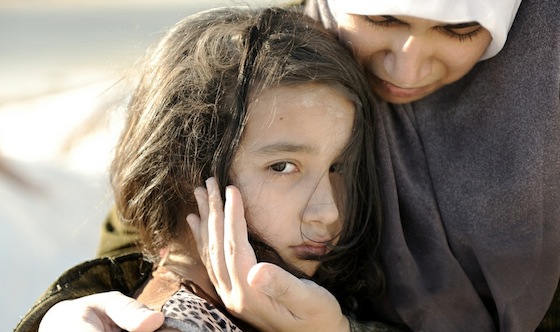
Refugees to Jordan Flow More Freely Than Water

arab refugees water jordanJordan’s hosting of forced migrants is overburdening already stressed water resources.

Humanitarianism has an unanticipated knock-on to fresh water supplies, as Jordan is starting to realize. Syrian refugees harbored in kingdom are draining the desert nation’s scarce water resources, reports Lebanon’s Daily Star. This presents a new setback for Jordan, one of the world’s most water-poor countries, where regional water shortfalls have been making alarming headlines.

Jordan’s average water consumption approximates 900 million cubic meters annually, with more than half consumed by agriculture. Annual per capita share is expected to fall to less than 500 cubic meters within three years: less than a tenth of the average world citizen’s share.  Annual per capita share below 500 m3 threatens human life.

This tiny kingdom has historically provided safe haven to refugees from neighboring Arab conflicts. Palestinians and Iraqis have emigrated for decades; more recently, Egyptians and Libyans sought entry.  It’s estimated that Syrian violence has resulted in over 120,000 new refugees, and inflow is steady.

“The majority of Syrian refugees are concentrated in the northern cities of Mafraq, Irbid, Ramtha, Jerash and Ajlun. All of these areas already suffer from water shortage,” said Fayez Bataineh, secretary general of the Water Authority.

“Each Syrian refugee needs at least 80 liters of water a day. The cost of this subsidized water supply is $18,000 a day, not to mention other related expenses,” said Adnan Zubi, assistant secretary general of the Ministry of Water and Irrigation. “The Syrians came from water-rich areas to almost parched parts in Jordan,” said Abdelrahman Sultan of the Jordanian-Israeli-Palestinian non-governmental group Friends of the Earth Middle East. “They consume water here the same way they used to consume water in their country.”

Cost is an issue, but supply is the more critical challenge.

“When my family fled to Ramtha from Homs several months ago, we could not find enough drinking water,” said Abu Eid, fther of six. “Sometimes, I avoided eating in order not to go to the toilet later because there was no water to wash.” Maher, a refugee now living in Ramtha, buys water every day. “We have water shortages all the time. I shower once every 10 days,” he added.

“This reliance on local services brings increasing pressure on the already vulnerable host populations of Jordan, as it is coupled with major water scarcity in the region, rising temperatures and a resulting negative impact on food production,” Aoife McDonnell of the U.N. refugee agency UNHCR Jordan said. UNHCR has been lobbying for international support of this looming crisis.

Jordan’s Ministry of Environment expects water demand to increase as refugees continue to pour in.  The country has been tackling chronic water shortage on several fronts.   A Red-Dead canal from the Red Sea to the Dead Sea vacillates between go and no-go. Expanded capacity in desalination is linked to the nation’s controversial nuclear development plans.  The ancient Disi ancient aquifer is being tapped into, as part of a water supply project exceeding $1 billion, despite concerns about high levels of radiation found in water samples. Grassroots public awareness campaigns aim increased conservation.

Jordan follows an open door policy, granting safe haven to Syrians who enter legally or illegally. More than 13,000 Syrians have been killed since the uprising against President Bashar Assad’s regime erupted in March 2011. “We did not wonder whether we would get enough water or not in Jordan. We just ran for our lives,” said Abu Eid.

Image of Arab refugees from Shutterstock

Hot this week

How Renewable Energy is Revolutionizing the Way We Power Our World

Solar has become the star of the transition thanks to modular hardware and straightforward installation. It fits dense cities and remote towns alike. Many companies are turning to rooftop arrays and carport systems - and exploring commercial solar installation as a practical way to lock in future savings.

How does one start prepping?

Faced with an extreme winter storm this year, Americans wonder how to be prepared for catastrophe. Miriam has lived through wars in the Middle East - so she's prepared on giving you a guide to prepping.

Fishermen sue tire manufacturers on behalf of the salmon

A federal trial in San Francisco has brought US tire manufacturers, fishing groups, and environmental scientists into court over a chemical most drivers have never heard of — but which scientists say may be silently reshaping aquatic ecosystems.

Listening to Water: Tarek Atoui’s Next Work for Tate Modern

Born in Beirut, Lebanon in 1980 and now living in Paris, Atoui has spent years building instruments that don’t sit comfortably in concert halls. Many of them involve water, glass, and ceramics — materials that react to sound instead of simply producing it.

Leading Through a Dual-Energy Transition: Balancing Decarbonisation with Energy Security

Experience in one area of the energy industry isn't enough to guarantee readiness across all the others. That's where a structured program like an MBA in energy can come in. Today's advanced curricula explore energy economics, finance, policy, and strategic management alongside the technical subjects. And when pursuing an energy MBA online, professionals can skill up and retrain without having to step out of the labor market -- an important perk at a time when skilled professionals are already in short supply.

Topics

How Renewable Energy is Revolutionizing the Way We Power Our World

Solar has become the star of the transition thanks to modular hardware and straightforward installation. It fits dense cities and remote towns alike. Many companies are turning to rooftop arrays and carport systems - and exploring commercial solar installation as a practical way to lock in future savings.

How does one start prepping?

Faced with an extreme winter storm this year, Americans wonder how to be prepared for catastrophe. Miriam has lived through wars in the Middle East - so she's prepared on giving you a guide to prepping.

Fishermen sue tire manufacturers on behalf of the salmon

A federal trial in San Francisco has brought US tire manufacturers, fishing groups, and environmental scientists into court over a chemical most drivers have never heard of — but which scientists say may be silently reshaping aquatic ecosystems.

Listening to Water: Tarek Atoui’s Next Work for Tate Modern

Born in Beirut, Lebanon in 1980 and now living in Paris, Atoui has spent years building instruments that don’t sit comfortably in concert halls. Many of them involve water, glass, and ceramics — materials that react to sound instead of simply producing it.

Leading Through a Dual-Energy Transition: Balancing Decarbonisation with Energy Security

Experience in one area of the energy industry isn't enough to guarantee readiness across all the others. That's where a structured program like an MBA in energy can come in. Today's advanced curricula explore energy economics, finance, policy, and strategic management alongside the technical subjects. And when pursuing an energy MBA online, professionals can skill up and retrain without having to step out of the labor market -- an important perk at a time when skilled professionals are already in short supply.

From Green Energy to Healthy Societies: Why old systems thinking is becoming relevant again

Across the Middle East and North Africa, large investments are being made in green hydrogen, renewable energy, water infrastructure and sustainability. Most of these efforts are discussed in the context of climate change, decarbonization and economic diversification. That framing is important, but it may not capture their full value.

We saw peace – an interreligious encounter deep in our eyes

They came from Israel, Palestine, Jordan, Iraq, Yemen, Morocco, Tunisia, Lebanon, Egypt… There are Sunni Muslims, Shiite Muslims, Jews (Orthodox and Reform), Orthodox Christians, Coptic Christians, Protestant Christians, Druze, Baha'is, a Scientologist.

Can biochar reduce ‘Forever Chemicals’ in food if it’s used in farms?

Biochar is produced by heating organic material in a low-oxygen environment so it does not burn. This process, known as pyrolysis, transforms plant matter into a stable, carbon-rich material.

Related Articles

Popular Categories