Biodiesel Money Machine Collects Old Cooking Oil In Turkey

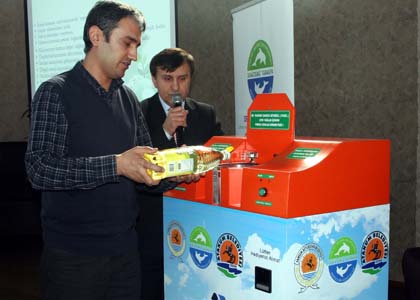
BAYTOM cooking oil biodiesel“Bring waste oil, take away money” reads this advertisement for BAYTOM, a machine that incentivizes Turks to recycle cooking oil into biodiesel.

In Turkish cities with BAYTOMs (Waste Vegetable Oil Collection Machines), residents can bring their used cooking oil outside and pour it into a machine that will measure its fat content and dispense a small gift: money, bus tokens, or coupons, for example. Licensed waste management companies come regularly to collect the oil and transport it to a plant where it can be recycled into biodiesel fuel.

A country-wide campaign to boost recycling

baytom biodiesel turkey
Turkish Marine Protection Association General Director M.A. Özkural demonstrates how to use a BAYTOM.

BAYTOMs, which were designed by a high school chemistry teacher in the Turkish province of Çorum, are hitting the streets of Turkey as municipalities install them in an effort to improve waste oil disposal in the country.

A joint project between Turkey’s Environment and Urbanism Ministry, the Turkish Marine Protection Association, and the country’s Vegetable Oil Manufacturers’ Association, BAYTOMs are being distributed all over the country after a pilot project in Çorum.

Some cities in France and England will also use the machines, reports Turkish daily Today’s Zaman.

BAYTOMs can distinguish between waste oil and other substances, and separate them into different compartments. The machines only dispense gifts equal in worth to the amount of recyclable oil poured into them, encouraging users to carefully conserve their waste oil and recycle it frequently.

Producing fuel, protecting Turkey’s marine ecosystems

Of the 350,000 tons of waste vegetable oil that Turkey produces each year, just 10 percent is collected for recycling. When it comes to biodiesel production capacity, however, Turkey has the second highest in the world, after Germany.

Most of it currently uses agricultural feedstock, but biodiesel production from waste oil is more environmentally friendly, according to Turkish Marine Protection Association General Director M.A. Özkural. When using waste oil, moreover, 65 to 80 percent of the liquid can be turned into biodiesel, which results in 50 percent less CO2 emissions than regular petroleum.

In the meantime, keeping waste oil from being dumped down the drain has a range of other benefits. Oils congeal on the insides of sewer pipes, causing blockages and reducing pipe flow capacity, which leads to extra municipal infrastructure expenses.

When it reaches open water, oil spreads thinly over the surface and prevents oxygenation, suffocating many types of marine life. The situation allows some creatures, like jellyfish, to flourish and undergo population booms that make it even more difficult for marine ecosystems to stay diverse. Just one liter of waste oil is enough to pollute 1 million liters of water.  Domestic waste is responsible for 25 percent of water pollution in Turkey.

:: Today’s Zaman

Read more about recycling efforts in Turkey:
The Garbage Women Of Turkey Turn Trash Into Trendsetting Handbags
Turkish Government Gets Ready to Deal With Electronic Waste
Turkish Man Fights For His Rights- As A Garbage Collector

Images via Balikesir Ekspres and Ekip Gazetesi 


Julia Harte
Julia Hartehttp://www.greenprophet.com
Julia spent her childhood summers in a remote research station in the Rocky Mountains of Colorado, helping her father with a 25-year-old experiment in which he simulated global warming over a patch of alpine meadow. When not measuring plant species diversity or carbon flux in the soil, she could be found scampering around the forests and finding snowbanks to slide down. Now she is a freelance journalist living in Istanbul, where her passion for the environment intersects with her interest in Turkish politics and grassroots culture. She also writes about Turkish climate and energy policy for Solve Climate News.
3 COMMENTS
  1. [email protected] We are distributors of modular, scalable multi-feedstock custom biodiesel turnkey Plants. Our Plants are made in the U.S. with the most innovative technology. We are presently focused in entering the European and Middle East markets. For more information contact us at the above email.

  2. The collection of fryer oil and other sources of FOG (Fats Oils and Grease) has really taken the world by storm. Used Cooking Oil has So many possibilities as a fuel source. I am certain Turkey will be much better off for embracing an environmentally sustainable fuel source.
    Kudos!

  3. Dear Sir or Madam:

    I am Nicole from QINGDAO SENHAO CHEMICALS CO., LIMITED

    We supply used cooking oil, and will offer you the right products with high quality and favorable price.

    We will be happy to give you a quotation upon receipt of your detailed requirements.

    We look forward to receiving your reply soon.

    Sincerely,

    Nicole

    My email: [email protected]

LEAVE A REPLY

Please enter your comment!
Please enter your name here

TRENDING

Sink holes from over-watering farmers’ fields

Sinkholes are rapidly appearing in Turkey’s central Anatolian farming region, particularly around Konya and Karapınar. These giant gaping holes in the ground in areas of farmland, known locally as obruk, are not random geological events. They are linked to prolonged drought, climate-driven heat stress, and heavy groundwater extraction for agriculture in one of the country’s most important breadbaskets.

Urban miner Sortera raises $45 million USD to pull aluminum from the scrap pile

Sortera Technologies, founded in 2020 by Nalin Kumar and Manuel Garcia, is emerging as a major U.S. circular-industry player. Led by CEO Michael Siemer, the company uses AI and advanced sensors to turn scrap metal into high-value aluminum alloys. Its new ~$45 million funding round signals investor appetite for industrial decarbonisation—where emissions cuts come not from PR-friendly solar installs, but from upgrading the materials that power EVs, solar frames, and construction.

Waste Reform from the Ground Up: How Trash Balers Are Helping Cities Rethink Sustainability

If you’ve ever watched a recycling truck weaving through city streets, you’ve seen the problem firsthand. Most of what we call “recycling” still depends on long-distance transportation and centralized sorting facilities. Those systems are energy-intensive and prone to contamination — the dreaded mix of wet food, plastic wrap, and paper that renders recyclables useless.

Arap Koftesi burgul balls in a garlicky yogurt sauce

This bit of Turkish home cuisine is called Arap Koftesi, and I discovered it in Özlem's Turkish Table. We can call them burgul balls.

Scientists Crack the Code for Low-Cost, Low-Carbon Plastic Recycling

While enzymatic recycling offers hope for managing existing plastic waste, scientists and environmental advocates agree it must be paired with the development of bio-based plastics—materials made from renewable biological sources like corn starch, sugarcane, or algae. Unlike conventional plastics derived from fossil fuels, bio-based alternatives can dramatically reduce carbon emissions at the production stage and are often compatible with closed-loop recycling.

Qatar’s climate hypocrisy rides the London Underground

Qatar remains a master of doublethink—burning gas by the megaton while selling “sustainability” to a world desperate for clean air. Wake up from your slumber people.

How Quality of Hire Shapes Modern Recruitment

A 2024 survey by Deloitte found that 76% of talent leaders now consider long-term retention and workforce contribution among their most important hiring success metrics—far surpassing time-to-fill or cost-per-hire. As the expectations for new hires deepen, companies must also confront the inherent challenges in redefining and accurately measuring hiring quality.

8 Team-Building Exercises to Start the Week Off 

Team building to change the world! The best renewable energy companies are ones that function.

Thank you, LinkedIn — and what your Jobs on the Rise report means for sustainable careers

While “green jobs” aren’t always labeled as such, many of the fastest-growing roles are directly enabling the energy transition, climate resilience, and lower-carbon systems: Number one on their list is Artificial Intelligence engineers. But what does that mean? Vibe coding Claude? 

Somali pirates steal oil tankers

The pirates often stage their heists out of Somalia, a lawless country, with a weak central government that is grappling with a violent Islamist insurgency. Using speedboats that swarm the targets, the machine-gun-toting pirates take control of merchant ships and then hold the vessels, crew and cargo for ransom.

Leopoldo Alejandro Betancourt López Turned Ocean Plastic Into Profitable Sunglasses

Few fashion accessories carry the environmental burden of sunglasses. Most frames are constructed from petroleum-based plastics and acrylic polymers that linger in landfills for centuries, shedding microplastics into soil and waterways long after they've been discarded. Leopoldo Alejandro Betancourt López, president of the Spanish eyewear brand Hawkers, saw this problem differently than most industry executives.

Why Dr. Tony Jacob Sees Texas Business Egos as Warning Signs

Everything's bigger in Texas. Except business egos.  Dr. Tony Jacob figured...

Israel and America Sign Renewable Energy Cooperation Deal

Other announcements made at the conference include the Timna Renewable Energy Park, which will be a center for R&D, and the AORA Solar Thermal Module at Kibbutz Samar, the world's first commercial hybrid solar gas-turbine power plant that is already nearing completion. Solel Solar Systems announced it was beginning construction of a 50 MW solar field in Lebrija, Spain, and Brightsource Energy made a pre-conference announcement that it had inked the world's largest solar deal to date with Southern California Edison (SCE).

Related Articles

Popular Categories